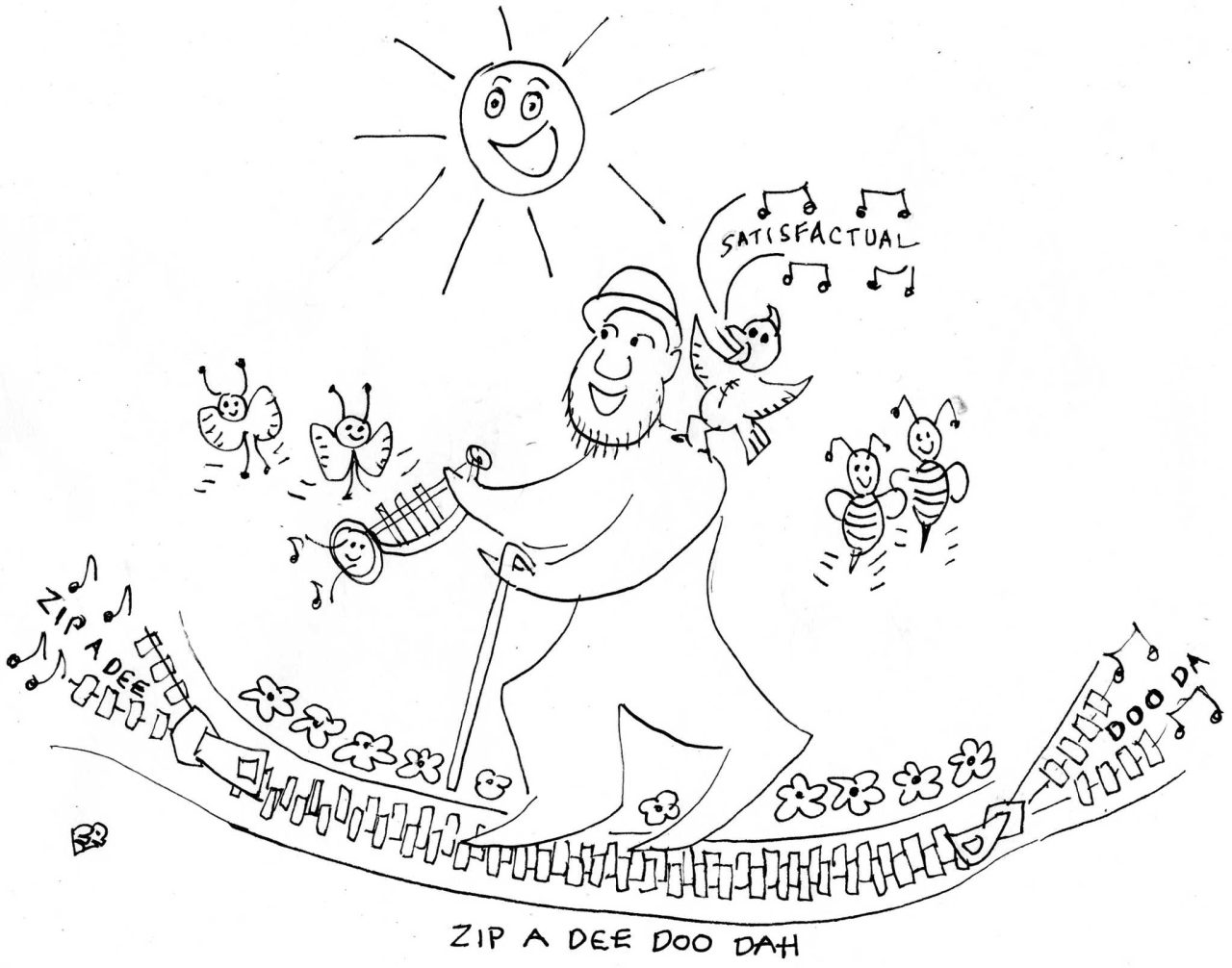
It’s the kind of song that gets stuck in your head for days. You know the one. It starts with that bouncy, upbeat whistle and then dives straight into a world where bluebirds sit on shoulders and everything is "satisfactual." For decades, the zip a dee doo dah lyrics were the gold standard for Disney magic. They represented the peak of technicolor optimism.
But things changed.
If you try to find this song on official Disney playlists today, or if you're looking for it while walking through a theme park, you’ll notice a very loud silence. The song hasn't just been moved; it’s basically been scrubbed. It’s a weird situation where a song won an Academy Award for Best Original Song in 1947 but is now treated like a family secret nobody wants to talk about at Thanksgiving.
The lyrics themselves seem innocent enough on the surface. They talk about a wonderful day. They talk about plenty of sunshine. However, you can't actually separate the words from where they came from.
The Origin Story Nobody Can Ignore
The song made its debut in the 1946 film Song of the South. Most people under the age of 40 haven't actually seen this movie. Why? Because Disney locked it in a vault years ago and hasn't let it out since.
The movie is based on the Uncle Remus stories by Joel Chandler Harris. The character of Uncle Remus, played by James Baskett, sings the song as he strolls through a field, interacting with animated characters like Brer Rabbit. Baskett was actually the first Black man to receive an Oscar, albeit an honorary one, for his performance. He couldn't even attend the film’s premiere in Atlanta because it was a segregated theater.
That's the core of the problem.
The zip a dee doo dah lyrics are inextricably linked to a film that many historians and critics, including those from the NAACP back in the 40s, argued romanticized the post-Civil War South. It painted a picture of "plantation life" that looked a lot more like a utopia than the reality of Reconstruction-era Georgia.
When you sing about "Mr. Bluebird on my shoulder," you’re singing a song born from a film that many find deeply offensive. It’s a sunny song from a very dark context.
Breaking Down the Zip A Dee Doo Dah Lyrics
Let’s actually look at what the song says. Honestly, it’s short. It’s repetitive. It’s designed to be a "zip-less" earworm.
The chorus goes: Zip-a-dee-doo-dah, zip-a-dee-ay My, oh, my, what a wonderful day Plenty of sunshine headin' my way Zip-a-dee-doo-dah, zip-a-dee-ay!
There’s a verse about Mr. Bluebird: Mister Bluebird's on my shoulder It's the truth, it's actual Ev'rything is 'satisfactual'
The word "satisfactual" is a portmanteau. It’s a made-up word combining "satisfactory" and "factual." It’s clever. It’s whimsical. But in the context of the film, it contributes to a specific dialect that scholars like Patricia Turner have pointed out was used to caricature Black speech patterns of the era.
It’s weirdly catchy. You can't deny that. The melody, written by Allie Wrubel with lyrics by Ray Gilbert, is a masterpiece of 1940s songwriting. It captures a specific type of American folk-pop that feels timeless, which is exactly why it stayed popular for seventy years even as the movie it came from faded into obscurity.
The Splash Mountain Connection
For a long time, the primary place people heard the zip a dee doo dah lyrics was at Splash Mountain. The ride was a staple at Disneyland and Walt Disney World. It was a log flume that told the story of Brer Rabbit, Brer Fox, and Brer Bear.
Disney tried to have it both ways for a while.
They kept the characters and the music because people loved the "vibe," but they stripped away any direct mention of the movie Song of the South. It was a corporate tightrope act. They figured if they just kept the "funny animals" and the "happy song," nobody would mind.
They were wrong.
By 2020, following the global conversations around racial justice, Disney announced they were gutting Splash Mountain. The ride has since been transformed into Tiana’s Bayou Adventure, themed after The Princess and the Frog. Along with the logs and the briar patch, the music went too. You won't hear those lyrics in the parks anymore. Even the catchy instrumental versions that used to play on the entrance loops have been swapped out for jazzier, New Orleans-style tracks.
Why Some People Still Hold On To It
If you go into the comments section of any YouTube video featuring the song, you'll see a massive divide. There’s a lot of nostalgia here. People remember singing this in elementary school choir. They remember it from the "Disney Sing-Along Songs" VHS tapes.
For many, the song represents a simpler time in their own childhoods. They don't see the historical baggage; they just see a bird on a shoulder.
But history is messy.
Critics argue that keeping the song alive helps "cleanse" the history of the film it came from. If you keep the song, you’re indirectly validating the film’s portrayal of a "happy" era that wasn't actually happy for everyone. It’s a debate about cultural memory. Can a piece of art be separated from its creator or its original intent?
In Disney’s eyes, the answer is a firm no. They’ve decided the brand risk is too high.
The Technical Brilliance of the Composition
Putting aside the controversy for a second—if that’s even possible—the song is a technical marvel. The way the "Zip" and "Doo-dah" sounds use plosives and vowels makes it incredibly easy to sing. It’s a phonetic playground.
The tempo is roughly 120 beats per minute. That’s the "walking pace" of most popular music. It feels natural to the human heart rate. When James Baskett sang it, he had this specific, warm baritone that felt like a hug.
It’s also one of the earliest successful examples of mixing live action with animation in a musical sequence. The "bluebird" wasn't just a lyric; it was a technical achievement in 1946. They had to composite hand-drawn cells over live-film footage with a level of precision that was mind-blowing at the time.
Where the Song Stands in 2026
As of 2026, the song is effectively "retired."
- It is not on Disney+.
- It is not played in Disney Parks.
- It is rarely featured in new Disney merchandise.
- Cover versions by modern artists have slowed to a crawl.
You can still find it on physical media if you own the old soundtracks. You can find it on third-party streaming uploads. But as far as the "official" Disney canon goes, the zip a dee doo dah lyrics are a relic of the past.
It’s a fascinating case study in how culture evolves. A song can go from being the literal anthem of a company—used in TV intros and commercials for decades—to being something that is professionally ignored. It’s not "canceled" in the way some people claim; it’s just been moved to the history books.
If you’re looking for the lyrics because you’re feeling nostalgic, that’s one thing. But understanding why those lyrics aren't everywhere anymore is arguably more important than the words themselves. It’s a lesson in how we choose to remember the past and what we’re willing to leave behind in order to move forward.
The bluebird hasn't flown away. He’s just been re-homed.
What To Do With This Information
If you’re a teacher or a parent wondering if you should still use this song, consider the context. Music doesn't exist in a vacuum. You can still appreciate the melody, but it’s worth knowing the history so you can explain it if someone asks.
For those who want to explore Disney’s musical history without the baggage, look into the work of the Sherman Brothers. They wrote songs like "It's a Small World" and the soundtrack to Mary Poppins. Those songs capture that same "whimsical" energy but without the complicated ties to 1940s racial tropes.
The best way to handle this song today is to view it as a historical artifact. It’s a window into 1946—both the incredible creative talent of the era and the blind spots of the people who were in charge.
Check out the soundtracks for The Princess and the Frog or Encanto if you want modern Disney songs that manage to be "satisfactual" while being inclusive. They offer the same earworm quality but are built for the world we live in now, rather than the one we left behind.