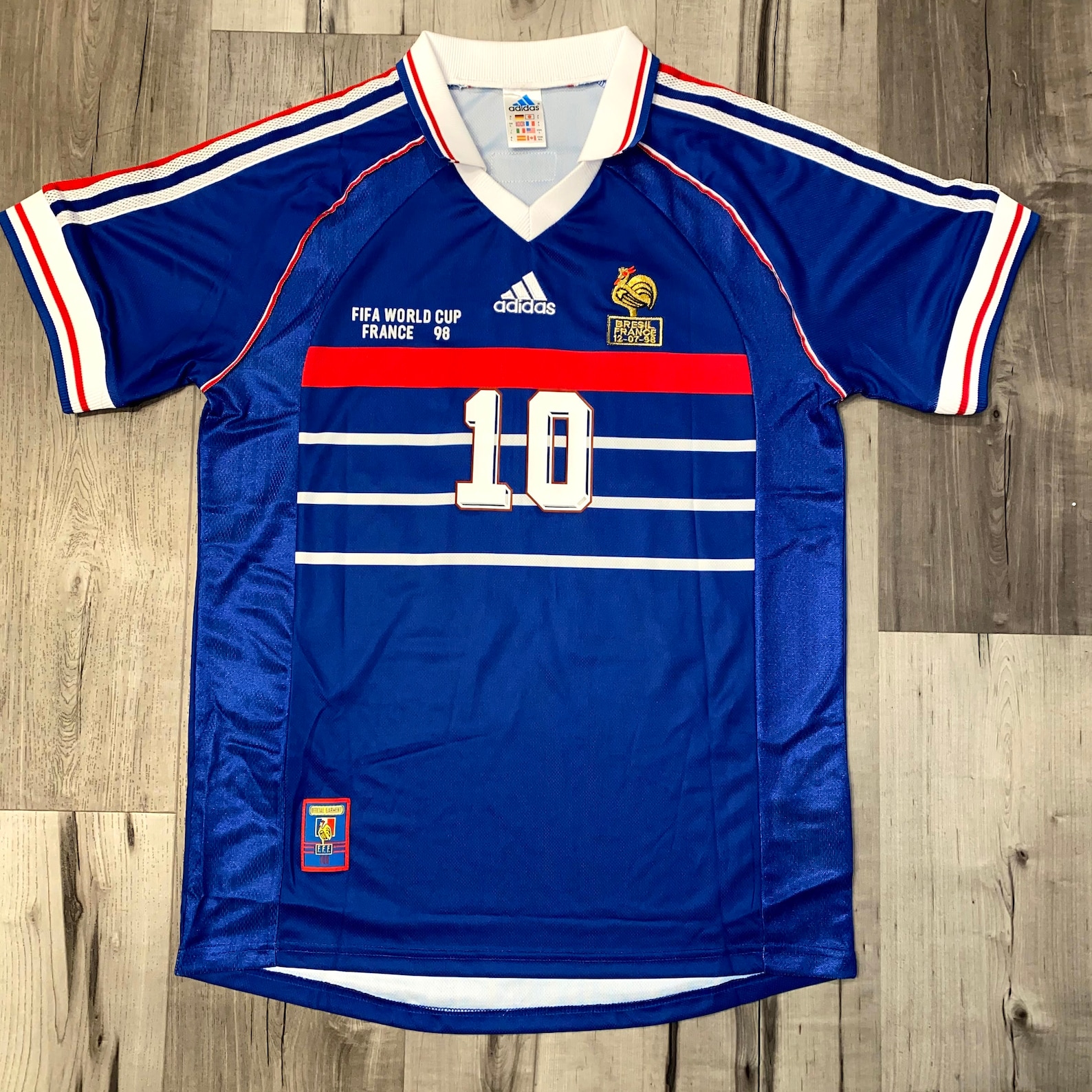
Honestly, if you close your eyes and think of French football, you probably see two things: the Arc de Triomphe and that deep royal blue kit with the red stripe across the chest. It’s the Zinedine Zidane France jersey. Specifically, the 1998 one. But there is a massive difference between a cheap "retro" reprint you find on a random Instagram ad and the actual fabric that touched Zizou's skin on that humid July night in Saint-Denis.
People obsess over the 1998 World Cup final. They remember the headers. They remember the "Zizou President" projections. But most fans don't realize how much the jersey itself changed between the group stages and that final match against Brazil. If you’re looking to buy one today, or if you’re just a nerd for kit history, you’ve got to know what actually makes these shirts special.
The 1998 Masterpiece: More Than Just Blue
The 1998 home shirt is basically the holy grail of sports memorabilia. Designed by Adidas, it featured a bold red horizontal stripe across the chest, flanked by thinner white lines. It was a direct callback to the 1984 Euro-winning kit worn by Michel Platini. It’s poetry, really. One legend handing the baton to the next through a polyester weave.
But here is the thing: the "Match Version" and the "Replica" were worlds apart. In '98, the technology wasn't what it is now. There was no "Authentic" slim-fit version available at your local sports shop. The players wore shirts with specific embroidery under the FFF crest—"Brésil - France 12-07-98"—and the fabric was slightly more ventilated than the fan versions.
If you find a Zinedine Zidane France jersey from 1998 that has the match details printed rather than embroidered, it’s probably a modern remake. Not that there's anything wrong with that, but for collectors, the embroidery is the soul of the shirt. One of Zidane’s actual match-worn shirts from that final reportedly sold for over 100,000 euros. That is the price of a house, just for some sweat-stained fabric.
Why the 2006 Jersey Is the "Dark" Alternative
Most people want the '98 kit because it’s happy. It’s the celebration. But the Zinedine Zidane France jersey from the 2006 World Cup? That one has teeth. It’s the shirt he wore when he chipped Gianluigi Buffon with a Panenka penalty in a World Cup final. It’s also the shirt he was wearing when he walked past the trophy after the headbutt heard 'round the world.
The 2006 kit was part of the "Teamgeist" era. It had those weird, curved lines and a much more "techy" feel. It was also the first time France moved toward a darker, almost navy blue.
- The Details: It had the "Formotion" technology for players.
- The Crest: One single star above the rooster, commemorating '98.
- The Vibe: Pure tragedy.
I've seen so many "2006 Zidane" shirts for sale lately, especially the white away version he wore against Brazil in the quarter-final. That match was arguably the greatest individual performance in the history of the sport. He was 34 years old, playing against prime Ronaldinho and Kaká, and he made them look like schoolboys. If you want a jersey that represents Zidane the artist, you get the 2006 white away kit. If you want the hero, you go for 1998.
Spotting the Fakes (It's Kinda Tricky)
Look, the market is flooded with "AAA+ Quality" replicas. They look great on a hanger. But if you’re trying to find a genuine vintage Adidas piece, you have to look at the wash tags.
In the late 90s, Adidas used specific production codes. For the 1998 kit, the tag should be on the side seam or near the neck, and the "Adidas" embroidery should be thick and slightly raised. On fakes, the "i" in Adidas often looks like it's melting into the stripes. Also, check the numbering. The authentic font for the '98 name-set had a very specific 3D-shadow effect. If the shadow is too thin or the blue is a shade too purple, you're looking at a knockoff.
Another weird detail? The 1998 original didn't have a star over the crest. The star was added after they won. So, if you see a "1998 World Cup Final" jersey with a star already on it, the manufacturer was time-traveling. It's a common mistake in retro remakes.
The Cultural Weight
Why does this specific piece of clothing still matter in 2026? Because it represents a version of France that felt united. They called it the "Black-Blanc-Beur" team (Black, White, North African). Zidane, a son of Algerian immigrants from Marseille, became the face of the Republic.
When you put on that number 10, you aren't just wearing a soccer shirt. You're wearing a symbol of a massive cultural shift. It’s why you see kids in London, New York, and Tokyo wearing it today. It’s "Bloke-core" fashion now, but the history is heavy.
How to actually find a good one:
- Check the "FFF" Crest: The rooster should be detailed, not a blob of yellow thread.
- Feel the weight: 90s jerseys were heavy. They weren't these paper-thin "vapor" shirts we have today.
- The Collar: The '98 jersey has a thick, ribbed collar. It should hold its shape. If it’s floppy, it’s a cheap poly-blend.
- The Numbering: Zidane almost always wore #10 for France. If you see a #7 or #21 on a France kit, it’s either a youth team throwback or a club kit (Juve/Bordeaux) masquerading as a national one.
If you’re serious about getting a Zinedine Zidane France jersey, start by scouring reputable vintage sites like Classic Football Shirts or looking for "deadstock" on eBay, but always demand photos of the internal tags. Don't just trust the "Made in France" label—ironically, many of the original 1998 fan replicas were made in Tunisia or Morocco.
Your next move: Check your local thrift stores or specialty vintage shops for 90s Adidas equipment tags. If you find an original '98 shirt without the match-day embroidery, it's still worth a few hundred dollars. If you find one with the "Finale" embroidery and it’s verified? You’ve just found a piece of history. Stop wearing it to the gym and get it framed.