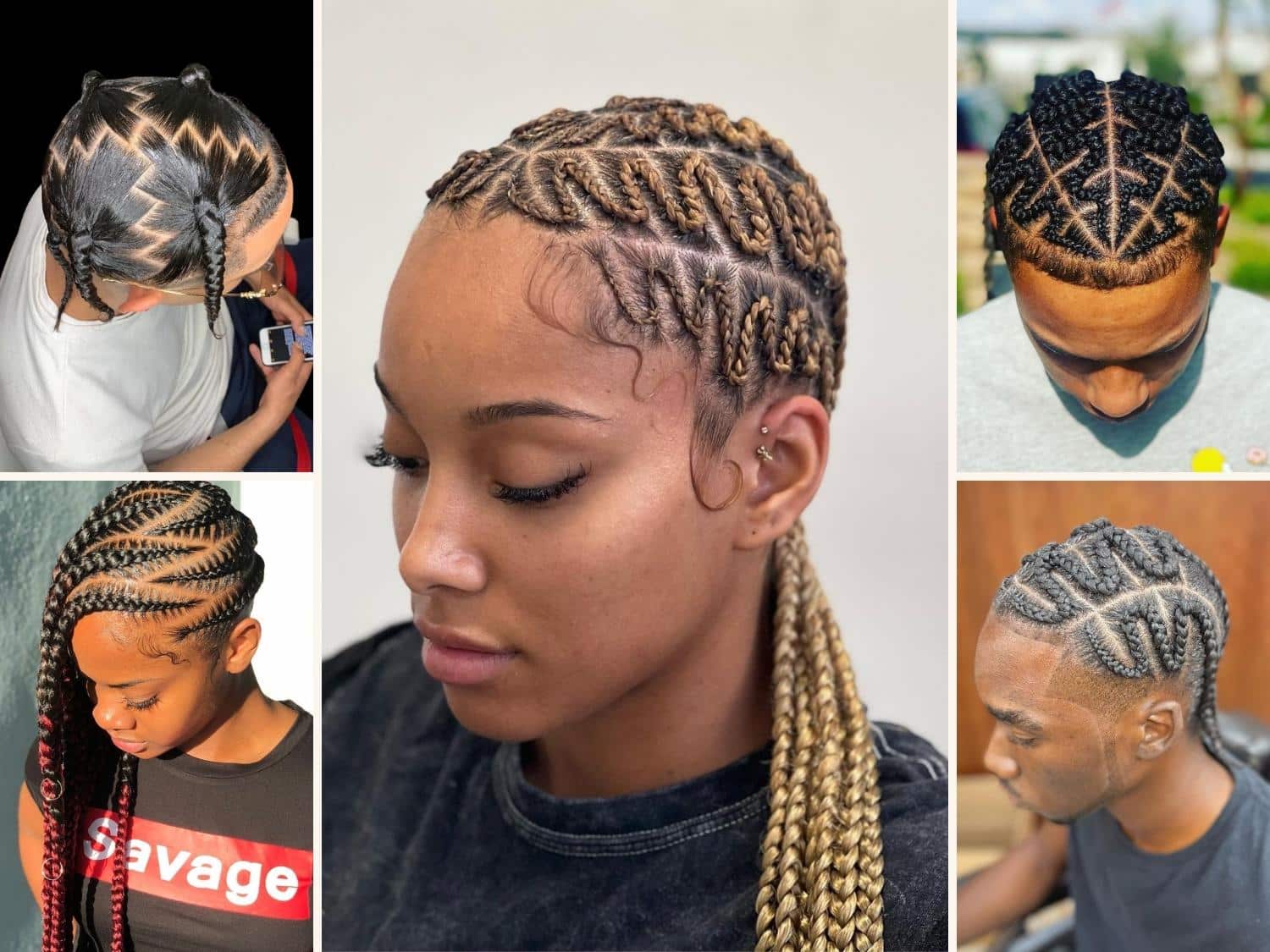
You've probably seen them on your feed or at the gym. A guy walks by, and instead of the usual straight-back cornrows, his scalp looks like a lightning bolt factory. It's sharp. It's aggressive. It's the zig zag.
Honestly, zig zag braids men styles aren't just a "trend" anymore; they've become a staple in urban hair culture because they solve a specific problem. That problem? Boredom. Straight lines are clean, sure, but they’re predictable. A zig zag pattern adds a geometric complexity that forces people to look twice. It’s the difference between a standard sedan and a custom sports car.
But here’s the thing. Most people walk into the barber shop or a braiding salon thinking they can just point at a picture and walk out looking like A$AP Rocky. It doesn't work like that. If your parts aren't crisp, or if your hair density isn't right, those sharp angles end up looking like a messy scribble. You need to understand the mechanics of the scalp and the math of the parting before you commit to three hours in the chair.
Why the Zig Zag Parting Changes Everything
The magic isn't actually in the braid itself. It’s in the negative space. When we talk about zig zag braids men options, we’re really talking about the art of the part. In a standard cornrow, the braider pulls hair into a straight line. With a zig zag, they’re essentially creating a series of "V" shapes along the scalp.
This does something interesting to the face. Straight lines can sometimes make a round face look rounder or a long face look longer. Zig zags break up those visual planes. They add a sense of movement. Because the lines are diagonal, they draw the eye across the head rather than just front-to-back. It’s a literal head-turner.
Kinda wild how a few crooked lines change your whole vibe, right?
The Technical Reality of Your Scalp
Not every head is built for this. If you have a lot of cowlicks or irregular hair growth patterns, your braider is going to have a harder time getting those "lightning" parts to stay straight. Also, tension is a massive factor here. Because the hair is being pulled at different angles to create the "zag," there is often more stress on the follicle than with a traditional straight row.
If you have a sensitive scalp or a receding hairline, you have to be careful. Traction alopecia is real. You don't want to trade your edges for a cool pattern that only lasts two weeks.
Choosing Your Style: From Subtle to Bold
There isn't just one way to do this. You have options.
For guys who want something low-key, you can go with a micro-zig zag. This is where the parting is slightly jagged but the braids themselves are relatively thin and close together. It looks like a texture from far away, but up close, the detail pops. It's a "if you know, you know" type of look.
Then you have the chunky zig zag. This is usually done with feed-in hair (extensions) to give the braids more volume. These are the ones you see on celebrities like Travis Scott or Lewis Hamilton. The parts are wide, the braids are thick, and the contrast between the dark hair and the scalp is high. This is a high-maintenance look. You’ll need to use a durag every single night—no excuses—or the frizz will ruin the geometric lines within 48 hours.
What about the "Fishbone" variation? This is a bit of a hybrid. You have a central zig-zag part, and then smaller braids feed into a larger main braid at an angle. It looks incredibly complex, like a skeletal structure. It takes longer to do, and it usually costs more. Expect to be in that chair for a while.
The Maintenance Routine (That Most Guys Skip)
Here is where most guys fail. They get the braids, they love the look, and then they treat their hair like they still have a buzz cut. Big mistake.
- Moisture is your best friend. Your scalp is exposed. Use a light oil—think jojoba or grapeseed—to keep the skin from flaking. If you get dandruff in a zig zag pattern, it’s going to look like a mess.
- Wash with caution. You can't just scrub your head under the showerhead. You'll create instant frizz. Use a stocking cap over your braids, apply diluted shampoo through the cap, and rinse gently.
- The Durag Rule. If you are sleeping without a silk or satin head covering, you are essentially sandpapering your hairstyle against your pillow.
Honestly, the longevity of zig zag braids men wearers experience is 100% dependent on how they sleep. If you’re a wild sleeper, get a high-compression durag. It keeps the hair flat and the parts sharp.
What Most People Get Wrong About Cost and Time
Don't expect to pay the same price as a basic set of cornrows. You are paying for the braider’s time and their "eye." Mapping out a symmetrical zig-zag pattern on a three-dimensional curved surface (your head) is basically geometry. It’s difficult.
A standard set of zig zag braids can take anywhere from two to five hours depending on the complexity. If you want them to add hair for length or thickness, add another hour. Cost-wise? You’re looking at a premium. In cities like New York, London, or LA, you might pay anywhere from $100 to $250 plus tip. It’s an investment in your aesthetic.
Finding the Right Professional
Don't go to someone who "can do braids." Go to someone who specializes in men's styling and geometric parting. Look at their Instagram. Do the lines look blurry in the photos? Are the parts red and irritated? If the parts look bloody or extremely tight, run. That braider is pulling too hard, and you’ll end up with "braid bumps"—those painful little white bumps at the root that signify your hair is literally being pulled out of the skin.
Dealing with the "Frizz Phase"
Around week two or three, the new growth starts coming in. This is the "frizz phase." Your sharp zig zags start to look a little fuzzy. Some guys try to fix this by applying heavy gels or waxes.
Don't do that.
Heavy products lead to buildup. When you finally take the braids out, you’ll have "braid lint" or "gunk" stuck in the hair that is a nightmare to detangle. Instead, use a light mousse and a tie-down scarf for 15 minutes in the morning. This "lays" the flyaways without turning your head into a sticky mess.
Real-World Examples and Cultural Impact
Braiding has always been more than just a haircut. For many, it's a connection to heritage. The zig zag, specifically, draws from West African traditions where intricate parting patterns often signaled status, tribe, or even a person's life events.
Today, it's a symbol of modern Black excellence and creative expression. We see athletes like Allen Iverson—who was a pioneer in bringing complex braid patterns to the mainstream—setting the stage for today's stars. Now, you see these styles in boardrooms and on tech campuses. The stigma is fading because the craft is undeniable.
Actionable Next Steps for Your Hair Journey
If you're ready to pull the trigger on some zig zag braids, here is exactly how you should handle the next 24 hours.
Step 1: The Scalp Prep. Don't just show up. Wash your hair with a clarifying shampoo to remove all old product. Deep condition it. A healthy, hydrated strand of hair is more elastic and less likely to break under the tension of a zig zag part. Do not put heavy oils in your hair before the appointment; it makes the hair too slippery for the braider to get a good grip.
Step 2: The Consultation. Show the braider exactly where you want the "peaks" of the zig zags to hit. Do you want them centered? Do you want them slanted to one side? Be specific. If you have a "good side" for photos, tell them.
Step 3: The Post-Chair Plan. Have your "braid kit" ready at home. This should include:
- A high-quality silk or satin durag.
- An anti-itch scalp spray (look for ingredients like peppermint or tea tree oil).
- A light mousse to keep the frizz down.
- A wide-tooth comb for when you eventually take them out (never use a fine-tooth comb to detangle after braids).
The most important thing to remember is that this style is temporary, but the health of your hair is permanent. If it feels too tight while they are braiding, speak up. No "cool" hairstyle is worth permanent hair loss.
When you get it right, though? It’s arguably the best look a guy can have. It’s sharp, it’s intentional, and it shows you actually give a damn about your presentation. Keep those lines clean, keep the scalp hydrated, and wear it with confidence. That's the real secret to pulling off the zig zag.
The removal process is just as vital as the installation. When it's time to take them down—usually after 4 to 6 weeks—take your time. Use a detangling spray or a bit of oil to help the braids slide apart. You will see a lot of "shed" hair. Don't panic. You naturally lose about 100 hairs a day; when your hair is in braids, those hairs have nowhere to go, so they all come out at once during the takedown. Just be gentle, wash thoroughly, and let your scalp breathe for at least a week before your next style.