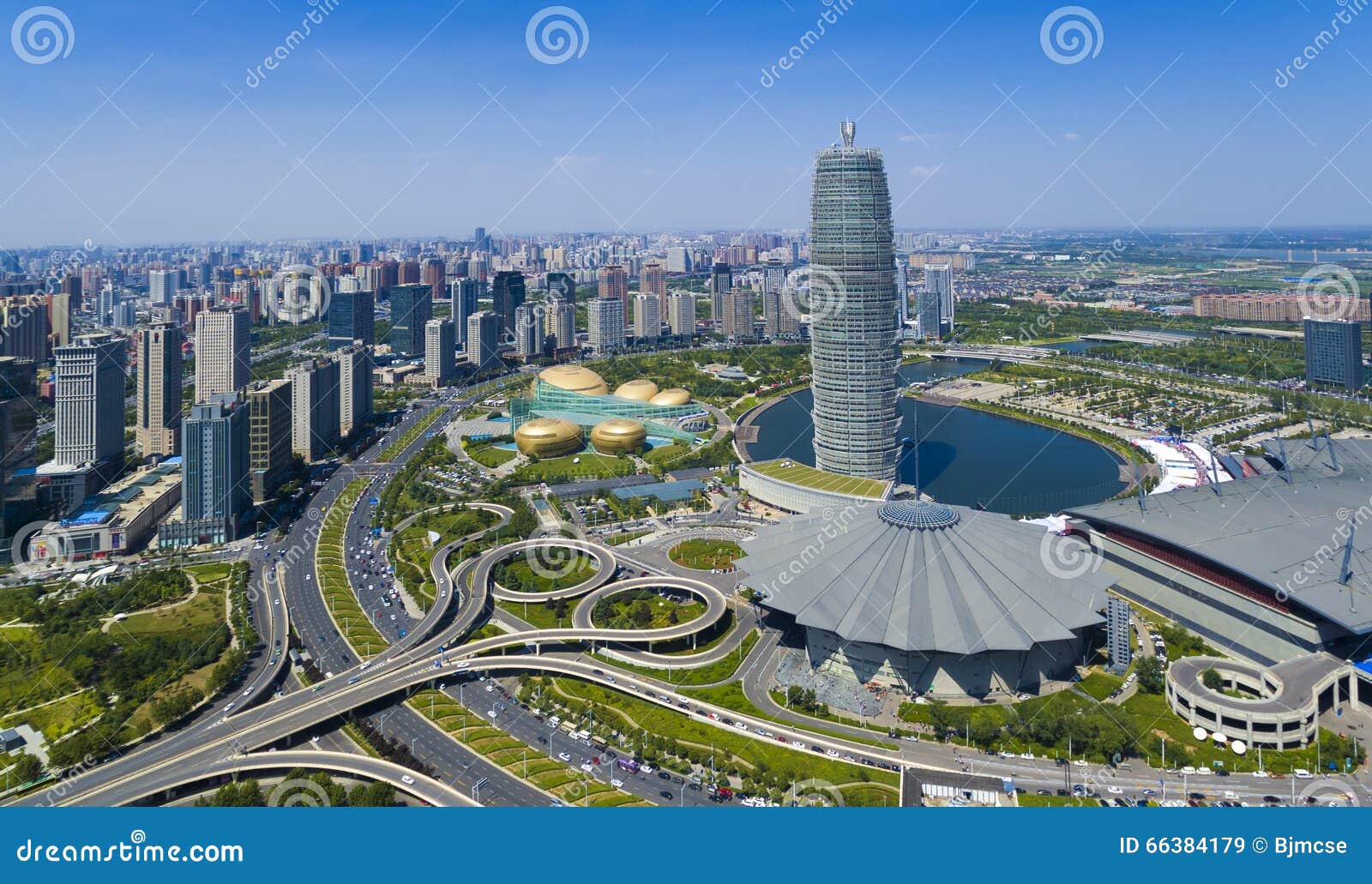
You’ve probably held a piece of Zhengzhou in your hand today without even realizing it. Honestly, most people only know Zhengzhou City Henan China as "iPhone City," that massive industrial sprawl where millions of Apple products get assembled. It's a fair label, but it's also kinda lazy. If you actually spend time here, you realize the city is this bizarre, high-speed collision between 3,000-year-old dynasty walls and futuristic glass skyscrapers that look like they were ripped out of a sci-fi flick.
It's big. It's loud. It's surprisingly green.
Zhengzhou isn't trying to be Shanghai. It doesn't have the "Bund" or the global glamour. What it has is raw, unfiltered momentum. Located right in the heart of the Central Plains, it’s the literal crossroads of China’s high-speed rail network. If China is a body, Zhengzhou is the heart pumping the blood. You can jump on a train here and be almost anywhere in the country in a few hours. That's not hyperbole; it’s logistics.
The 3,000-Year-Old Elephant in the Room
Most visitors miss the history because they're blinded by the neon. That’s a mistake. Zhengzhou is one of the Eight Ancient Capitals of China. We’re talking about the Shang Dynasty era. While London was barely a collection of huts, Zhengzhou was a walled powerhouse.
You can still see the remnants of the Shang Dynasty City Walls. They aren't some polished, fake tourist trap. They're these massive, earthen mounds stretching for miles through the middle of the modern city. Locals do their morning Tai Chi on them. Kids walk past them on their way to school. It’s weirdly casual. You’re looking at 3,500 years of compressed dirt while someone next to you is checking their social media on a 5G phone.
The Henan Museum is where the real "wow" factor lives. It’s shaped like a pyramid (sorta) and houses things like the Jiahu Bone Flutes. These aren't just old instruments; they're some of the oldest playable musical instruments ever found. We're talking 7,000 to 9,000 years old. Standing in front of a flute made from the wing bone of a red-crowned crane makes you feel tiny. It’s a reality check on what "old" actually means.
Why Zhengzhou City Henan China Rules the Tech World
Let’s talk about the Foxconn factor. It’s impossible to ignore. At its peak, the Foxconn facility in Zhengzhou produced about half of the world's iPhones. This single factory complex is so large it basically functions as its own ecosystem, with dormitories, hospitals, and social hubs for hundreds of thousands of workers.
But Zhengzhou is pivoting. The city is trying to shed the "cheap labor" image.
They’re dumping billions into the Zhengdong New District. Ten years ago, Western media called this a "ghost city." They were wrong. Today, it’s a thriving financial and tech hub. The architecture is wild. You’ve got the "Big Corn" tower (the Greenland Plaza), which lights up the night sky like a golden beacon. It’s the centerpiece of a circular urban plan designed by the late Kisho Kurokawa. It’s efficient, slightly sterile, but undeniably impressive.
The Kung Fu Connection
You can’t mention Zhengzhou without talking about the Shaolin Temple. It’s technically in Dengfeng, which is part of the Zhengzhou municipal area.
Is it touristy? Yeah, definitely. Is it still worth it? Absolutely.
The Pagoda Forest at the temple is a hauntingly beautiful site where hundreds of stone pagodas mark the burial sites of prominent monks. When the wind hits the trees and you hear the distant thud of students practicing their kicks, the commercialism fades away. You see kids—some as young as five—performing feats of flexibility that seem physically impossible. They aren't doing it for the cameras; they’re doing it because that’s their life.
It’s grueling. It’s disciplined. It’s the soul of Henan.
Eating Your Way Through the Central Plains
If you come here looking for Dim Sum, you’re in the wrong province. Zhengzhou food is hearty. It’s wheat-based, heavy on the spice, and designed to keep you full during a cold winter.
Hui Mian (Braised Noodles) is the king here. These are wide, hand-pulled noodles served in a rich lamb broth. The best spots are usually the ones with the shortest menus and the most steam fogging up the windows. You get a bowl, you add a mountain of cilantro and some chili oil, and you forget about your diet.
Then there’s the soup for breakfast: Hu La Tang (Spicy Soup). It’s thick, peppery, and contains things like beef, wood ear mushrooms, and gluten. It looks a bit like grey sludge, honestly. But one sip on a freezing morning and you’ll get it. It wakes up your entire nervous system.
The Logistics of a Mega-City
Navigating Zhengzhou used to be a nightmare of traffic jams and dust. The subway system changed everything. It’s clean, fast, and covers almost every major point of interest.
If you’re coming from Beijing, it’s a 2.5-hour ride on the G-train. From Shanghai, it’s about 4 hours. The Zhengzhou East Railway Station is a beast—one of the largest in Asia. Don't arrive five minutes before your train. You will get lost. Give yourself 40 minutes just to find the right gate.
- Check the weather. Henan gets surprisingly cold in the winter and humid in the summer. Spring and Autumn are the sweet spots.
- Download a translation app. English isn't as common here as it is in coastal cities.
- Use the "Didi" app. It’s the Chinese version of Uber and it has an English interface. It saves you from haggling with taxi drivers.
Beyond the Concrete
People think Zhengzhou is just flat plains. Not quite. The Yellow River flows right past the city.
The Yellow River Scenic Area is a bit of a trek, but it gives you a sense of scale. The river is massive, silt-heavy, and literally the "Mother River" of Chinese civilization. There are two giant statues of emperors Yandi and Huangdi carved into a mountain there. They’re over 100 meters tall. It’s a bit over-the-top, sure, but that’s Zhengzhou for you. They don't do "subtle" very well.
Actionable Insights for the Modern Traveler
Zhengzhou isn't a city that reveals its charms immediately. It’s a place you have to dig into. If you're planning a trip or looking at it for business, here is the ground-level reality:
- For History Buffs: Prioritize the Henan Museum and the Shang City Walls early in the morning before the crowds hit.
- For Business/Tech: Focus your stay in the Zhengdong New District (CBD). It’s where the high-end hotels and international dining options are clustered.
- For Culture: Take the bus or a private car to Dengfeng for the Shaolin Temple, but stay for the "Zen Music Shaolin Grand Ceremony" at night. It’s an outdoor performance with hundreds of actors on a mountainside. It sounds cheesy, but it’s actually breathtaking.
- For the Foodie: Look for "Xiaoji" or "Heji" branded restaurants for the most authentic Hui Mian experience. These are local institutions.
Zhengzhou is a city in a hurry. It’s loud, it’s growing, and it’s unapologetically Chinese. It represents the "New China" better than almost anywhere else—a place where the ancient past is physically being built over by the high-tech future. Don't just fly over it. Stop. Eat the noodles. Watch the monks. See the "Big Corn" glow. It’s worth the detour.
To get the most out of your visit, book your high-speed rail tickets via the official 12306 app at least two weeks in advance, especially if you're traveling during a public holiday. For those looking to understand the industrial side, a drive through the Airport Economy Zone offers a staggering look at the scale of global logistics that most people never see.