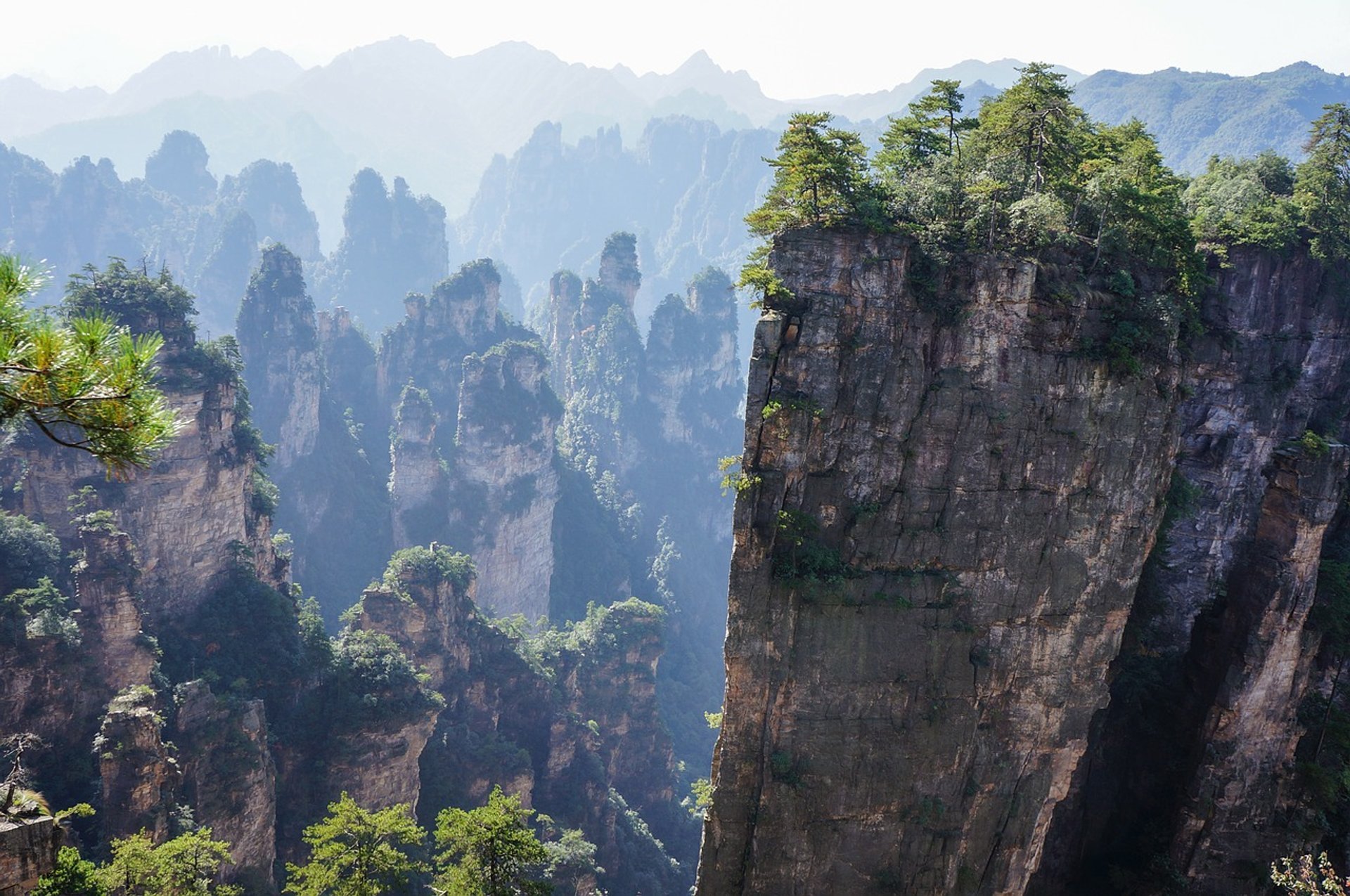
You’ve seen the photos. Those impossibly skinny quartz-sandstone pillars poking through a sea of mist like giant stone fingers. Most people call it "the Avatar place," and honestly, that’s why they go. But here is the thing: Zhangjiajie National Forest Park is massive, confusing, and surprisingly easy to hate if you don't know how the local logistics actually work. It isn't just one park. It’s a 11,900-acre labyrinth located within the Wulingyuan Scenic Area in China’s Hunan Province, and if you show up thinking you’ll just "stroll around," you’re going to have a bad time.
The scale is just weird. We’re talking over 3,000 individual peaks. Some are over 2,600 feet tall. For another view, see: this related article.
Most travelers arrive expecting a serene, spiritual mountain experience. Then they hit the crowds. Because Zhangjiajie isn't a secret anymore, it hasn't been for decades. Since it became China's first national forest park in 1982, the infrastructure has exploded. We’re talking glass elevators glued to cliff faces and cable cars that feel like they’re launching into space. It’s a mix of raw, prehistoric nature and aggressive, high-tech engineering. If you want the mist-covered solitude, you have to work for it. You have to go where the tour groups aren't willing to hike.
The Avatar Connection: Legend vs. Reality
Let's address the Hallelujah Mountains. It’s the biggest marketing hook the park has. For years, there was a bit of a spat between Zhangjiajie and Huangshan (Yellow Mountain) over which range actually inspired James Cameron’s Avatar. In 2010, Zhangjiajie basically won the PR war by officially renaming the "Southern Sky Column" to "Avatar Hallelujah Mountain." Similar reporting on this trend has been published by Travel + Leisure.
Did it actually inspire the movie? Sorta.
The film’s production designers have noted that they used photos from several Chinese ranges, but the verticality of Zhangjiajie is unmistakable in the floating mountains of Pandora. When you stand at the Enchanted Terrace or the Sea of Clouds, the resemblance isn't just marketing fluff. It’s eerie. But don't expect the mountains to float. They’re held up by gravity and millions of years of erosion, specifically physical weathering caused by the expansion of ice in the winter and the growth of plants whose roots literally crack the stone apart.
Navigating the Three Main Areas
You can’t see everything. Don't even try. The park is roughly divided into the mountain top (Yuanjiajie, Tianzi Mountain) and the valley floor (Golden Whip Stream).
Yuanjiajie is the "main event." This is where you find the Bailong Elevator. It’s the world's tallest outdoor elevator, and it shoots you up 1,070 feet in about 88 seconds. It’s terrifying. It’s also usually packed. If you’re at the top, you’re looking down at the peaks. If you’re at the Golden Whip Stream, you’re looking up. The difference in perspective is everything. Most people spend all their time at the top because that’s where the "famous" views are, but the valley floor is where you actually feel the scale of the place. Plus, there are macaques.
Those monkeys are not your friends. Seriously.
They have learned that human backpacks contain snacks. I’ve seen them unzip bags. I’ve seen them hiss at tourists who try to take selfies. If you have food in your hand, it belongs to the monkeys now. Just let it go. It’s their park; you’re just visiting.
The Tianzi Mountain Fog Gamble
Tianzi Mountain is famous for the "sea of clouds." But here is the catch: if it’s too cloudy, you see nothing. Literally nothing. Just a wall of white.
I’ve met travelers who spent three days in the park and never saw a single pillar because the fog was too thick. On the flip side, if the sun comes out right after a rainstorm, that’s the jackpot. That’s when the mist clings to the middle of the peaks, making them look like they’re floating. It’s a total gamble. Check the weather, but don't trust it. The mountains create their own microclimate.
The Logistics Most Guides Skip
People talk about the "Zhangjiajie National Forest Park" and "Tianmen Mountain" like they’re the same thing. They aren't. They’re about 30 miles apart.
Tianmen Mountain is the one with the big hole in it (Heaven’s Gate) and the world’s longest cable car ride from the city center. The National Forest Park—the one with the pillars—is in Wulingyuan. If you book a hotel in Zhangjiajie City thinking you’re "right there," you’ve got a 45-minute bus ride ahead of you every morning. Stay in Wulingyuan town. It’s much closer to the park entrances.
The ticket system is also a bit of a headache. Your entry pass is usually valid for four days. It’s a smart card that uses fingerprint recognition. Why? To stop people from reselling their tickets. It’s efficient, but it feels a bit "Big Brother" when you’re just trying to look at some rocks.
- Buy the ticket at the Wulingyuan or Forest Park gate.
- Scan your thumb.
- Keep that card like it’s your passport. If you lose it, you’re buying a new one.
How to Actually Avoid the Crowds
If you follow the purple lines on the tourist map, you will be shoulder-to-shoulder with hundreds of people wearing matching hats and following a guide with a megaphone. It’s loud. It ruins the vibe.
To find the "real" Zhangjiajie, head toward the Yangjiajie Scenic Area. It’s the most "rugged" part of the park. The "Great Wall of Tianzhuang" is here—natural stone walls that look like fortifications. The paths are steeper, the stairs are narrower, and because it’s harder to get to, the big tour groups usually skip it.
Another pro tip: go late. Most tour groups start early and leave by 4:00 PM to get to dinner. The park stays open later, and that golden hour light hitting the sandstone is spectacular. Just make sure you know when the last cable car or shuttle bus runs, or you’re walking down thousands of stone steps in the dark. That’s not a fun way to end the day.
The Impact of Modernization
There is a lot of debate about whether the glass bridges and elevators have ruined the park. It’s a valid point. UNESCO, which designated this a World Heritage site in 1992, has expressed concerns in the past about the sheer volume of tourists and the "urbanization" of the scenic areas.
But there is an accessibility argument here, too. Without the Bailong Elevator, only the physically fit could see the top of Yuanjiajie. Now, a grandmother or someone in a wheelchair can experience the same view. It’s a trade-off. The park is a masterpiece of nature, but it’s managed like a high-capacity theme park. You have to accept that dissonance to enjoy it.
Seasonal Realities
Winter is underrated. It’s cold, yes. Sometimes it snows, and the pillars look like they’ve been dusted with powdered sugar. Most importantly, the crowds vanish. You can actually hear the wind.
Spring and Autumn are the "sweet spots" for weather, but Autumn is better because it’s less rainy. May and June bring the plum rains, which means high chances of that "white wall" fog I mentioned. If you go during the first week of October (National Day) or the Lunar New Year, honestly, just don’t. The queues for the cable cars can be four or five hours long. You’ll spend more time looking at the back of someone’s head than at the landscape.
Actionable Steps for Your Trip
Don't just wing it. Zhangjiajie punishes the unprepared.
Download an Offline Map. Google Maps is notoriously bad in China, and GPS can be wonky in the deep canyons. Use an app like Maps.me or a local equivalent. Even better, take a photo of the big wooden maps at the park entrances.
Gear Matters. You will walk. A lot. Even with the elevators and buses, expect to clock 15,000 to 20,000 steps a day. Wear shoes with actual grip; those stone stairs get incredibly slick when it’s humid or raining.
The Food Situation. Food inside the park is expensive and mostly mediocre (think instant noodles and oily sausages). Pack some high-energy snacks and plenty of water. There are small stalls selling fruit and water, but they charge "mountain prices."
Hire a Guide for One Day. If you’re feeling overwhelmed by the shuttle bus system—which is a sprawling network of free buses that go to different stations—hire a local guide for your first day. They know the shortcuts, they know which viewpoints are currently obscured by clouds, and they can help you navigate the language barrier at the ticket counters.
Check the "Yellow" Condition. The sandstone here is rich in iron. When it’s sunny, the peaks have a distinct yellowish-orange glow. This is why the area was historically called "the land of the yellow lion." To see this, you need a clear afternoon. If the forecast shows sun, drop everything and get to the highest point possible.
The magic of Zhangjiajie National Forest Park isn't in the Avatar fame. It’s in the sheer geological impossibility of the place. It feels like a landscape that shouldn't exist on Earth. Despite the crowds, the noise, and the expensive elevators, standing at the edge of a 1,000-foot drop looking at a stone pillar that has stood for 300 million years... well, it’s one of the few places on the planet that actually lives up to the hype. Just bring some decent shoes and watch your bag around the monkeys.