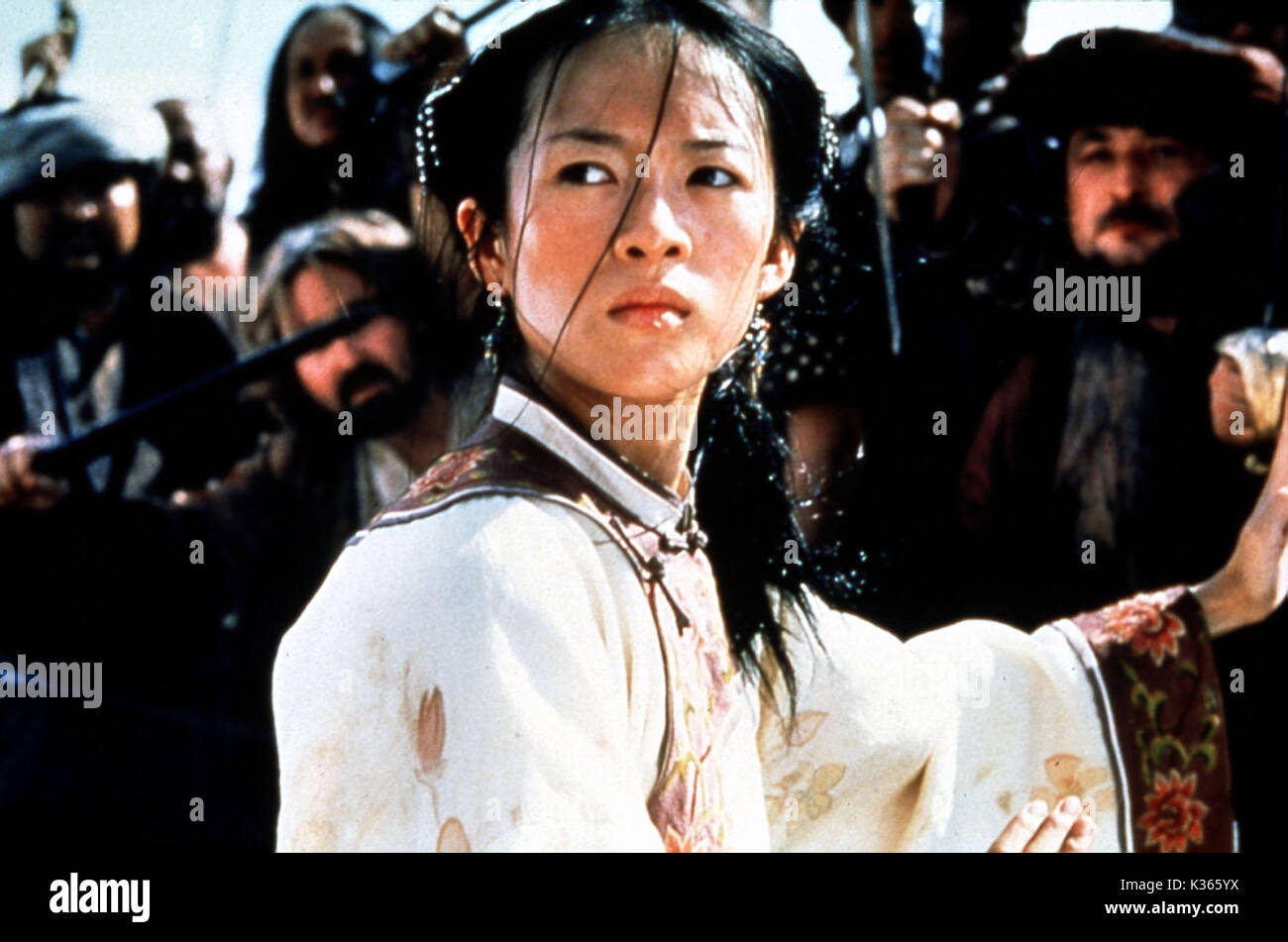
Twenty-six years later, people still talk about the bamboo forest. They talk about the way the branches bend under the weight of two fighters who seem to weigh nothing at all. But if you really look at Zhang Ziyi in Crouching Tiger, Hidden Dragon, you aren't just watching a martial arts performance. You're watching a nineteen-year-old girl fight for her life—both on and off the screen.
Honestly, the movie shouldn't have worked. It was a Mandarin-language wuxia film directed by a guy known for Jane Austen adaptations, starring a lead who had never thrown a punch in her life. Zhang Ziyi wasn't even the first choice for Jen Yu.
Most people don't realize how close we came to a version of this movie without her.
The Casting Gamble That Changed Everything
Ang Lee originally wanted Shu Qi. She was the star he had in mind for the rebellious aristocrat Jen Yu. When she turned it down, Zhang Ziyi was basically a "maybe" on a list of unknowns. She had just finished The Road Home with Zhang Yimou, and it was actually Yimou who made the call to Ang Lee to vouch for her.
He told Lee she was worth a look.
But even after she was cast, the pressure was suffocating. Zhang has often talked about how she felt like she was constantly on the verge of being replaced. She would see other girls still coming in to audition even after she had started training. Can you imagine? You're training eight hours a day, your body is covered in bruises, and you look out the window to see your potential replacement walking into the director’s office.
That's the kind of environment that creates the raw, desperate energy you see in Jen Yu. It wasn't just acting; it was a teenager trying to prove she belonged in a room with giants like Michelle Yeoh and Chow Yun-fat.
Why the Action Felt Different
If you’ve watched a lot of Hong Kong action cinema, you know the "hard" style. It’s crisp, fast, and rhythmic. But Zhang Ziyi brought something weirdly beautiful to the fight scenes.
She was a dancer first.
She started at the Beijing Dance Academy when she was eleven. Because she didn't have a traditional kung fu background, she approached the choreography by Yuen Wo-ping as if it were a ballet.
- The Tea House Brawl: This is the scene where Jen Yu takes on an entire room of seasoned warriors. Look at her wrists. They don't move like a fighter's; they move like a performer's.
- The Softness: She once described her style as "soft on the outside, strong on the inside."
- The Weight: During the wirework scenes, she didn't use her hands to break her falls when she hit the walls or the ground. She just hit them.
Ang Lee was notoriously stingy with his praise. For the entire six months of filming, he gave Michelle Yeoh a hug every day. He didn't hug Zhang Ziyi once. She spent the whole production thinking he hated her performance. It wasn't until the wrap party that she finally got that validation. That's a lot of emotional baggage to carry while you're also trying to learn how to wield a 4-pound Jian sword without hitting yourself in the face.
The "Buffy" of the East
In 2000, Western audiences didn't really know what to make of Jen Yu. She was a "feminist fury" at a time when female leads in action movies were usually just sidekicks or "strong" in a very one-dimensional way.
Jen Yu is a brat. She’s selfish, she’s reckless, and she makes terrible decisions.
That's exactly why she's a great character. She isn't a saintly warrior like Yu Shu Lien. She’s a girl who wants to escape an arranged marriage and live a life of adventure, but she doesn't realize that the "freedom" of the desert comes with a body count.
When the film hit the US, critics started comparing her to Buffy the Vampire Slayer. It was a way to ground her in Western pop culture, but it also highlighted how revolutionary it was to see a young woman dominate the screen with that level of physical intensity.
Breaking the Box Office
Before this, the highest-grossing Chinese-language film in America hadn't even cracked a million dollars. Crouching Tiger did $128 million in the US alone. It eventually grossed over $213 million worldwide.
The Physical Toll Nobody Mentions
We see the beautiful shots, the "watercolor" aesthetic captured by cinematographer Peter Pau, but the reality was a nightmare.
Zhang Ziyi has admitted that she "hit herself all the time" with the heavy props. In the desert flashback scenes—the ones with the golden-red hues—the heat was brutal. In the forest, they had thirty people on the ground pulling wires to make the bamboo sway "just right" while she hung forty feet in the air.
There’s a famous story about a fight scene where she actually lost a fingernail during a stunt. She didn't stop. She just jammed her hand into the snow to numb the pain and kept going. That's the kind of grit that took her from being "Little Gong Li" (a nickname she hated) to a global icon in her own right.
Why It Still Matters in 2026
You can see the DNA of Zhang Ziyi in Crouching Tiger, Hidden Dragon in almost every modern action heroine. Without Jen Yu, do we get the version of the MCU we have today? Probably not. The film proved that "art-house" and "action" weren't mutually exclusive.
It also launched a career that would lead to House of Flying Daggers, Memoirs of a Geisha, and eventually the "Grand Slam" of Chinese film awards.
But if you want to understand the heart of the movie, go back and watch the final scene at Wudang Mountain. It’s quiet. There are no swords. Just a girl making a choice that most of us are still arguing about decades later. Was it a leap of faith or a final act of rebellion?
If you're looking to revisit this masterpiece, don't just watch the fight scenes. Watch Zhang's eyes. You can see the exact moment she stops being a girl in a costume and starts being the "Hidden Dragon" the title promised.
Next Steps for Fans
If you want to see the evolution of her performance, you should watch The Grandmaster (2013) immediately after a re-watch of Crouching Tiger. It shows the transition from the raw, unrefined energy of her youth to the disciplined, world-weary mastery of her later career. Also, pay close attention to the score by Tan Dun; the cello solos by Yo-Yo Ma are designed to mimic the emotional arc of Jen Yu, starting with "serene melancholy" and ending in "pulse-quickening excitement."