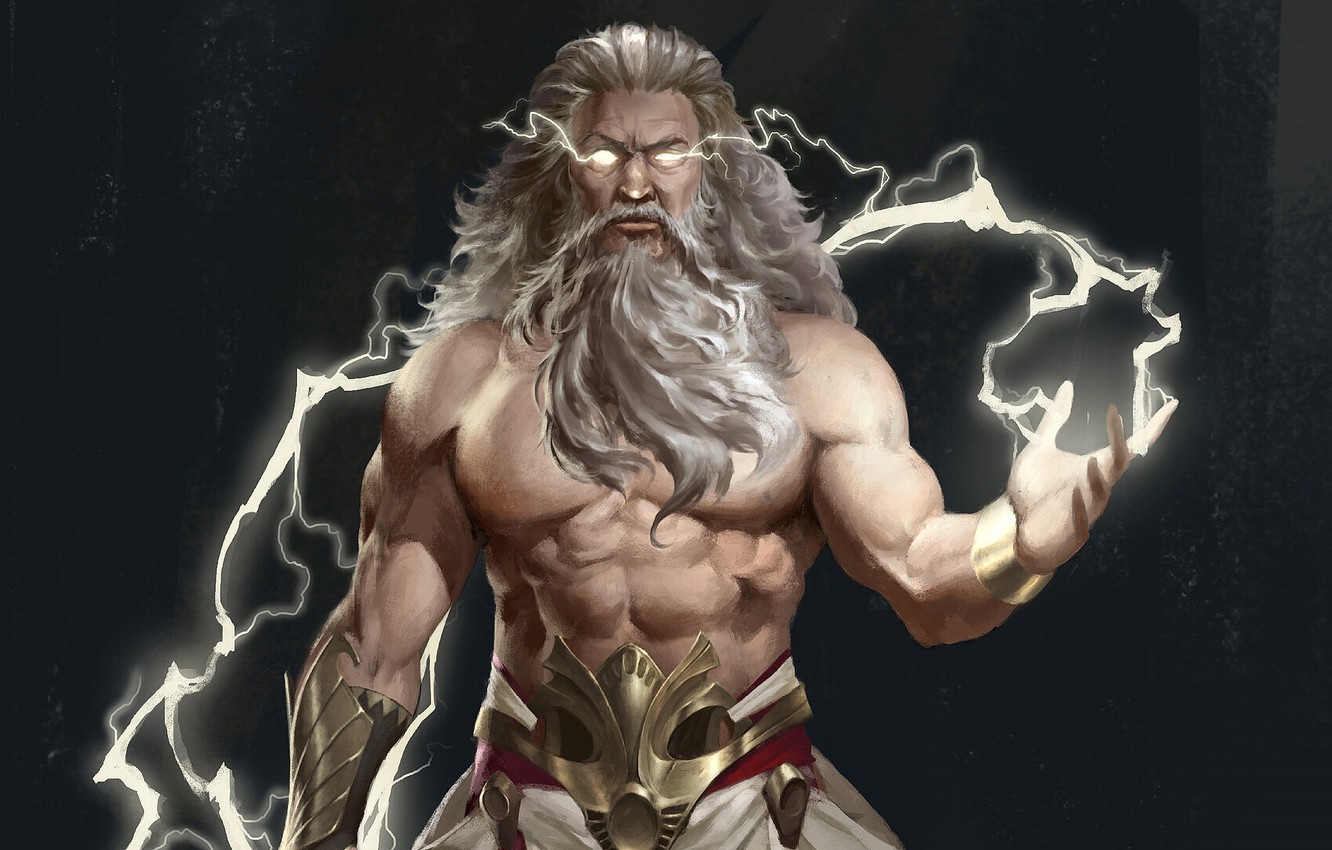
Everyone thinks they know Zeus. Big beard, white robe, throwing thunderbolts when he’s grumpy—basically the CEO of Mount Olympus. But if you actually dig into the ancient sources like Hesiod’s Theogony or the works of Homer, you realize the zeus the god facts we learned in school are just the tip of the iceberg. He wasn't just a king. He was a survivor who escaped being eaten by his own father, a political mastermind who overthrew a generation of giants, and honestly, a bit of a chaotic force who constantly blurred the lines between justice and pure ego.
He was complicated. Really complicated.
To understand Zeus, you have to look at the sheer violence of his upbringing. His father, Cronus, was terrified of being overthrown. To prevent it, he literally swallowed his children—Hestia, Demeter, Hera, Hades, and Poseidon—as soon as they were born. When Zeus came along, his mother Rhea pulled a fast one. She handed Cronus a rock wrapped in swaddling clothes instead of a baby. Cronus ate the rock. Zeus grew up in a cave on Mount Ida, raised by nymphs and a goat named Amaltheia. It's a wild way to start a life. This isn't just myth; it's the foundation of his entire persona as a protector of the vulnerable and a punisher of those who abuse power.
The Titanomachy and the Rise of a King
You can't talk about zeus the god facts without mentioning the Titanomachy. This was a ten-year war between the Titans (the old guard) and the Olympians (the new kids). Zeus didn't just win by being strong. He won by making alliances. He went down into Tartarus and freed the Cyclopes and the Hundred-Handed Ones, who had been imprisoned by Cronus. In return, the Cyclopes forged his signature weapon: the thunderbolt.
It wasn't a clean fight.
The earth literally shook. Mountains were thrown. Imagine the scale of a conflict where the combatants are personifications of the natural world. When the dust settled, Zeus didn't just kill his enemies; he imprisoned them in the deepest pit of the underworld. This established him as the arbiter of order. He divided the universe with his brothers, Poseidon and Hades. They literally drew lots. Poseidon got the sea, Hades got the underworld, and Zeus got the sky. He became the "Father of Gods and Men," but that title carries a lot of weight and a fair amount of controversy.
The Weaponry of a Sky God
The thunderbolt is his brand. But what was it, actually? Ancient Greeks didn't see it as a physical spear. It was a manifestation of divine will. There were actually different types of lightning in the Greek tradition—some for signaling, some for punishing, and some for purifying.
- The Keraunos (Thunderbolt) was crafted by Brontes, Steropes, and Arges.
- He also carried the Aegis, a shield (or sometimes a breastplate) often depicted with the head of a Gorgon.
- The eagle was his personal messenger, symbolizing his sight that covered the entire world.
Why Zeus Was the God of "Xenia" (And Why It Matters)
If you wanted to see Zeus truly angry, you didn't need to steal his lightning. You just had to be a bad host. One of the most important zeus the god facts that people overlook is his role as Zeus Xenios. He was the protector of travelers and the enforcer of hospitality laws. In a world where traveling between cities was incredibly dangerous, Xenia was the social glue that kept civilization together.
Basically, if a stranger showed up at your door, you had to feed them and give them a place to sleep before you even asked their name. If you harmed a guest, you weren't just a jerk; you were an enemy of Zeus. This is why the story of Paris kidnapping Helen was such a big deal—it wasn't just about a stolen wife, it was a massive violation of hospitality that Zeus could not ignore.
He was also the god of oaths. If you made a business deal and swore by Zeus, and then backed out? Good luck. He was Zeus Horkios, the watcher of promises. People used to set up small altars to him in their courtyards (Zeus Herkeios) to protect their homes. He was deeply embedded in the daily life of a regular person, not just someone you talked about in big temples.
The Many Faces of the King
The Greeks didn't just have one "Zeus." They used "epithets"—specific titles that highlighted different parts of his personality. This gave him a weirdly flexible nature.
- Zeus Panhellenios: The god of all Greeks, used to unite the disparate city-states.
- Zeus Agoraios: The patron of the marketplace and honest trade.
- Zeus Georgos: The god of crops and agriculture (showing his link to rain).
- Zeus Meilichios: A much darker, chthonic (underworld-adjacent) version often depicted as a snake.
The Complicated Reality of His Relationships
We have to address the elephant in the room. Zeus’s romantic life was... extensive. And often problematic by modern standards. He had dozens of children with goddesses, nymphs, and mortal women. While this is often played for laughs in modern media, in ancient times, these myths served a very specific purpose: genealogy.
Every major city-state or royal family wanted to claim they were descended from a god. If you were a king in Argos or Thebes, having Zeus as a great-great-grandfather gave you "divine right" to rule. It was a political tool. It also explained the existence of "demigods" or heroes like Heracles, Perseus, and Minos.
His wife, Hera, was the goddess of marriage, which made the whole situation incredibly ironic. Their relationship was a constant power struggle. Hera wasn't just a "jealous wife"; she was a queen in her own right who often challenged Zeus's authority. There’s a famous story in the Iliad where Hera, Poseidon, and Athena actually managed to chain Zeus to his bed in a coup attempt. He only escaped because a sea-nymph brought a giant to rescue him.
He was powerful, but he wasn't invincible.
Zeus vs. Other Mythology Leaders
How does Zeus stack up against other "top tier" gods? Most people compare him to Jupiter (his Roman counterpart) or Odin.
Jupiter is basically Zeus with a law degree. The Romans took the Greek myths and stripped away some of the more "human" flaws, making him a more rigid symbol of the State. Odin, on the other hand, is much more of a seeker of knowledge and a sorcerer. Zeus didn't care much for secrets or magic; he cared about power and order.
While Odin knew the world would end at Ragnarok, Zeus believed his reign was eternal. He had defeated the cycle of sons overthrowing fathers. When a prophecy claimed his son by Metis would overthrow him, he simply swallowed Metis. (Later, Athena popped out of his head, fully grown, which settled that problem without him losing his throne).
Science and the Myth
Archaeologically, we see evidence of Zeus worship dating back to the Mycenaean period (around 1400 BCE). His name actually comes from the Proto-Indo-European root dyeu-, which means "to shine" or "sky." This connects him to the Indian god Dyaus Pitar and the Roman Jupiter.
In the real world, his main sanctuary at Olympia was home to one of the Seven Wonders of the Ancient World: a massive gold and ivory statue by the sculptor Phidias. It was so big that if Zeus had "stood up," he would have unroofed the temple. People traveled from all over the Mediterranean just to see it. It wasn't just religion; it was a massive cultural event.
Misconceptions You Probably Believe
1. Zeus was the "God of Goodness." Not exactly. He was the god of Justice (Dike), but his justice could be cruel. He punished Prometheus for giving fire to humans by having an eagle eat his liver every day forever. He wasn't "good" in a modern sense; he was "just" in a cosmic sense.
2. He lived alone on a throne. Olympus was more like a royal court. It was loud, full of bickering, feasts, and music. He was the chairman of the board, not a hermit.
3. He was omnipotent. He wasn't. Zeus was bound by the Moirai (The Fates). Even he couldn't change what was destined to happen. In the Iliad, he watches his son Sarpedon die in battle and wants to save him, but Hera reminds him that if he breaks the rules of fate, all the other gods will do the same. He has to let his son die.
Taking Action: Exploring the Myths Further
If you’re fascinated by these zeus the god facts, the best way to dive deeper is to look at the primary sources rather than modern retellings. Modern movies often make him out to be either a pure hero or a total villain, but the ancients saw him as both.
- Read the Homeric Hymns: These are short poems dedicated to the gods that give a great sense of how they were worshipped.
- Visit a museum with a Greek collection: Look at the pottery. The way Zeus is depicted—often holding a tiny figure of Nike (Victory) in his hand—tells you everything about how the Greeks viewed his power.
- Research "The Great Altar of Pergamon": It’s currently in Berlin and shows the battle between the gods and giants in incredible, visceral detail.
- Study the Stoic view of Zeus: Later Greek philosophers like Epictetus viewed Zeus not as a literal man in the sky, but as the "logos" or the rational mind of the universe.
Understanding Zeus is about more than just trivia. It’s about understanding how the ancient world tried to make sense of the weather, the law, and the messy reality of human nature. He was the "Sky Father," but he was also the reminder that power is complicated, and even the king of the gods had to answer to the laws of the universe.
To truly get a handle on his influence, look into the specific cults of the regions of Greece, such as the cult of Zeus Lykaios in Arcadia, which involved much darker and more mysterious rituals than the standard Olympic festivals. Following the trail of his epithets across the Mediterranean will reveal a god that changed shape and meaning depending on who was praying to him.