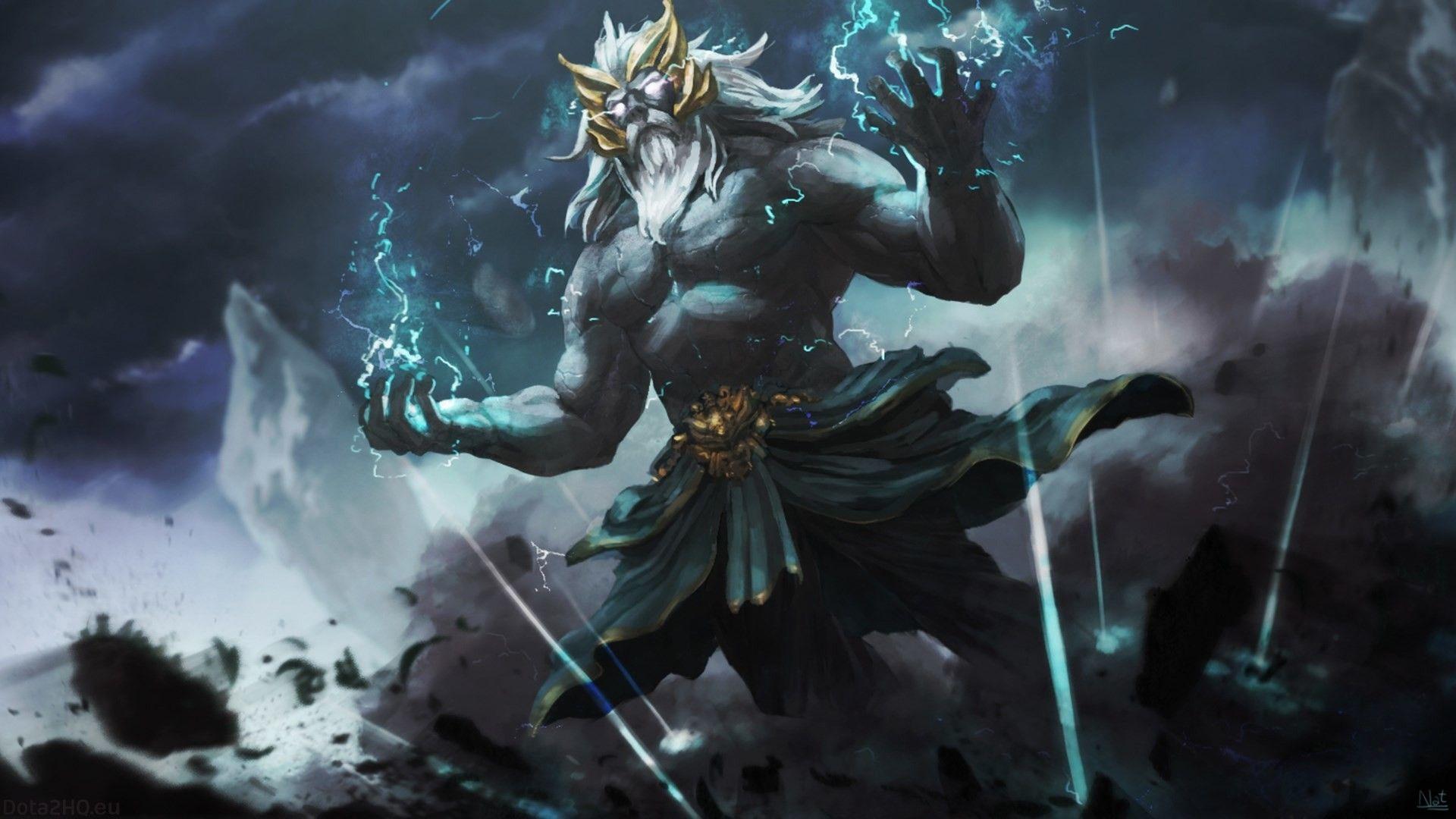
Everyone knows the image. The white beard. The bulging biceps. That jagged lightning bolt gripped in a hand that looks like it could crush a boulder. Zeus, the Greek god of thunder, is basically the blueprint for every "king" archetype in Western history. But if you actually sit down and read the Theogony by Hesiod or dive into the darker corners of Homeric hymns, you realize pretty quickly that the guy was a mess.
He wasn't just a weather man.
To the ancient Greeks living in the shadow of Mount Olympus, Zeus was the "Father of Gods and Men," but he was also a terrifying force of nature that followed no rules but his own. He was the sky. He was the rain. He was the guy who would turn into a swan or a shower of gold just to ruin someone's Tuesday.
The Weird Physics of the Lightning Bolt
We usually think of the lightning bolt as a weapon, like a sword or a gun. In Greek mythology, it’s more like a specialized piece of high-tech artillery forged by the Cyclopes—specifically Brontes (Thunder), Steropes (Lightning), and Arges (Brightness).
They didn't just give him a shiny stick.
They gave him the literal power of the cosmos to win a ten-year cosmic war called the Titanomachy. Before Zeus got his hands on the bolt, his father, Cronus, was running the show and eating his children to avoid a prophecy. Zeus survived because his mom, Rhea, fed Cronus a rock instead.
Think about that. The Greek god of thunder exists because a Titan couldn't tell the difference between a baby and a limestone pebble.
Once Zeus freed his siblings from his father’s stomach—which is a whole different level of gross—he needed an edge to take down the older generation. The Cyclopes, who had been imprisoned in Tartarus, were so grateful to be out that they crafted the keraunos. That’s the Greek word for the thunderbolt. In art, you’ll see it depicted as a double-pointed object, sometimes with wings or flames. It wasn't just for show. When Zeus threw it, the world literally shook.
Why the "Thunder" Part Actually Matters
Most people focus on the lightning. It’s flashy. It looks cool on a t-shirt. But the "thunder" aspect was about authority. In a world without microphones or mass media, the loudest thing on the planet was the sky.
If it thundered, Zeus was speaking.
If you were a king in ancient Mycenae or Athens, you claimed your right to rule through Zeus. He was the patron of Xenia—the law of hospitality. Basically, if you were a jerk to a guest in your house, the Greek god of thunder might personally strike your roof off. It kept society from collapsing. It was the ancient version of a social contract, enforced by the threat of literal incineration.
He Wasn't Always the Hero
We’ve sanitized these stories for kids' movies. Honestly, the real Zeus was pretty problematic.
Take the story of Prometheus. Most of us know Prometheus stole fire to help humans stay warm and cook food. We see him as a hero. Zeus saw him as a thief who broke the natural order. Zeus’s punishment wasn't just a slap on the wrist; he had Prometheus chained to a rock where an eagle—Zeus’s sacred animal—would eat his liver every single day. Because Prometheus was immortal, the liver grew back at night.
Cycle. Repeat. Forever.
That’s the side of the Greek god of thunder people forget. He wasn't "good" in the modern sense. He was order. And order is often violent. He kept the giants in the ground and the monsters in the dark, but he did it with an iron fist.
The Identity Crisis of a Sky God
One of the most fascinating things about Zeus is how he absorbed other gods. As the Greeks moved around the Mediterranean, they encountered other cultures with their own sky deities. Instead of fighting them, they basically said, "Oh, that’s just our Zeus, but with a different hat."
- In Egypt, he became Zeus-Ammon.
- In Crete, he was sometimes depicted as a dying and reborn god, which is weird because the main Olympian version is definitely immortal.
- In Syria, he took on traits of Baal.
This is why his personality seems so inconsistent in the myths. In one story, he’s a wise judge. In the next, he’s a paranoid tyrant. He’s a collection of thousands of years of different tribes trying to make sense of the weather.
What the Scholars Say (The Real E-E-A-T Stuff)
If you look at the work of Walter Burkert, one of the most respected scholars of Greek religion, he points out that Zeus is the only Greek god whose name has a clear Indo-European origin. The name "Zeus" comes from the root Dyeus, which means "sky" or "shine."
It’s the same root that gives us the Latin Dies (day) and the Roman name Jupiter (Sky-Father).
Archaeologists at Mount Lykaion have found evidence of ash altars dedicated to Zeus that date back over 3,000 years. They found bones of animals, and—get this—some evidence that suggests the possibility of human sacrifice in the very early, "primitive" stages of his cult. This wasn't just a story people told; it was a religion that demanded serious, sometimes terrifying, devotion.
Nuance is key here.
Ancient worshippers didn't "love" Zeus the way modern religious people might love a deity. They respected him. They feared him. They knew that a dry summer meant no crops, and a stormy sea meant no trade. The Greek god of thunder held the economy in his hands.
Common Misconceptions About the King of Olympus
Let's clear some stuff up because Hollywood has done a number on the classics.
1. He wasn't the "God of Everything." He had limits. He couldn't overrule the Fates (the Moirai). If they decided a hero was going to die, Zeus could complain about it, but he couldn't change it. He was the CEO, not the owner of the company.
2. His "affairs" weren't just about romance. In the context of ancient politics, saying a local hero was the son of Zeus was a way to legitimize a city-state. If you live in Argos and you want to feel important, you claim your founder was a demigod. It was branding.
3. Hera wasn't just a "jealous wife." Hera was his equal in many ways. Their marriage was a cosmic metaphor for the tension between the sky (Zeus) and the earth (Hera). When they fought, the weather got weird. It’s a drama played out in the atmosphere.
Why We Still Care About a 3,000-Year-Old Myth
Why does the Greek god of thunder still show up in movies, video games, and even car commercials?
Maybe it’s because he represents the ultimate human fantasy: total freedom and total power. Zeus does whatever he wants. He doesn't have a boss. He doesn't have to apologize. But the myths also serve as a warning. Almost every story where Zeus exerts his power ends with someone—usually a human—getting hurt.
He’s the personification of "unchecked ego."
Even today, we use the term "lightning bolt" to describe a sudden, life-changing epiphany. We look at the sky during a summer storm and feel that tiny prickle of "what if?" on our skin. That’s the legacy of Zeus.
Actionable Steps for Mythology Fans
If you're actually interested in the Greek god of thunder and want to go deeper than just a Wikipedia skim, here is how you should actually spend your time.
First, stop watching movies. Seriously. Most of them get the genealogy wrong and turn Hades into a villain (he wasn't; he was just the guy with a boring job). Instead, pick up a copy of The Odyssey. Pay attention to how the characters talk about Zeus. They don't talk about him like a character; they talk about him like the wind.
Next, check out the Pergamon Altar (you can find high-res scans online if you can't get to Berlin). It shows the battle between the gods and the giants. The detail on Zeus is insane. You can see the tension in his muscles. It gives you a much better sense of the "awe" he was supposed to inspire than any CGI movie ever could.
Finally, if you’re a traveler, put the National Archaeological Museum in Athens on your list. There’s a bronze statue there—the Artemision Bronze. Historians are still debating if it’s Zeus or Poseidon. If the hand was holding a thunderbolt, it’s Zeus. If it was a trident, it’s Poseidon. The fact that we can't tell the difference says a lot about how the Greeks viewed power: it’s dangerous, it’s beautiful, and it’s usually pointed right at you.
Start with the Theogony. It’s short. It’s weird. It’s got a lot of "who begat who," but it lays the foundation for everything. Once you understand the family tree, the lightning makes a lot more sense. You'll see that Zeus wasn't just a god; he was the personification of the sky’s chaotic, unpredictable, and ultimately necessary energy.
Ancient history isn't just about old rocks. It’s about how people tried to explain why the world is the way it is. And sometimes, the answer is just a very big guy with a very loud bolt of energy.