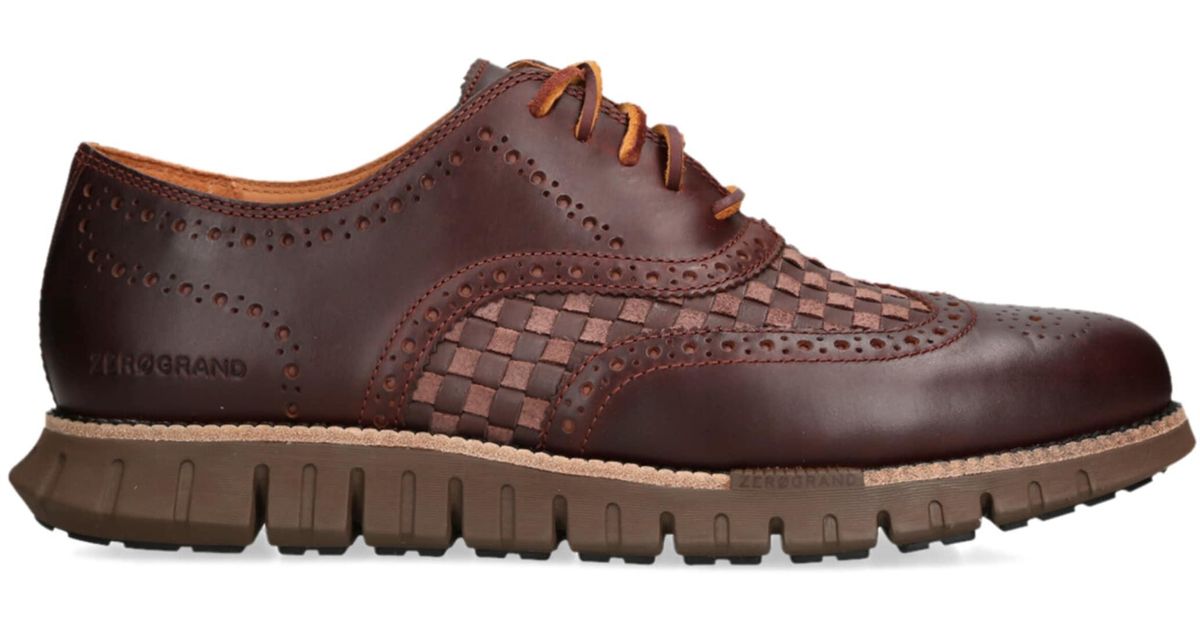
You’ve seen them. Maybe in a crowded terminal at O'Hare or peeking out from under a navy suit in a midtown boardroom. Those thick, athletic-looking soles paired with a classic leather brogue upper. Some people call them the "tech bro" uniform. Others swear they saved their lower back during an eight-hour trade show. Honestly, when Cole Haan first dropped the Zerogrand wingtip oxford shoes back in 2014, they basically broke the traditional footwear industry’s brain. It was a weird marriage. It looked like a running shoe and a dress shoe had a baby that grew up to be a disruptor.
Let's be real: wearing them used to be a statement. Now? They’re a staple. But there is a massive amount of confusion about what these shoes actually do, how they should fit, and why some people think they’re "ruining" menswear while others can't live without them.
The Engineering of a "Grand" Shoe
Forget the leather for a second. The magic—or the controversy—is all in the sole. Cole Haan didn't just glue a foam slab to a shoe. They developed something called Grand.ØS technology. It’s basically an operating system for your feet. Most dress shoes are built on a rigid welt. They’re heavy. They require a "break-in" period that usually involves Band-Aids and a lot of cursing.
The Zerogrand wingtip oxford shoes flipped that script.
They use an injection-molded EVA outsole. That’s the same stuff you find in high-performance running sneakers. Because of the deep grooves—called flex grooves—the shoe mimics the natural motion of your foot. You can literally bend the shoe in half. Try doing that with a traditional Allen Edmonds Park Avenue. You can’t.
Weight is the other factor. A typical leather oxford weighs about 18 to 22 ounces. A Zerogrand? It’s often under 10 ounces. It’s light. Shockingly light. When you pick it up, your brain expects the heft of a cobbler-made shoe, but you get the weight of a croissant. This lightness isn't just for show; it reduces leg fatigue. If you’re walking three miles across a city campus or standing for five hours at a gallery opening, that weight difference is the difference between feeling fine at dinner and wanting to chop your feet off.
Why the Wingtip Style Matters
Why didn't they just make a plain toe? Because the wingtip—the "W" shape on the toe cap—provides structure. The perforations, known as broguing, were originally designed in Scotland and Ireland to let water drain out of shoes when walking through bogs. Today, nobody is walking through bogs in $200 Cole Haans. It’s purely aesthetic. But on a hybrid shoe, that extra stitching and layering of leather provides the lateral stability that a flimsy mesh sneaker lacks. It keeps your foot centered over that squishy foam sole.
Common Misconceptions and the "Suit" Rule
Here is the thing: some people try to wear Zerogrand wingtip oxford shoes with a formal tuxedo. Please, stop. Don't do that.
There is a specific boundary for hybrid footwear. Because of the visible foam and the sporty ridges, these shoes sit firmly in the "Business Casual" to "Smart Casual" categories. They are the kings of the "Chinos and a Blazer" look. They work perfectly with dark denim and a crisp button-down. But the second you put them on with a structured, three-piece power suit, the visual weight of the sole starts to clash with the elegance of the tailoring.
- The "Vibe" Check: If your pants have a sharp crease, stick to a traditional sole.
- The "Traveler" Check: If you are navigating Heathrow and then going straight to a meeting, these are your best friend.
- The "Office" Check: If your boss wears a tie, go for the leather-soled version. If your boss wears a Patagonia vest, the Zerogrand is your North Star.
Many critics argue that these shoes represent the "casualization" of the workplace. Maybe. But the reality is that the modern worker moves more than the worker of 1950. We commute, we bike, we walk to lunch. A hard leather sole is a relic of a time when people sat at a desk and didn't move until the 5:00 whistle.
Durability: The Elephant in the Room
Let's talk honestly about how long these last. A traditional Goodyear-welted shoe can be resoled. You wear down the bottom, you take it to a cobbler, they stitch on a new one, and you’re good for another five years.
You cannot resole Zerogrand wingtip oxford shoes.
Once that EVA foam wears down or the traction pods smooth out, the shoe is effectively dead. For some, this is a dealbreaker. It’s "fast fashion" for your feet. However, the leather uppers are surprisingly high quality. Cole Haan uses decent hides that take a shine well, though you have to be careful not to get polish on the foam sole, or it’ll look like a DIY disaster.
Typically, if you wear them three times a week, you’ll get about 18 to 24 months of peak comfort out of them. After that, the foam begins to "compress." It loses its bounce. You’ll notice you’re feeling the pavement a bit more. That’s the trade-off. You’re trading decades of longevity for immediate, out-of-the-box comfort.
Stitchlite vs. Leather
Cole Haan also offers these in "Stitchlite," which is a knitted fabric. It’s basically a sock with a sole. It’s incredibly breathable. If you live in a humid climate like Florida or Singapore, the Stitchlite Zerogrand wingtip oxford shoes are a godsend. But be warned: they have zero water resistance. One puddle and your day is ruined. The leather version offers much better protection against the elements and, frankly, looks a lot more professional.
The Science of the Fit
Don't buy your sneaker size. This is the biggest mistake people make.
Most people find that Cole Haan runs a bit large and narrow. If you wear a 10 in Nike, you might be a 9 or a 9.5 in a Zerogrand. The leather will stretch slightly, but the foam sole won't. You want a snug fit across the bridge of your foot, but plenty of room in the toe box. Since the shoe is so flexible, if it's too big, your heel will slip out constantly, causing blisters that the "comfort" sole was supposed to prevent.
Also, consider the socks. Because these shoes bridge the gap between sports and dress, your sock choice matters. A thick athletic sock will make the shoe feel tight and look bulky. A thin dress sock is better, but look for something with moisture-wicking properties. The foam sole doesn't breathe as well as leather, so your feet can get a bit "swampy" if you're not careful.
Cultural Impact: Why They Stuck Around
When they debuted, many fashion purists laughed. They called them "clown shoes." But then, something happened. Wall Street changed its dress code. Silicon Valley became the center of the economic universe. The "uniform" shifted.
The Zerogrand wingtip oxford shoes became the bridge. They allowed people to keep a veneer of professionalism while acknowledging that they were no longer willing to be uncomfortable. They are a triumph of function over tradition. They represent a shift in how we view work: it’s no longer about looking like a statue; it’s about being mobile and efficient.
Interestingly, we’ve seen brands like Wolf & Shepherd or even high-end labels like Prada try to mimic this "sneaker-sole dress shoe" vibe. But Cole Haan owns this space because they hit the price point perfectly. At around $150 to $200, they are an "aspirational" purchase that doesn't require a second mortgage.
How to Style Them Without Looking Like a Dork
- The Taper is Key: Your trousers must be tapered. If you wear wide-leg or "bootcut" pants with these, the bulky sole makes your feet look like paddles. You need a narrow leg opening to balance the silhouette.
- Color Coordination: If you get the version with a white or contrasting sole, keep the rest of your outfit muted. Let the shoes be the "pop." If you want to be subtle, get the "triple black" or the navy-on-navy version.
- The No-Show Look: In the summer, these look fantastic with no-show socks and a pair of cuffed chinos. It’s the ultimate "out of the office" look.
Actionable Steps for the Buyer
If you are thinking about pulling the trigger on a pair of Zerogrand wingtip oxford shoes, do not just click "buy" on the first pair you see.
First, determine your environment. If you work in a creative field or a "business casual" office, go for the classic tan leather with a white sole; it’s the most iconic version. If you’re in a slightly more conservative spot like a law firm or bank, stick to the black leather with a black sole to hide the "sneaker" look.
Second, check the "Grand" version number. Cole Haan is constantly iterating. You’ll see 2.Zerogrand, 3.Zerogrand, and even 4.Zerogrand. Each has a slightly different sole pattern. The 4.Zerogrand usually has the most cushioning, while the original Zerogrand is the lightest and most flexible.
Third, invest in a suede brush or a damp microfiber cloth. The foam soles pick up dirt from the sidewalk like a magnet. If you leave that dirt on there, it will eventually stain the foam, making the shoes look old long before the leather wears out. A quick wipe-down every three wears keeps them looking "fresh out of the box."
Finally, recognize that these are tools. They are designed for the "modern commute." They aren't heirlooms to be passed down to your children. Use them, walk miles in them, and enjoy the fact that your feet don't ache at the end of the day. When the sole finally loses its spring, thank them for their service and move on to the next pair. That is the reality of the hybrid shoe era.
Next Steps for Long-Term Care:
- Rotate your pairs: Never wear the same pair two days in a row. The EVA foam needs 24 hours to "decompress" and return to its original shape, and the leather needs time to dry out from foot moisture.
- Use shoe trees: Even though they are "sneaker-like," the leather uppers will still develop deep creases if you don't use cedar shoe trees to maintain the shape.
- Clean the soles: Use a dedicated sneaker cleaner or a "magic eraser" on the white foam parts to keep the contrast sharp and the look professional.