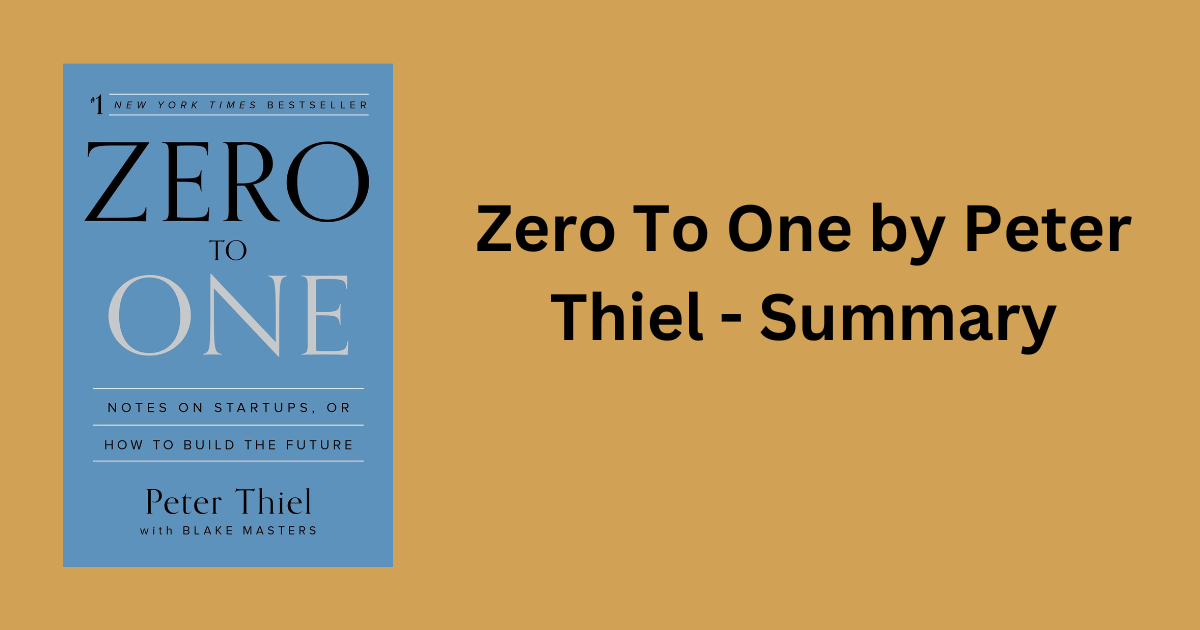
You’ve heard the pitch before. Build a "better" app. Disrupt an industry. Move fast and break things.
Actually, if you’ve spent any time reading Zero to One, you know Peter Thiel thinks most of that is total nonsense.
Most people treat business like a game of copycat. They see a successful coffee shop and decide to open one with slightly better beans. That is going from 1 to $n$. You’re just adding more of what already exists. Thiel argues that the real money—the world-changing, "f-you" levels of capital—comes from going from 0 to 1.
It’s about doing something nobody else is doing.
I recently re-read the notes from his Stanford class that eventually became this book. It’s funny how much the "lean startup" crowd still hates his advice. They want to iterate. Thiel wants a plan. They want to listen to customers. Thiel thinks customers don't know what they want until you build it.
Why Competition is for Losers
This is the big one. It’s the headline that makes economists twitch.
In every Intro to Econ class, they teach you that "perfect competition" is the ideal state. It’s supposed to be efficient. But if you're the one running the business, perfect competition is a nightmare. It means your profits get ground down to zero because you’re fighting everyone else for the same scraps.
Look at the airline industry. They serve millions of people and create massive value, but for decades, they made almost no money per passenger. Then look at Google. Google is a monopoly. They don't have to worry about anyone else, so they can actually afford to innovate.
Thiel’s core thesis is simple: Monopoly is the condition of every successful business. If you aren't building a monopoly, you're just a commodity. And commodities die when the market shifts by 1%.
Of course, monopolists lie about being monopolists. They don't want the government breathing down their necks. Google says they’re a "tech company" or an "advertising platform" or a "self-driving car pioneer." They pretend the market is huge so their share looks small. Meanwhile, the guys in the hyper-competitive restaurant business pretend they’re "the only authentic Thai-fusion spot in South Jersey" to make themselves sound like a monopoly.
It's a weird psychological game.
The 10x Rule and the Secret Question
How do you actually get to 0 to 1? You can't just be 10% better.
If you’re 10% better than the incumbent, nobody cares. The switching costs are too high. You have to be 10x better in at least one important dimension. When Amazon launched, it didn't just have 10% more books than a local bookstore; it had practically every book in print. That’s a 10x improvement.
But even before the tech, you need a "Secret."
Thiel likes to ask this infamous interview question: “What important truth do very few people agree with you on?” It’s a brutal question. Most people give a "safe" contrarian answer like "the education system is broken." Everyone agrees with that. A real secret is something that sounds crazy to everyone else but turns out to be true.
- Airbnb's secret: People are actually willing to let strangers sleep in their spare beds.
- Uber's secret: People would rather jump into a stranger’s Toyota Camry than call a dispatcher for a yellow cab.
If you don’t have a secret, you don't have a startup. You just have a project.
The "Definite Optimist" Problem
Honestly, this is the part of Zero to One that feels most relevant in 2026. Thiel breaks the world into four categories:
- Indefinite Pessimism: The future will be bad, and we don't know what to do about it (Europe, often).
- Definite Pessimism: The future will be bad, so we better save up and prepare (China's traditional view).
- Indefinite Optimism: The future will be better, but we don't know how, so let's just "iterate" and hope for the best.
- Definite Optimism: The future will be better if we build it according to a specific plan.
We are currently drowning in indefinite optimism.
Venture capitalists tell founders to "pivot" and "stay lean." It’s basically saying, "We have no idea what’s going to work, so just throw spaghetti at the wall." Thiel hates this. He argues that a bad plan is better than no plan. If you treat the future as a random lottery, you've already lost.
You need a vision. You need to be "fanatically right" about something everyone else has missed.
Why "Lean" is Often a Trap
The Silicon Valley dogma is to build a Minimum Viable Product (MVP) and then let the market tell you what to do.
Thiel calls this out as a way to avoid the hard work of thinking. If you’re just iterating, you’re making incremental changes to things that already exist. You might reach a "local maximum," like the world’s best app for ordering toilet paper. But you’ll never find the "global maximum"—the breakthrough that changes everything.
He uses the dot-com crash of 2000 as the reason why everyone became so scared of big plans. People got burned by the "exuberance," so they overcorrected. They decided that sales don't matter (only "virality" does) and that "stealth mode" is better than a grand announcement.
Thiel argues the opposite: Sales matters just as much as the product. If you have a great product but no way to sell it, you have a bad business. Period. "Nerds" often think the product should sell itself, but that’s a fantasy.
Building the Foundation
You can’t fix a broken startup.
Thiel’s "Law" is that a startup messed up at its foundation cannot be fixed. This includes the "People Question." If you have co-founders who don't know each other well or have misaligned incentives, the company is dead before it starts.
He’s also weirdly specific about the board of directors. Keep it small. Three people is ideal. Five is the absolute limit. Anything more than that and you don't have a board; you have a talking shop where nobody is actually in control.
Ownership, possession, and control. You have to get those right.
Actionable Takeaways for Your Next Move
If you’re sitting on an idea or running a team, stop asking how to "beat" the competition. Start asking how to avoid them.
- Audit your "10x" advantage: Is your tech truly 10 times better than the next best thing? If it's just a better UI or a slightly lower price, you're in the "1 to n" trap. Find the one feature that makes the competition look prehistoric.
- Identify your small pond: Don't try to get 1% of a $100 billion market. That’s a death sentence. Find a tiny market you can 100% dominate—like Facebook did with Harvard—and then expand.
- Write down your secret: What is the one thing you believe about your industry that everyone else thinks is wrong? If you can't name it, you’re just building a commodity.
- Pick a side on the future: Stop "iterating" for a week. Sit down and write a definite 5-year plan. Even if it’s wrong, it gives you a North Star that "lean" methodologies never will.
Building a business that goes from zero to one is scary because it requires you to be an outlier. It means you might be wrong. But as Thiel points out, the only other option is to join the crowd and watch your profits disappear into the noise of the marketplace.
Focus on the singular moment of creation. That's the only way to actually build the future.