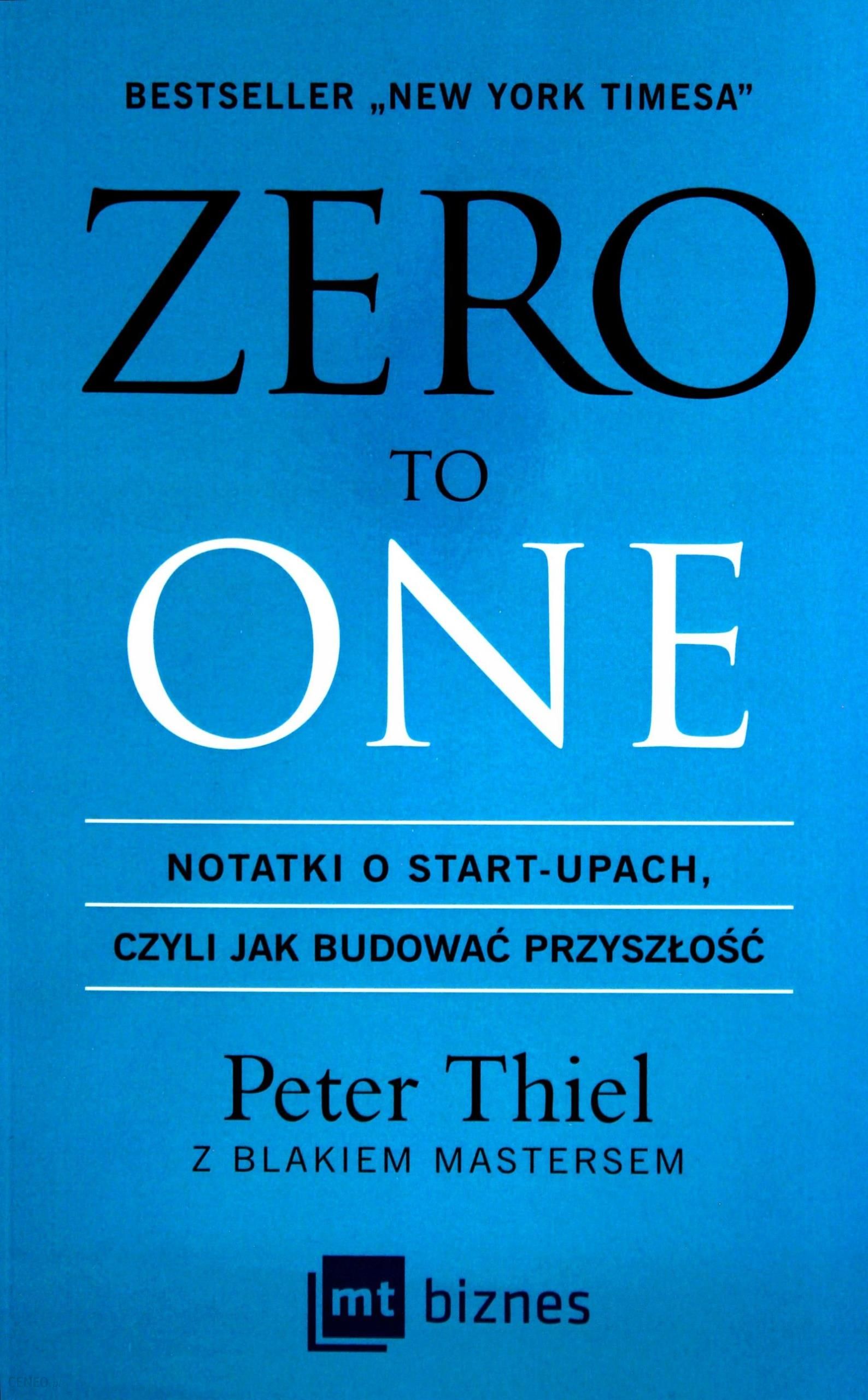
You’ve probably seen the Zero to One PDF floating around the corners of the internet or sitting in a dusty "Read Later" folder on your desktop. It’s one of those documents that people treat like a digital relic. Honestly, it’s kind of funny how a book about the future has become such a staple of the present-day startup grind. Peter Thiel, the guy who co-founded PayPal and was the first outside investor in Facebook, basically sat down and decided to tell everyone they were doing business wrong. He didn't do it alone, though. The book actually started as a set of class notes taken by Blake Masters at Stanford. That’s why it feels so punchy. It wasn't written by a committee of corporate ghostwriters trying to play it safe.
Thiel is a provocateur. He likes to poke at things. His core premise in the Zero to One PDF is that doing what we already know how to do takes the world from 1 to n, adding more of something familiar. But whenever we create something new, we go from 0 to 1. That’s the vertical progress he’s obsessed with. It’s the difference between building a better typewriter and building a word processor. One is an improvement; the other is a revolution.
The Monopoly Myth and Why Competition is for Losers
If you went to business school, you were probably taught that perfect competition is the ideal state for a healthy market. Thiel says that’s nonsense. In the Zero to One PDF, he argues that if you want to create real value, you need to build a monopoly. This isn't the kind of monopoly that cheats its way to the top by lobbying the government. It’s a creative monopoly that is so much better at what it does that no other firm can offer a close substitute.
Think about Google. They own search. They haven't had a serious competitor in decades because their product is fundamentally better than the next best thing. They don't have to worry about "competing" in the traditional sense, which allows them to focus on innovation. When companies are locked in ruthless competition, their profit margins get squeezed to zero. They spend all their time fighting for scraps. Thiel’s advice is simple: if you’re starting a company, avoid competition like the plague.
But how do you actually do that? You start small.
Most people think they need to "disrupt" a giant market. Thiel thinks that’s a mistake. He suggests you should find a niche—a tiny, underserved market—and dominate it completely. Once you own that space, you can expand. Amazon started with just books. They didn't try to be "the everything store" on day one. They became the "book monopoly" first, then used that leverage to take over the world.
The Seven Questions Every Founder Must Answer
Deep in the Zero to One PDF, Thiel outlines a framework that sounds almost too simple to be true. He claims that every business must answer seven specific questions to succeed. If you can’t answer them, you’re basically just gambling.
The first one is the Engineering Question: Can you create breakthrough technology instead of incremental improvements? If your product is only 20% better than the competition, people won't switch. It has to be 10x better.
Then there’s the Timing Question: Is now the right time to start this particular business? Look at the dot-com bust. Plenty of companies had good ideas—like online grocery delivery—but they were a decade too early. The infrastructure wasn't there yet.
He also talks about the Monopoly Question: Are you starting with a big share of a small market?
The People Question: Do you have the right team? This isn't just about talent; it's about alignment. Thiel is famous (or infamous) for his "mafia" at PayPal. He wanted people who were tightly knit and shared a vision that bordered on the cultish.
The Distribution Question: Do you have a way to not just create but deliver your product? This is where many tech geniuses fail. They think the product will sell itself. It won't.
The Durability Question: Will your market position be defensible 10 and 20 years into the future?
And finally, the Secret Question: Have you identified a unique opportunity that others don't see?
Secrets and the Power of Being Wrong (Correctly)
The most famous part of the Zero to One PDF—and the question Thiel famously asks job candidates—is: "What important truth do very few people agree with you on?"
This is harder to answer than it sounds. Most people give "safe" answers that are actually consensus views. A real secret is something that seems crazy to everyone else but turns out to be true. If you want to go from 0 to 1, you have to find a secret. You have to find a gap in the way the world works that everyone else is ignoring.
Thiel believes that there are two types of secrets: secrets about nature and secrets about people. Secrets about nature are things like undiscovered laws of physics or better ways to build a rocket. Secrets about people are things that people don't know about themselves or things they hide from others. Airbnb was built on a secret about people: that strangers would be willing to stay in each other’s homes. Before 2008, almost everyone thought that was a terrifying, terrible idea. They were wrong. Brian Chesky and his team were right. That’s a 0 to 1 move.
Why We Stopped Building the Future
One of the more somber sections of the Zero to One PDF deals with the stagnation of technology. Thiel argues that we've had massive progress in the world of "bits" (computers and software) but almost no progress in the world of "atoms" (transportation, energy, medicine).
We were promised flying cars and instead, we got 140 characters.
He blames this on a culture of "indefinite optimism." We think the future will be better, but we have no idea how, so we don't make any specific plans. Instead of building new things, we’ve become obsessed with finance and insurance—moving money around rather than creating new wealth. The Zero to One PDF is a call to arms for "definite optimism." It’s the belief that the future will be better because we have a specific plan to make it so.
Critical Nuances: Where Thiel Might Be Wrong
It’s easy to read the Zero to One PDF and feel like Thiel has all the answers, but the book has its critics. Economists often point out that his "monopoly" argument ignores the social costs of concentrated power. While a monopoly might be great for a founder, it’s not always great for the consumer or the labor market.
Furthermore, Thiel’s obsession with "breakthrough" technology can sometimes overlook the value of incrementalism. Companies like Toyota or Starbucks didn't necessarily go from 0 to 1 in a technological sense; they succeeded through relentless, incremental improvement and operational excellence. Not every successful business needs to be a "secret" revealed to the world. Sometimes, just doing a common thing exceptionally well is enough to build a billion-dollar empire.
How to Apply Zero to One Today
If you’re reading the Zero to One PDF in 2026, the context has shifted. We are currently seeing a massive 0 to 1 shift in Artificial Intelligence. This isn't just another app; it’s a fundamental change in how we process information. But even in this "gold rush," the rules Thiel laid out still apply.
Are you just building another wrapper for an existing LLM? That’s going from 1 to n. You’re competing with everyone else doing the exact same thing. To go from 0 to 1 in the AI era, you have to find the "secret"—the use case or the data set that everyone else is overlooking because they’re too busy following the hype.
Actionable Steps for Founders and Creators
- Audit your competition. If you find yourself constantly looking at what your competitors are doing, you’re already losing. Stop trying to beat them at their own game. Figure out how to play a different game entirely.
- Find your 10x. Look at your product. Is it marginally better or substantially better? If it’s not 10x better, you need to go back to the engineering stage. You can’t market your way out of a mediocre product.
- Target a "boring" niche. Don't go for the "big" market first. Find a group of people who are currently ignored by the giants and solve their problems so well that they become your disciples.
- Identify your secret. Write down three things you believe to be true about your industry that most of your peers think are false. If you can’t think of any, you haven't looked deep enough yet.
- Focus on distribution from day one. It doesn't matter how great your "0 to 1" invention is if you can't get it into people's hands. Sales and marketing are just as much a part of the "0 to 1" process as the code itself.
The Zero to One PDF isn't just a business book; it’s a philosophy of contrarianism. It challenges the idea that the path to success is found by following the crowd. Whether you agree with Peter Thiel’s politics or his world view, the logic of his startup framework is hard to ignore. It forces you to ask the uncomfortable questions that most people would rather avoid. And in a world that feels increasingly crowded and competitive, that might be the most valuable thing of all.
To get the most out of these concepts, start by applying the "Seven Questions" to your current project. Be brutally honest. If you can't answer the "Secret Question" or the "Distribution Question," stop building and start thinking. The goal isn't just to start a company; it's to start a company that actually changes the trajectory of the future.