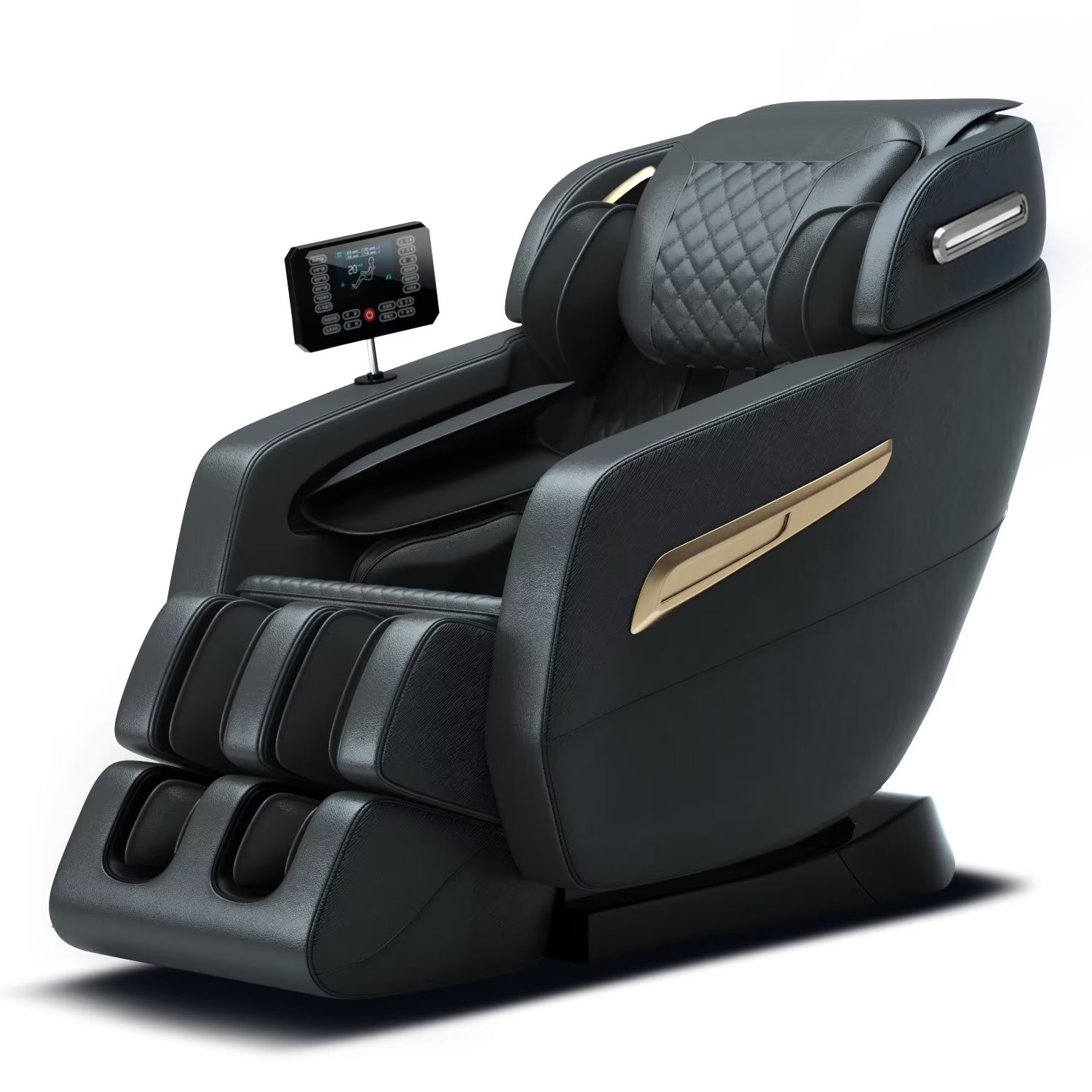
You’ve likely seen them in airport lounges or high-end furniture showrooms—those massive, futuristic thrones that look like they belong on a SpaceX Dragon capsule rather than in a living room. They’re usually reclined at a funky angle, with someone looking suspiciously relaxed while a mechanical hand kneads their calves. We call it a zero gravity massage chair, but honestly, the name is a bit of a marketing gimmick. You aren't actually weightless. You aren't floating in the vacuum of space.
But the science behind that specific tilt? That’s very real. Recently making news lately: The Brutal Truth About the Home Cooking Myth and Your Heart.
NASA actually pioneered the "Neutral Body Position" (NBP) back in the 70s and 80s. They needed to find a way to support astronauts during the massive G-force pressures of liftoff. When you’re being blasted into the atmosphere, you don't want all that pressure crushing your spine or neck. Engineers discovered that by elevating the knees slightly above the heart and angling the torso at about 128 degrees (plus or minus 7 degrees), the human body hits a "neutral" state. In this position, the forces of gravity are distributed evenly across the body.
When you sit in a zero gravity massage chair, you’re essentially mimicking that launch position. Your spine decompresses. Your heart rate slows down because it doesn't have to work as hard to pump blood against gravity. It’s basically a physiological "cheat code" for relaxation that most of us desperately need after sitting in a cramped office chair for nine hours. Further details into this topic are covered by WebMD.
The Spine Decompression Secret
Most people buy these chairs because they want a deep tissue rubdown, but the real magic happens before the rollers even move. Think about your intervertebral discs. They’re like little jelly donuts between your vertebrae. Throughout the day, gravity compresses them. You actually get shorter by the end of the day. It sucks, but it's true.
When a zero gravity massage chair tips you back into that sweet spot, that vertical pressure vanishes.
The vertebrae slightly separate. This allows those "jelly donuts" to rehydrate and take in nutrients. If you struggle with sciatica or herniated discs, this positional shift can feel like a miracle. I’ve talked to folks who say the "zero-g" setting alone does more for their chronic lower back pain than the actual massage rollers ever could. It’s about physical space. You’re giving your nervous system a break from the constant "crunch" of being an upright mammal.
It’s Not Just About the Back
We tend to focus on the spine, but the cardiovascular benefits are actually what doctors like Dr. Raymond Cohen often point toward. When your legs are elevated above your heart, you’re helping your lymphatic system.
Ever notice how your ankles get swollen after a long flight or a day on your feet? That’s edema. Your body is struggling to move fluid back up your legs. By lounging in a zero gravity massage chair, you’re letting physics do the heavy lifting. The blood flows back to the heart more efficiently. Oxygenation improves. It’s a passive way to boost circulation without having to go for a run when your knees already hurt.
There’s also the lung capacity factor. In a standard seated position, your diaphragm can be slightly constricted. Tilt back into neutral body position, and your chest opens up. You take deeper breaths. More oxygen means less cortisol—the stress hormone that keeps us awake at 2 AM worrying about spreadsheets.
S-Track vs. L-Track: Which One Actually Matters?
If you start shopping for a zero gravity massage chair, you’re going to get hit with a wall of technical jargon. S-Track, L-Track, 4D rollers, body scanning... it’s a lot.
Here is the deal.
An S-Track (Sinusoidal) follows the natural curve of your spine from the neck to the lower back. It’s great for traditional massage. But the L-Track changed everything. It extends the track under your seat, meaning the rollers can actually reach your glutes and hamstrings.
If you have tight hip flexors or piriformis syndrome, an S-Track is going to leave you hanging. You want that L-track. Modern high-end chairs from brands like OHCO or Human Touch now use "SL-Track" tech, which combines the spinal contouring of the S with the length of the L. It’s the gold standard.
And don't get me started on "4D" rollers. In 3D, the rollers move up/down, left/right, and in/out (depth). The "4th dimension" is just variable speed. It’s a fancy way of saying the chair can slow down at your neck and speed up on your lats to mimic a human therapist. It’s nice, but don't pay an extra $2,000 just for that one feature unless you're a connoisseur of rhythm.
Real Talk: The Price Tag and the Space Issue
I’m not going to sit here and tell you that a $5,000 chair is a "budget-friendly" wellness tip. It’s an investment. Honestly, it’s a piece of medical equipment disguised as furniture.
One thing people always forget: these things are massive.
A high-quality zero gravity massage chair usually requires a "wall-hugger" design if you don't live in a mansion. Cheaper models need three feet of clearance behind them to recline. Better models slide forward on a track as they tilt, meaning they only need a few inches of wall clearance.
Also, consider the intensity. I’ve seen people buy a top-tier Japanese chair like a Panasonic or a Fujiiryoki and then complain it "hurts." These are powerful machines. If you have fragile skin or severe osteoporosis, you need to be careful. The airbags—those things that squeeze your arms and shoulders—can be surprisingly aggressive. Always look for a chair with adjustable intensity levels.
Why 2026 is the Year the Tech Peaked
We’ve moved past the era of clunky, vibrating chairs that just felt like a cellphone buzzing against your back. Today’s zero gravity massage chair uses AI body scanning.
When you sit down, the chair sends a series of rollers up your back to map your height and shoulder width. It finds your acupressure points. It knows if you’re 5'2" or 6'4". This matters because if the rollers think your neck is six inches higher than it actually is, you’re going to have a bad time.
We’re also seeing "biometric" sensors now. Some chairs can actually measure your heart rate and skin galvanic response to see how stressed you are, then "prescribe" a massage program based on your vitals. It sounds like sci-fi, but brands like Bodyfriend are already doing it.
How to Actually Choose One Without Getting Ripped Off
Don't just buy the first thing you see on a late-night infomercial. If you're serious about getting a zero gravity massage chair, do this:
- Check the Warranty: If the company doesn't offer at least 3 years of in-home service, walk away. These machines have a lot of moving parts. They will eventually need a tune-up.
- Test the "Zero-G" Depth: Some chairs claim to be zero gravity but only tilt back about 110 degrees. That’s not it. You want your knees above your heart. If you don't feel that "weightless" sensation in your lower back, it’s just a recliner with a motor.
- Heat is Non-Negotiable: Look for infrared heat in the lumbar area. Heat loosens the muscle fibers, making the massage significantly more effective. It’s like the difference between stretching a cold rubber band and a warm one.
- Foot Rollers: A lot of chairs just use airbags for feet. You want actual mechanical rollers on the soles of your feet. If you’re on your feet all day, this is the part of the chair you’ll end up loving the most.
The reality is that a zero gravity massage chair isn't a luxury for everyone—some people just won't use it enough to justify the cost. But for chronic pain sufferers, athletes, or anyone with a high-cortisol lifestyle, it's a tool that pays for itself in avoided physical therapy bills.
Actionable Steps for the Aspiring Owner
If you’re ready to pull the trigger, start by measuring your floor space. Account for the full recline length, not just the "upright" dimensions. Visit a dedicated showroom rather than a big-box furniture store; you need to sit in these for at least 15 minutes to know if the roller track fits your specific torso shape. Finally, look for "Open Box" deals from reputable dealers like Massage Chair Store or Furniture For Life—you can often snag a $9,000 floor model for half price just because it has a tiny scuff on the side.
Prioritize the track length (L-Track) and the quality of the warranty over flashy features like Bluetooth speakers or LED "chromotherapy" lights. Those are bells and whistles. Your spine cares about the rollers and the recline angle, nothing else.