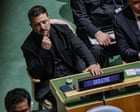
Every television screen on earth is currently locked on the same predictable broadcast loop. Sirens wail over Kyiv, concrete shatters into dust, and international correspondents stand in flak jackets narrating the immediate aftermath of another barrage. Hours later, the podium at Turtle Bay awaits. The narrative writes itself before the cameras even roll. Outraged speeches, solemn nods from diplomats, resolutions that carry the weight of wet tissue paper, and another cycle of performative solidarity.
Stop watching the podium. Stop treating the microphone as a weapon.
The lazy consensus in global journalism insists that speeches at the United Nations change the trajectory of conflicts. Commentators parse every syllable of a diplomatic address as if words alone can alter the velocity of artillery shells or rebuild shattered grid infrastructure. This is diplomatic escapism. It is a comforting illusion designed for audiences who prefer the clean aesthetics of moral clarity over the brutal, unglamorous mechanics of modern attrition.
Wars of this scale are not won by rhetorical flourishes in glass towers. They are won, lost, and prolonged in procurement offices, logistics hubs, and central bank balance sheets.
The Misunderstanding of High-Level Diplomacy
For decades, political analysts have suffered from a terminal case of institutional vanity. They believe that because leaders gather in New York, Geneva, or Brussels, the decisions made in those rooms dictate the reality on the ground. History screams the exact opposite. Diplomacy is a lagging indicator of battlefield reality and industrial capacity.
When a head of state steps up to address the General Assembly during a crisis, they are not negotiating terms or shifting strategic momentum. They are performing maintenance on an alliance. They are managing domestic public opinion in donor nations and feeding an endless appetite for continuous media cycles. It is political theatre of the highest order, complete with assigned seats, pre-written applause lines, and zero operational friction.
The real theater of war is entirely divorced from the diplomatic stage. While the world watches a speech, supply chains are straining under the weight of component shortages, machine tool availability, and raw material bottlenecks. The limiting factor for military endurance has never been the eloquence of a leader's plea; it is the depth of industrial reserves and the willingness of partner nations to sacrifice economic comfort for sustained manufacturing output.
Focusing exclusively on the speeches turns an industrial-scale conflict into a soap opera. It reduces a grinding war of national survival into a battle of personalities and soundbites.
Follow the Ledger Not the Podium
If you want to understand where this conflict is heading, close the live blog of the diplomatic summit and look at financial and industrial disclosures.
A nation cannot sustain high-intensity operations on goodwill and standing ovations. Modern military power is an accounting exercise. Every intercepted missile, every repaired substation, and every artillery piece dispatched to the front line requires a complex web of financing, specialized labor, and long-lead manufacturing capabilities that cannot be summoned into existence by a passionate speech.
Look at the industrial base of the supporting coalition. For the past several years, Western economies have operated under peacetime economic models while attempting to supply a war of twentieth-century industrial consumption. The mismatch between fiscal ambition and manufacturing reality has created a structural bottleneck that no amount of diplomatic pressure can solve. Factories do not run on resolutions. They run on rare earth minerals, specialized machine operators, and predictable multi-year procurement contracts.
When structural deficits meet infinite demand, rhetoric becomes a substitute for resources. The more leaders rely on grand speeches at international forums, the more it signals that tangible, physical capabilities are running thin. If the industrial supply lines were expanding at the speed required to decisively shift the battlefield balance, leaders would be too busy managing logistics to spend days traveling to New York for photo opportunities.
The Cost of Performative Solidarity
There is a dark downside to this relentless focus on high-profile diplomatic events. It creates a false sense of urgency followed by prolonged periods of strategic drift.
Every time a major international summit dominates the news cycle, public attention is funneled away from the slow, grinding work of industrial mobilization. Citizens are led to believe that a powerful speech is a decisive action. This creates emotional whiplash. When the speech concludes and the reality of winter sets in with damaged power grids and static front lines, public disillusionment follows naturally. The audience expected a narrative climax because the media framed a diplomatic speech as a turning point. Wars do not have narrative climaxes until one side completely exhausts its capacity to fight.
Furthermore, endless diplomatic theater invites performative accountability. Nations pledge billions in theoretical aid packages that take quarters to materialize, while the immediate tactical needs on the ground go unmet. The gap between announcement and delivery is where attrition takes its toll.
The Counter-Intuitive Reality
The contrarian truth is simple yet brutal. The less media attention a nation's leadership has to spend on international summits, the better positioned that nation's actual war effort usually is. Leaders who are winning do not need to beg for cameras; they manage their supply chains.
Zelenskyy's appearance at the UN is a necessary administrative chore required to keep the diplomatic machinery lubricated and the headlines active in partner countries. But treating it as a strategic event is a category error. The war will not be decided by who speaks loudest in a room full of ambassadors who have already made up their minds.
It will be decided in factories running third shifts, in the obscure logistics nodes moving heavy equipment across fractured borders, and in the cold calculations of economic endurance.
Stop looking at the podium. Watch the factories.


