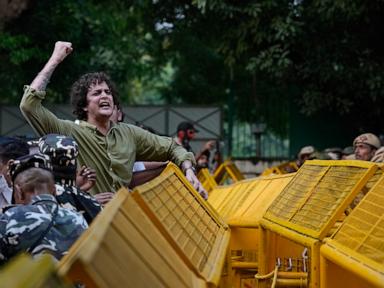
Political mobilization among youth cohorts during periods of structural economic contraction is frequently misread as spontaneous emotional outbursts. Observers often attribute large-scale street protests to ephemeral grievances or sudden escalations of public sentiment. This framing obscures the underlying mechanical drivers. When employment elasticity drops relative to labor market entrants, structural friction emerges between state economic projections and individual upward mobility. Youth mobilization against political incumbents, such as the observed friction involving Indian youth and Prime Minister Narendra Modi, represents the visible output of a constrained optimization problem. Individuals facing suppressed lifetime earnings and prolonged underemployment calculate that the expected utility of public disruption exceeds the expected utility of institutional compliance.
The Structural Mechanics of Demographic Pressure
The primary variable driving political friction is the divergence between labor market absorption capacity and labor force expansion. India operates within a demographic window characterized by a high absolute volume of working-age individuals entering the market annually. However, the composition of economic growth has favored capital-intensive sectors—such as information technology, financial services, and automated manufacturing—over labor-intensive sectors capable of absorbing unskilled or semi-skilled labor at scale.
This asymmetry creates a distinct macroeconomic bottleneck:
- High-Volume Entrants: Millions of graduates exit universities and secondary education systems each year with expectations calibrated to historical growth narratives.
- Low Elasticity of Formal Employment: Net job creation in stable, wage-regulated sectors remains disproportionately low relative to the volume of job seekers.
- Informal Sector Saturation: The informal economy, which historically acted as a shock absorber for surplus labor, faces regulatory tightening and digitalization pressures, reducing its capacity to absorb displaced workers.
When the marginal product of education approaches zero—meaning a degree fails to yield a proportional wage premium—the opportunity cost of participating in street-level political agitation drops toward zero. The individual has little operational capital to lose within the formal economy, lowering the barrier to entry for collective action.
The Cost Function of State-Led Development Models
State-led strategies focused on macroeconomic stabilization, infrastructure capital expenditure, and fiscal consolidation often generate aggregate growth while exacerbating distributional inequities. From a quantitative perspective, Gross Domestic Product expansion driven by capital projects and corporate balance-sheet repair does not automatically translate into median wage growth or widespread employment stability.
The cost function experienced by the youth demographic involves three distinct penalty variables:
- Credentials Inflation: The cost of acquiring higher education has risen faster than entry-level remuneration packages, resulting in negative net present value for many academic investments.
- Underemployment Tax: A significant percentage of university graduates accept positions well below their qualification levels, leading to skill degradation and long-term earnings scarring.
- Information Asymmetry in Recruitment: Public sector examinations and recruitment pipelines frequently suffer from bureaucratic delays, paper leaks, and administrative bottlenecks. These operational failures lock applicants in multi-year holding patterns, extending the window of economic dependency on familial networks.
When administrative processes break down repeatedly, the frustration shifts from specific policy disagreements to systemic legitimacy challenges. The state is no longer evaluated on its long-term vision, but on its immediate transactional competence in fulfilling basic economic contracts.
Information Diffusion and Collective Action Coordination
Mobilization requires overcoming coordination failures. Historically, large-scale political resistance faced high friction due to communication barriers and geographic fragmentation. Digital infrastructure has fundamentally altered this cost-benefit matrix.
The widespread availability of mobile data and social media platforms reduces the marginal cost of organizing collective action to near zero. Grievances that were previously isolated to specific geographic clusters or local academic institutions aggregate rapidly into national narratives.
- Horizontal Networks: Information travels peer-to-peer, bypassing traditional media filters and state-aligned information channels.
- Amplification of Administrative Failures: Incidents of bureaucratic corruption or exam mismanagement are documented, digitized, and broadcast instantly, creating synchronized emotional and intellectual convergence across diverse demographics.
- Decentralized Leadership: Modern movements often operate without a singular hierarchical leadership structure. This structural resilience makes conventional state containment strategies—such as detaining prominent figures or negotiating with designated representatives—ineffective.
Strategic Outlook and Institutional Adaptations
Resolving the structural tensions that drive youth mobilization requires more than rhetorical reassurance or short-term palliative measures. The fundamental challenge is structural economic restructuring to increase labor intensity without sacrificing productivity.
Policymakers face a complex optimization challenge: maintaining macroeconomic stability while accelerating employment generation in sectors that can absorb millions of workers annually. If institutional channels for economic mobility remain blocked, street-level mobilization will persist as a rational, high-visibility mechanism for demographic segments attempting to force systemic recalibration. The durability of political incumbents will depend less on ideological narrative control and more on their capacity to clear the operational bottlenecks choking the entry-level labor market.