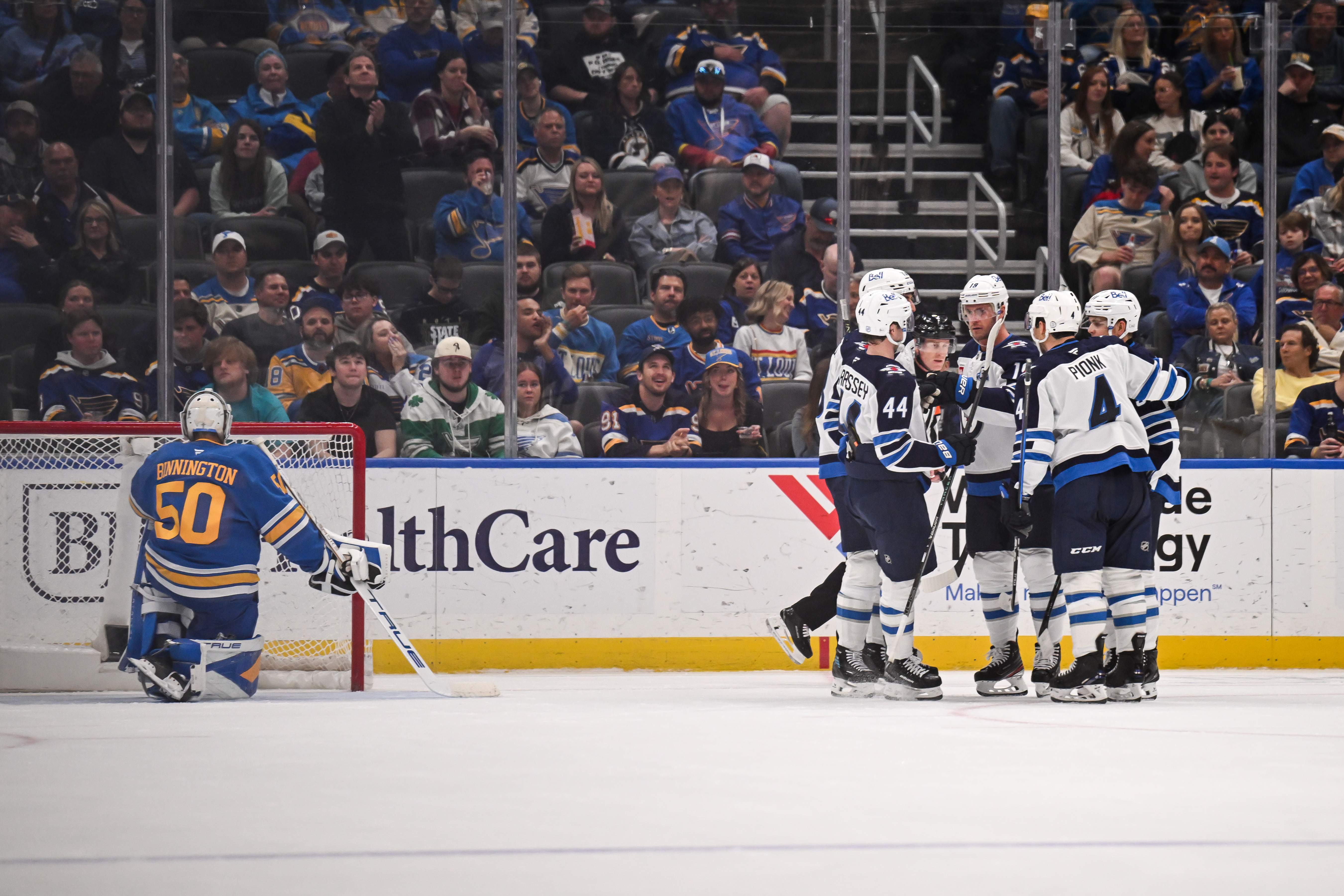
The Winnipeg Jets survived St. Louis with a 3-2 victory that felt more like a stay of execution than a genuine revival. They are currently a team living on a diet of mathematical prayers and statistical anomalies. While the box score credits them with two points in the standings, the reality of their situation remains grim. They are chasing a playoff spot that is moving away from them faster than they can pursue it. Winning in Missouri didn't change the trajectory of their season; it simply delayed the inevitable conversation about what went wrong in the boardroom and on the ice.
The Illusion of Momentum
Hockey culture loves a comeback story. It is easy to look at a gritty road win and claim a "turning point" has been reached. But a closer look at the advanced metrics suggests the Jets are treading water in a deep ocean. They won because of a fortunate bounce and a goaltender who stood on his head, not because they dictated the pace of the game.
When you look at High-Danger Scoring Chances, the Jets are consistently losing the battle in the "inner slot." They are allowing opponents to penetrate the most dangerous areas of the ice while struggling to generate their own sustained pressure. A 3-2 win is a thin margin. It is a razor-thin line between a "gutsy road performance" and another night of being outplayed and bailed out by individual brilliance.
The Central Division Trap
The math is the most brutal opponent the Jets face. The Western Conference, and specifically the Central Division, has become a meat grinder of efficiency. To make the postseason, a team generally needs to hit the 95-point threshold. Winnipeg’s current pace leaves them well short of that mark, requiring a winning percentage over the final stretch of the season that this roster has never proven it can maintain.
The Problem with the Loser Point
The NHL's point system often masks the true health of a team. By rewarding overtime losses, the league keeps teams "in the hunt" long after their pulse has faded. This creates a false sense of security for front offices.
- Winnipeg has relied too heavily on taking games to the extra frame.
- The gap between them and the final wild-card spot is not just three or four points; it is a gap of regulation wins.
- Tiebreakers are rarely in their favor because they struggle to close games out in sixty minutes.
Breakdown of Defensive Structural Failures
The most glaring issue remains the defensive zone exit. Under pressure, the Jets' defensive corps often defaults to "glass and out" hockey. This gives the puck back to the opposition and forces the forwards into a constant state of back-checking. You cannot win a modern Stanley Cup without a mobile back end that can facilitate a clean transition.
Watching the tape from the St. Louis game, it was evident that the Blues' forecheck caused panic. Every time Winnipeg attempted to build a play from their own goal line, the spacing was off. The wingers were too high, the centers were caught in the corners, and the result was a series of turnovers that forced the goaltender to make "save of the year" candidates just to keep the score tied.
The Leadership Vacuum and the Core Contract Problem
Beyond the X's and O's lies the uncomfortable reality of the roster's construction. Several key players are entering the twilight of their prime years with massive cap hits that make flexibility impossible. When the pressure mounts, the body language on the bench often tells a story of frustration rather than resolve.
Veteran journalism requires looking past the post-game quotes. When a captain says, "We just need to stick to our game," you have to ask if "their game" is actually good enough to beat the elite teams in the West. Based on the last forty games, the answer is a resounding no. The core of this team has been together for years, and the ceiling appears to have been reached long ago.
The Cost of the Long Shot
There is a psychological and financial cost to chasing a 5% playoff probability. By refusing to acknowledge the season is lost, the organization risks missing out on the opportunity to sell off expiring assets for draft capital. Every win like the one in St. Louis provides a shot of dopamine to the fan base, but it also reinforces a management philosophy that favors "competitive mediocrity" over a necessary rebuild.
The draft lottery is where franchises are reborn. By finishing in the "mushy middle"—not good enough for the playoffs, but not bad enough for a top-three pick—the Jets are trapping themselves in a cycle of irrelevance. The 3-2 win over the Blues might actually be the worst thing that could have happened to the long-term health of the franchise because it provides an excuse to stand pat at the trade deadline.
Individual Brilliance vs. Team System
Connor Hellebuyck remains the only reason this team isn't at the bottom of the division. His Goals Saved Above Expected (GSAx) is elite, yet again. But asking a goaltender to be perfect every night is not a sustainable strategy. It is a frantic way to live.
$$GSAx = Expected Goals Against - Actual Goals Against$$
When a team’s $GSAx$ is the only reason they stay in the playoff conversation, it indicates a systemic failure. The skaters are not doing their job. They are over-relying on a single point of failure. If Hellebuyck has even one "average" week, the season is officially over.
Scouting the Remaining Schedule
The road ahead is not kind. The Jets face a gauntlet of top-tier Eastern Conference teams and divisional rivals who are fighting for seeding.
- Strength of Schedule: Winnipeg has one of the hardest remaining paths in the league.
- Back-to-Backs: Fatigue will play a major role in the final two weeks.
- Injury Depth: The bottom six forwards lack the scoring punch to mitigate any injuries to the top line.
The Reality of the "Faint Hope"
Journalists often use the term "faint hope" to soften the blow for a local audience. In reality, it is a mathematical graveyard. To leapfrog three teams while those teams also have games in hand requires a collapse of epic proportions from the competition. It isn't just about Winnipeg winning; it’s about a half-dozen other variables falling perfectly into place.
The win in St. Louis didn't move the needle. It didn't solve the power play that has gone cold at the worst possible time. It didn't fix the lack of secondary scoring. It was a localized success in a season-long failure. The fans deserve a team that doesn't just "keep hopes alive" by the skin of its teeth, but a team that commands the ice with a clear, modern identity.
Until the organization addresses the disconnect between its aging core and the speed of the modern game, these small victories will remain exactly what they are: temporary distractions from a looming offseason of difficult, overdue decisions. The clock is ticking on this era of Jets hockey, and no amount of 3-2 wins will reset it.
Stop looking at the scoreboard and start looking at the draft board.