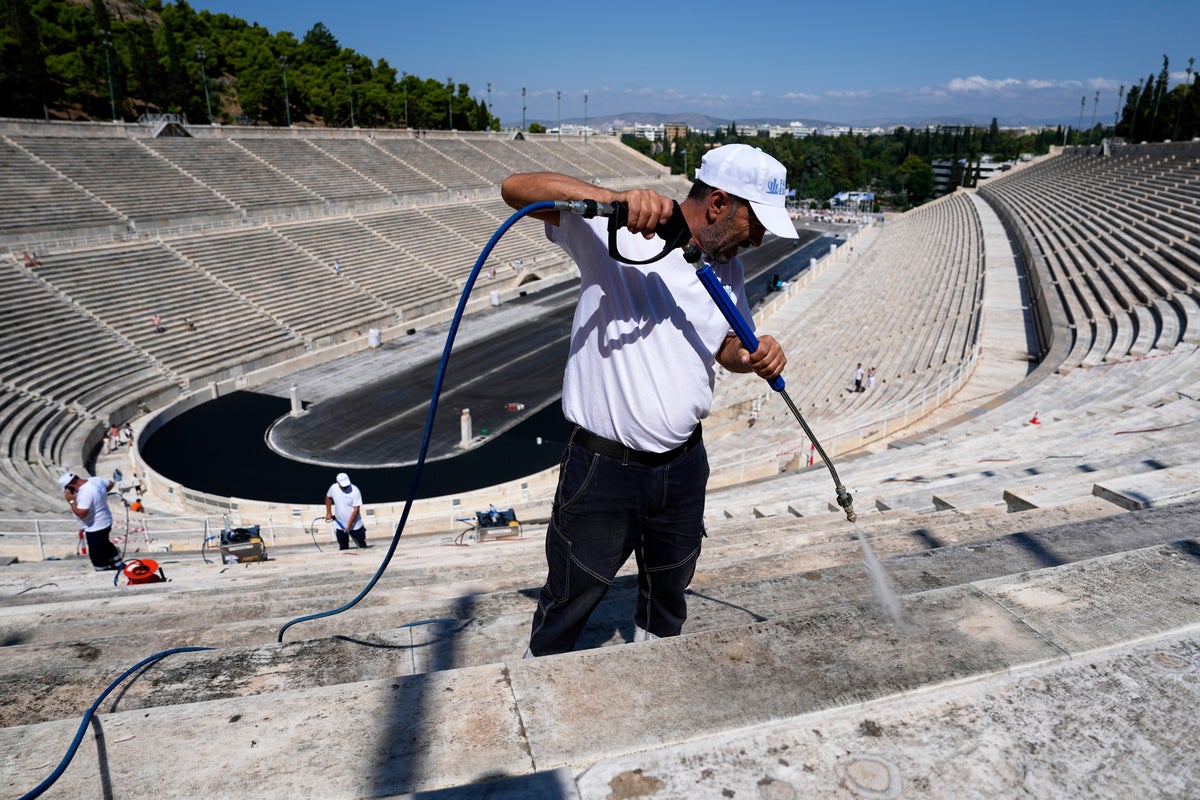
Dust does not merely settle in a century. It settles, it breathes, it marries itself to stone.
Stand in the center of the Panathenaic Stadium on a blistering July afternoon, and you can smell it. It is an ancient, metallic scent born of baked marble, urban exhaust, and the slow, grinding erosion of a hundred winters. For one hundred years, the stadium sat beneath the Attic sun, a blinding white horseshoe of Pentelic marble glowing against the smog of modern Athens. It held the ghosts of 1896, the sweat of the first modern Olympians, and the silent footsteps of Roman spectators who once watched gladiators duel where runners now chase fractions of a second. For an alternative view, read: this related article.
It was dirty. Beautiful, breathtaking, but profoundly filthy.
Panagiotis stands on the scaffolding, high above the curving tiers where kings and paupers once sat side by side. He wears a heavy respirator, his boots caked in a grey paste that was once a pristine mineral crust. When he directs his high-pressure water wand against the weathered stone, a dark scar of pollution—a century of diesel soot, bird droppings, and microscopic grit—dissolves into milky run-off. Related reporting on this trend has been published by Bleacher Report.
"People forget," Panagiotis says, his voice muffled behind rubber and filters, "that marble is alive. It breathes. When you choke it with grime, you suffocate the history inside it."
He is not a poet. He is a conservator. Yet his hands perform surgery on an icon.
The Mountain That Walked to the City
To understand the weight of this cleaning, one must understand the mountain.
Mount Penteli, looming northeast of Athens, bled white for this stadium. Two thousand four hundred years ago, ancient quarrymen drove iron wedges into the heart of the mountain, splitting stone with brute force and iron will to build the Parthenon. Centuries later, in 1895, the same quarries were reopened. A revival of impossible scale took place. Millions of drachmas poured from the pockets of wealthy benefactors like George Averoff to resurrect an ancient stadium buried beneath dirt and weeds.
They hauled thousands of tons of pure Pentelic marble down winding dirt tracks, placing every block by hand, mule, and sheer muscle. When the stadium reopened for the inaugural modern Olympic Games in 1896, it looked like a jagged tooth of pure light dropped into the ravine of Pangrati.
Then came the twentieth century.
Cars choked the surrounding streets. Factory smoke drifted across the city. Acid rain fell from stormy Mediterranean skies, reacting with the calcium carbonate in the marble, eating microscopically into the surface, turning a luminous white finish into a stubborn, yellowish-grey armor of pollution.
For a hundred years, maintenance meant sweeping. A broom here. A garden hose there. It was like trying to clean a stained glass window with a damp handkerchief.
The stadium grew old. Not with the grace of ruins left in a quiet field, but with the indignity of a monument trapped in a roaring, modern metropolis.
The Anatomy of a Bath
The restoration project did not arrive with a grand political fanfare. It crept in through logistics, engineering reports, and quiet determination.
Consider the sheer scale of the challenge. The Panathenaic Stadium—often called the Kallimarmaro, meaning "beautifully marbled"—can hold roughly 50,000 spectators. Every single seat, every stair, every curving wall of the horseshoe is carved from that singular, glowing stone.
When the specialized cleaning crew began their work, they faced a paradox. Use too much pressure, and you pit the stone, stripping away the micro-layer of historical patina and accelerating erosion. Use too little, and you leave the century-old black crust untouched.
Laser technology was deployed in sensitive areas. Yes, lasers. High-frequency beams of light that vaporize pollution particles at a molecular level without ever touching the underlying mineral structure. In other areas, microscopic water-misting systems gently coaxed decades of urban grease from the pores of the marble.
Imagine standing inches from a block of stone that has absorbed the cheers of nineteenth-century spectators, watching a beam of invisible light sweep across its face to reveal a blinding, crystalline white underneath. It is an act of temporal excavation. You are peeling back the decades, stripping away the twentieth century to reveal the nineteenth, which in turn mirrors the fourth century BCE.
As the scaffolding moves, section by section, the stadium seems to wake up. The yellowed haze lifts. Under the midday sun, the stadium no longer looks like an aged relic surviving on past glory. It gleams with a sharp, almost aggressive purity.
Beyond the Clean Stone
There is a temptation to view this as a purely cosmetic endeavor. A municipal polish. A tourist board's dream.
That perspective misses the human core entirely.
Monuments matter because they anchor us in a world that moves too fast. We live in digital echoes, disposable architectures, and glass towers designed to be torn down in forty years. We crave permanence. When a city takes a hundred years of grime off its most sacred athletic shrine, it is making a statement about memory. It is saying that what came before us still matters. It is saying that the sweat of Spyridon Louis—the Greek water-carrier who won the 1896 Olympic marathon and entered this very stadium to the roar of 80,000 delirious fans—deserves a clean stage.
Louis ran through dust and mud in those early days, but the stadium around him was fresh. For generations, visitors have looked at the darkened, soot-stained marble and assumed that was simply what ancient stone looked like. They mistook neglect for antiquity.
Now, the illusion is broken.
The marble is white again. Not the blinding, sterile white of a modern hospital, but a warm, crystalline ivory that catches the pink hues of an Athenian sunset and reflects them back into the sky.
The Runner’s Echo
Late at night, after the tourists have gone and the cleaning crews have powered down their generators, the stadium falls completely silent.
The marble cools in the night air, releasing the heat of the day. If you stand on the running track—the same curving horseshoe where athletes from every corner of the globe still occasionally race—you can hear the wind whistling through the open arches.
The soot is gone. The heavy, suffocating blanket of the twentieth century has been washed away into the drains of Athens. What remains is stone, light, and history, stripped bare and standing tall under the Attic stars.
The stadium has taken its first bath in a century. And in doing so, it has reminded us of a simple, enduring truth: the past is never truly lost. It is only waiting for someone to wash away the dust.