The concrete of modern Lahore does not breathe. It radiates heat, bouncing the screech of rickshaws and the heavy fumes of traffic across streets that grow wider and more sterile by the year. If you walk down Ravi Road, past the timber markets where the scent of freshly cut pine battles the exhaust, you will see a city frantically building its future over the bones of its past.
But if you stop near the old banks of the Ravi River—where the water has long since retreated, leaving behind a ghost of a waterway—you might feel a sudden, inexplicable drop in temperature. It is a trick of the shade, or perhaps something older.
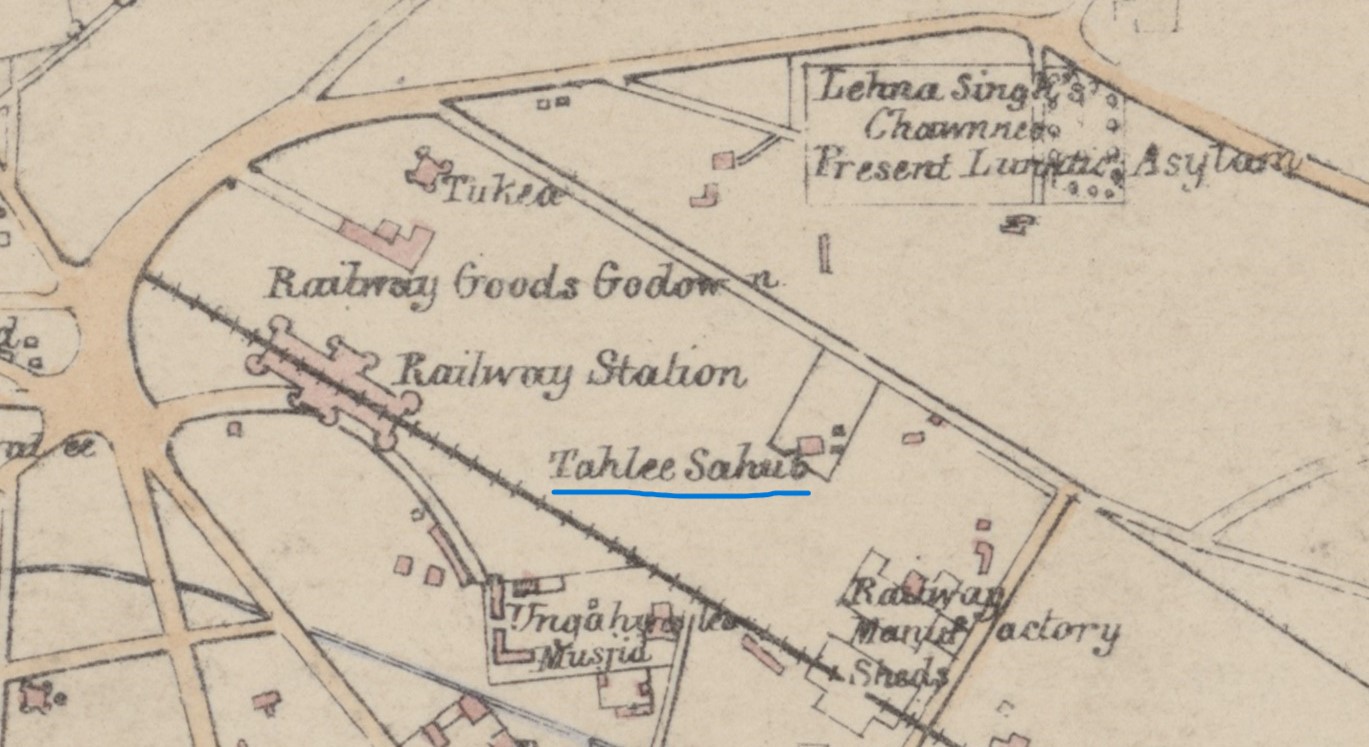
Here stands a gate. Behind it lies Dera Tahli Sahib.
Most people pass it without a glance. To the casual observer, it is just another fragment of old Lahore, a crumbling structure swallowed by urban sprawl. But history is not a collection of dates in a textbook. It is a living, breathing entity that bleeds when we cut it. And right now, a vital piece of our collective soul is bleeding out in the quiet corners of Pakistan.
The Shadow Under the Sheesham
To understand what is fading, you have to understand the tree.
Tahli is the Punjabi word for the sheesham, or Indian rosewood. Generations ago, long before borders were drawn with bleeding ink, a massive tahli tree stood on this ground. It was vast, its canopy offering an umbrella of deep, cool relief from the punishing Punjab sun.
Under this specific tree sat Baba Sri Chand.
He was the eldest son of Guru Nanak, the founder of Sikhism. Sri Chand was an ascetic, a mystic who chose the path of the Udasi—those who renounce worldly attachments to seek the divine. He did not build empires of stone. He sat on the dirt, under the rustling leaves of the sheesham, and meditated.
Imagine him there. The year is somewhere in the sixteenth century. The ground beneath him is damp from the river. The air is clear. Travelers stopping along the trade route do not ask for his credentials or his creed; they simply seek the shade. In that shade, a sanctuary was born. A dera—a dwelling place, a hearth for the soul.
Eventually, the tree withered, as all living things do. But the memory of the peace found beneath it was so profound that people built a shrine around its ghost. They preserved the stump. They erected beautiful, sweeping arches, floral frescoes, and a majestic dome. They turned a natural refuge into an architectural marvel, anchoring the spiritual weight of the Udasi tradition right here in Lahore.
For centuries, Dera Tahli Sahib was alive. The floors were swept daily. The music of devotion echoed off the walls. Strangers were fed.
Then came 1947.
The Day the Keys Were Dropped
We often talk about Partition in terms of political lines and massive population shifts. We talk about millions of people moving west and east. We look at the macro-level trauma, the macro-level tragedy.
But consider a hypothetical man named Gurdial. He is not a king or a politician. He is simply the man whose family looked after Dera Tahli Sahib for three generations.
On an August morning, the air is thick with fear. Smoke rises from the horizon. Gurdial knows he has to leave. He looks at the marble floors he scrubbed every morning. He looks at the frescoed walls, where the painted petals of lilies seem to wilt in the heat. He gathers a few belongings, but he cannot pack a building. He cannot put a sacred tree stump into a suitcase.
He steps outside, locks the heavy wooden doors, and looks at the key in his hand. He passes it to a Muslim neighbor, a friend he has shared tea with for decades.
"Keep it safe," Gurdial says, his voice cracking. "We will be back when the madness passes."
He never came back. The madness never truly passed; it just solidified into bureaucracy.
When the Sikhs left Lahore, they didn't just leave houses and shops. They left their sanctuaries. Dera Tahli Sahib, once a bustling hub of spiritual solace, suddenly found itself on the wrong side of a brand-new border. The music stopped. The incense burned out. The silence that followed was heavy, suffocating, and absolute.
The Slow Violence of Forgetting
Walk into the compound today, and the silence has evolved into something worse: neglect.
The Evacuee Trust Property Board (ETPB) is the government entity tasked with maintaining these abandoned holy sites. But a bureaucracy has no heart. It operates on budgets, paperwork, and shifting political priorities. When resources are scarce, an old shrine tucked away near a timber market falls to the very bottom of the ledger.
The decay does not happen all at once. It is a slow, insidious process.
First, the moisture seeps into the foundations. The plaster begins to blister. Then, the intricate frescoes—painted by master craftsmen who spent months mixing natural pigments to create the perfect indigo and ochre—begin to flake away. They fall to the ground as dust, swept away by the wind or crushed under the boots of trespassers.
Next come the encroachments. When a space is deemed abandoned, the surrounding city treats it like an open wound. Shops press against its outer walls. Debris is piled against the historic brickwork. The sacred space shrinks, suffocating under the weight of commercial indifference.
It is a form of cultural amnesia. By allowing these spaces to rot, we are systematically erasing the multi-faith reality of Punjab’s history. We are rewriting the story of Lahore to make it look as though it was always homogenous, always one-dimensional.
But it wasn't. Lahore was a kaleidoscope. To forget Dera Tahli Sahib is to break one of the mirrors that reflected the city’s true splendor.
The Human Cost of an Empty Room
It is easy to look at a ruined building and feel a detached sort of pity. We see it all the time—old castles, ruined forts, ancient tombs. But Dera Tahli Sahib is different because the longing for it is still alive, carried in the hearts of people who live thousands of miles away.
For the global Sikh and Udasi diaspora, these sites are not mere historical curiosities. They are open wounds.
Imagine a young woman living in Vancouver or Birmingham today. She grows up hearing stories from her grandfather about a beautiful shrine by the Ravi River where the air smelled of wet earth and rosewater. She saves money for years to make a pilgrimage back to her ancestral homeland. She arrives in Lahore, steps off the plane with a heart full of expectation, and navigates her way through the chaos of Ravi Road.
When she finds the site, she does not find a preserved monument of peace.
She finds a locked gate, peeling plaster, and a structure that looks more like a haunted warehouse than a place of God. She stands outside, peering through the cracks in the wood, tears welling in her eyes. The heartbreak of Partition is not a historical event for her. It is happening right now, in real-time, as she watches her grandfather’s memories turn to rubble.
This is the invisible stake. This is what we lose when we let these places die. We lose the ability to heal old wounds. We reinforce the walls of division instead of building bridges out of our shared heritage.
Reclaiming the Shade
There is an alternative.
Reclaiming memory does not mean rebuilding the past exactly as it was; that is impossible. The Ravi River will not flow back to its old banks, and Baba Sri Chand will not sit beneath the sheesham again.
But preservation is an act of defiance. It is a statement that we refuse to let hatred and time dictate what we remember.
In recent years, there have been glimmers of hope across Pakistan. The opening of the Kartarpur Corridor showed that when there is political will, sacred geography can triumph over political hostility. Gurdwaras are being restored. Pilgrims are returning.
Dera Tahli Sahib waits for its turn.
It does not require an astronomical budget to save it. It requires attention. It requires structural stabilization, a clearing away of the encroaching commercial debris, and a recognition that this site belongs to the heritage of all of Punjab, regardless of who holds the keys today.
Imagine the doors swinging open once more. Imagine the plaster stabilized, the remaining fragments of the frescoes protected from the elements. Imagine a small garden planted where the great sheesham once stood, offering shade to the tired workers from the timber market and the travelers who still wander down Ravi Road.
The sun begins to set over Lahore, casting long, dramatic shadows across the bricks of the old dera. The noise of the city intensifies as the evening rush hour peaks. Inside the locked compound, a single leaf falls from a nearby tree, drifting through the twilight before settling quietly onto the cracked, dusty floor where an ancient mystic once taught the world how to sit still.