The wind in Mendoza does not just blow; it hunts. It sweeps down from the snow-capped peaks of the Andes, rushing through the vineyards and kicking up a fine, pale dust that settles over everything. For generations, this dust was just a nuisance, something to be swept off the porch at sundown. But recently, that same dust has started to carry a silent, terrifying weight.
When a virus lives in the shadows of a community, the first sign of its presence is never a headline. It is a sudden, unexplained fever. It is a healthy farmer collapsing in his fields, gasping for air as his lungs mysteriously fill with fluid.
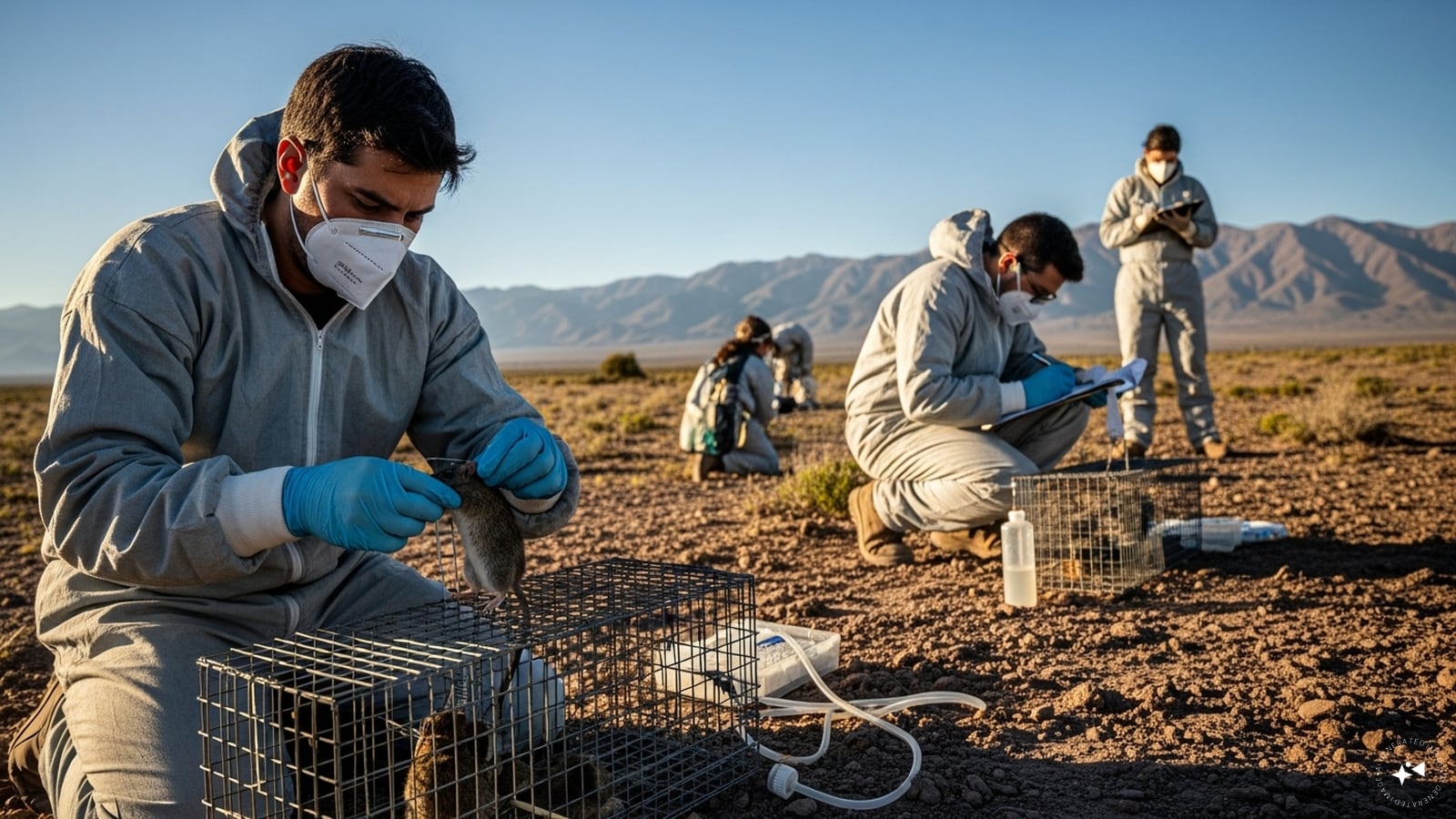
Argentina is currently expanding an aggressive epidemiological probe, dispatching specialized medical teams into the heart of Mendoza. Their mission is straightforward yet perilous: capture and test the local rodent populations. They are hunting for Hantavirus, a pathogen that turns the simple act of breathing into a lethal gamble.
To understand what is happening on the ground right now, we have to look past the clinical data. We have to look at the people who sweep the barns, the families who live where the wilderness meets the suburbs, and the scientists tracking a killer that is practically invisible.
The Invisible Border
Imagine a rural home on the outskirts of the city. Let us call the owner Sofia. She is a hypothetical composite of the people living on this specific frontier, but her daily routine is entirely real. Sofia opens her old tool shed to grab a shovel. The air inside is still, thick, and smells of dry earth and old wood. In the corner, a wild mouse scurries behind a stack of burlap sacks.
Sofia does not think twice. She sweeps the floor, kicking up a small cloud of dust.
That single, mundane movement is the exact moment the trap springs. Hantavirus does not require a bite. It does not require physical contact. The virus is shed in the saliva, urine, and feces of infected rodents—specifically long-tailed pygmy rice rats. When those waste products dry out, they mix with the dirt. When Sofia sweeps, she aerosolizes the virus. She breathes it in.
Within days, the trap snaps shut. The early symptoms mimic a common flu: muscle aches, fatigue, a spiking temperature. But then comes the sudden, terrifying shift. The virus attacks the endothelium, the thin layer of cells lining the blood vessels. They begin to leak. The lungs fill with fluid, mimicking the sensation of drowning from the inside out. This is Hantavirus Pulmonary Syndrome. It carries a mortality rate that hovers around forty percent.
Four out of ten.
Those are the stakes driving the current mobilization in Mendoza. Health officials are not reacting to a massive outbreak yet; they are trying desperately to prevent one. The expansion of the probe means that the threat is no longer contained to the dense, humid forests of the south where Hantavirus is historically notorious. It has found a foothold in the arid, sun-drenched wine country.
Traps in the Dark
The scientists sent into the Mendoza countryside do not wear capes. They wear heavy-duty respirators, thick rubber gloves, and protective coveralls that trap the heat until sweat stings their eyes. Working in the brush, they set special traps designed to capture the rodents alive and unharmed.
Every morning, the teams return to the fields to check the line. Handling a wild rat in these conditions requires a level of focus that leaves the knuckles white. One scratch, one sudden movement that kicks up dried bedding, and the researcher becomes the patient.
They are looking for patterns. Is the virus mutating to spread more easily? Is the rodent population exploding due to recent climate shifts?
For years, the scientific consensus was reassuring: humans were dead-end hosts. You could catch it from a mouse, but you could not pass it to your daughter or your spouse. Then came the 2018 outbreak in Epuyén, a small town in southern Argentina. There, the virus changed the rules. It proved it could jump from human to human through close contact. The town was forced into a strict, agonizing quarantine. Neighbors looked at neighbors with suspicion. A cough became a threat.
The ghost of Epuyén hangs heavily over the current operation in Mendoza. If the virus is expanding its geographic range, authorities must determine exactly which strains are circulating in the local wildlife before the pathogen makes the leap into a crowded urban center.
The Vulnerability of Our Boundaries
It is tempting to view this as a localized crisis, a unique misfortune for rural South America. That is a dangerous mistake. The situation unfolding in Mendoza is a textbook example of a global phenomenon: the fracturing of the buffer zone between humanity and the wild.
When cities expand, orchards push further into the hills, and wilderness is chopped into neat suburban plots, we do not just displace wildlife. We invite them into our spaces. A shed filled with grain is a paradise for a rodent. A cozy crawlspace beneath a house is the perfect refuge from a cold Andean winter night.
We are creating the perfect environment for spillover events.
The true difficulty of managing Hantavirus lies in its sheer randomness. A farmer can clean a barn a thousand times and be perfectly fine. On the thousand and first time, the wind shifts, the dust rises, and life changes forever. This randomness breeds a specific kind of quiet anxiety among the locals. You cannot see the threat. You cannot smell it. You can only respect the dust.
Rewriting the Protocol
Because there is no cure, no magic pill, and no vaccine for Hantavirus, the only real weapon is knowledge. The expanded probe in Mendoza is as much about education as it is about biology.
Teams are moving door-to-door, instructing residents on how to break the chain of transmission. The advice is frustratingly simple, yet it requires a complete overhaul of lifelong habits. Do not sweep dry floors. Wet them down with a bleach solution first to pin the dust to the ground. Wear masks when entering closed spaces. Seal every crack in the walls larger than a coin.
It sounds easy on paper. In practice, it means convincing a tired laborer, coming home after a twelve-hour shift in the vineyards, to meticulously disinfect a shed before grabbing his tools. It requires shifting a culture from passive coexistence with nature to active vigilance.
The medical teams currently checking traps in the Mendoza brush are fighting against time and human nature. They are cataloging blood samples, mapping rodent densities, and watching the hospitals for the first sign of an uptick in respiratory failures. They are trying to build a dam before the river floods.
The Andean wind continues to sweep through the vineyards, carrying the scent of ripening grapes and dry earth. The dust will always be there. But as the teams move through the fields under the vast Argentine sky, the hope is that the dust will eventually lose its teeth, leaving the people of Mendoza to breathe easy once again.