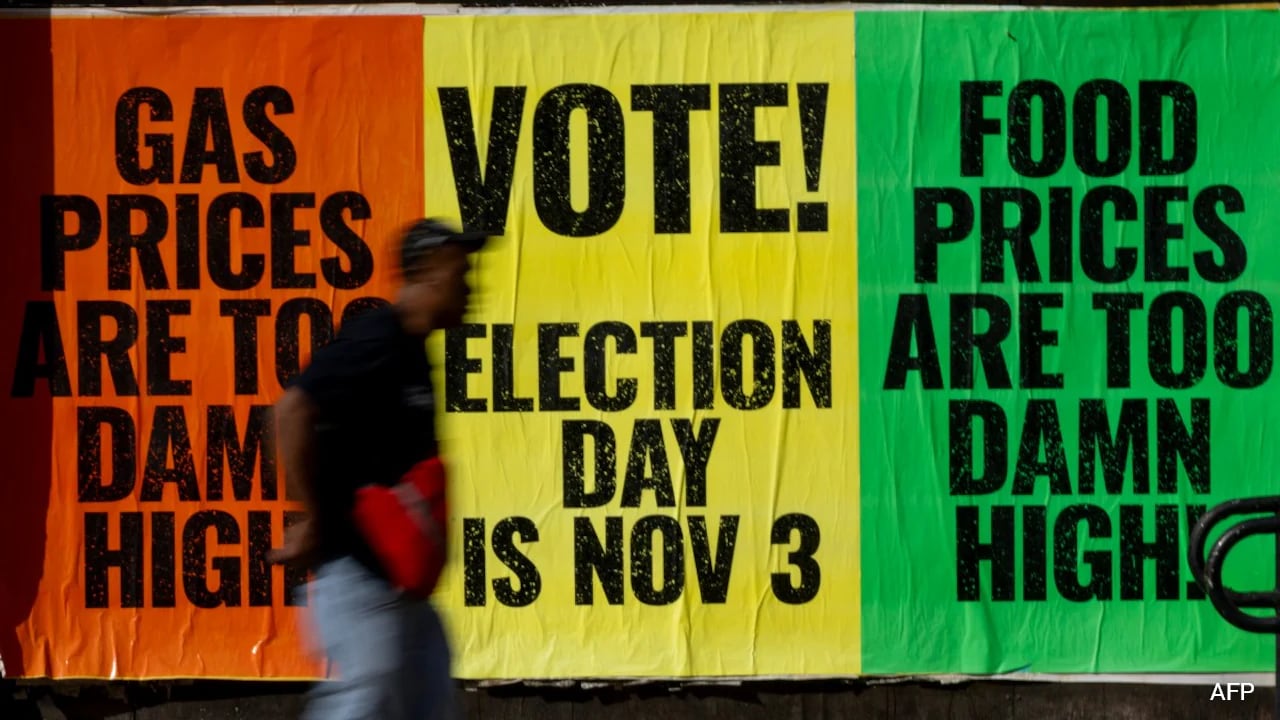
The fluorescent lights in an Ohio high school gymnasium do not flatter anyone, least of all a voter standing in line at six in the morning. You can smell the stale floor wax, the damp wool of autumn coats, and the faint, metallic tang of cold coffee cooling in paper cups. Outside, the November wind rattles the chain-link fences, carrying the last dry leaves across the asphalt.
Inside, people stare at their phones. They are reading the final dispatches from a frantic closing stretch.
In the final hours before the 2026 midterm elections, the headlines blared a familiar cadence. Donald Trump, stepping onto tarmac stages in battleground states during the closing pitch, distilled months of legislative battles, economic anxieties, and cultural friction into five words. "Have to keep America great," he told the crowds, framing the midterm referendum not as a routine check on congressional power, but as an existential defense of his administration's trajectory.
Most news outlets covered those rallies like a box score. They counted the crowd sizes, noted the arrival times of Air Force One, and cataloged the familiar talking points about border enforcement, tariffs, and energy production. They treated the closing pitch as a piece of political theater—loud, predictable, and easy to summarize in a live-blog bullet point.
They missed the quiet part. They missed what happens when a five-word slogan leaves the roar of an airport hangar and lands on the kitchen table of someone who actually has to pay the bills.
The Architecture of a Slogan
To understand why a phrase like "keep America great" carries such combustible energy in a midterm year, you have to strip away the partisan noise and look at the mechanics of human memory. Politics is rarely an audit of spreadsheets. If it were, voters would sit down with a calculator, tally up the Bureau of Labor Statistics reports from the past twenty-four months, cross-reference them against Federal Reserve interest rate adjustments, and cast a dispassionate vote.
Nobody votes with a calculator. We vote with our nervous systems.
Think of a political slogan as a compression algorithm—like a ZIP file for human emotion. A politician cannot stand at a podium and read four hundred pages of tax code revisions or explain the supply-chain logistics of domestic manufacturing incentives. Instead, they compress all of that policy, all of that ambition, and all of that grievance into a single, resonant phrase. When a voter hears it, their brain decompresses the file using their own lived experience.
For one person, those five words decompress into the relief of seeing a new factory break ground twenty miles outside town. For another, standing in the exact same grocery aisle, those same five words decompress into frustration over the price of eggs, insurance premiums, or the deep, unsettling sense that the rules of the country are shifting beneath their feet.
I have spent years covering American elections from the ground up, standing in diners from Pennsylvania to Arizona, watching the gap between what politicians say on stage and what citizens hear in their living rooms. What strikes you every single time is the vulnerability of the voter. People are not stupid, and they are rarely blindly loyal. Mostly, they are tired. They are trying to figure out who is telling them the truth in an information ecosystem designed to keep them perpetually enraged.
When the 2026 midterm campaign reached its final, breathless sprint, the stakes were fundamentally structural. In American politics, the midterm election of a president's second term is historically a brutal reckoning. Dating back to the Civil War, the president's party has almost always lost seats in the House of Representatives during the sixth year of a presidency—a phenomenon political scientists call the "six-year itch."
Consider what happens when a sitting president stares down that kind of historical gravity. You cannot run on abstract promises anymore. You are no longer the outsider knocking on the door; you are the person holding the keys to the house. If the roof is leaking, people look at you.
Two Kitchen Tables, One Ballot
Let us step away from the podiums and look at two hypothetical voters—composite portraits built from real conversations across swing districts—to see how this closing argument actually lands.
Meet Marcus. He is forty-two, a logistics manager in suburban Michigan. Two years ago, Marcus voted for change because he felt squeezed by inflation and invisible to the people running Washington. Today, his 401(k) looks healthier, and his company recently expanded its regional warehouse, hiring thirty new drivers. When Marcus watches the news coverage of the 2026 midterms and hears Trump argue that voters "have to keep America great," Marcus feels a surge of protective instinct. To him, handing the House or Senate over to the opposition means inviting two years of gridlock, subpoenas, and regulatory reversals that could stall the momentum he is finally feeling in his own bank account.
Now, look three miles down the road at Elena. She is thirty-six, a pediatric nurse and a mother of two. Elena does not care about cable news shouting matches. She cares about the fact that her family's healthcare deductible jumped again this autumn, and that the local school board meetings have turned into shouting matches over national culture-war issues that have nothing to do with reading scores. When Elena hears the same closing pitch from the White House, she does not hear stability. She hears triumphalism that does not match her Tuesday afternoon reality. To Elena, a midterm election is not about crowning a king or validating a movement; it is the emergency brake on a train moving too fast without anyone checking the tracks.
Neither Marcus nor Elena is a caricature. Both are acting entirely rationally based on the evidence sitting right in front of them.
This is the invisible tension behind every live-update feed during election week. Journalists love to track the "horse race"—who is up two points in Nevada, which Senate seat in Georgia is within the margin of error, how many millions of dollars in last-minute ad buys flooded the airwaves in Wisconsin. Those numbers are real, and they matter. Control of Congress determines whether judicial confirmations glide through or grind to a halt, whether major spending bills pass or die in committee, and whether the executive branch operates with a blank check or a persistent check-and-balance.
Yet the numbers alone cannot explain the emotional weight inside that voting booth.
The Weight of the Sixth-Year Referendum
Why do midterms feel so much heavier now than they did a generation ago?
Part of the answer lies in how thoroughly national politics has swallowed local life. Thirty years ago, a voter in rural North Carolina or suburban Illinois might split their ticket without blinking—voting for a Republican president while sending a Democrat to the House because that representative secured funding for a local bridge or understood the local agricultural economy.
That world is largely gone. Today, every congressional race is nationalized. A candidate running for a House seat in a district you have never visited is treated as a direct proxy for the president. When Trump stood on stage in the final days of the 2026 cycle and framed the entire ballot around preserving his administration's legacy, he was leaning directly into this reality. He was asking voters to ignore the local resume of the candidates on their ballot and treat the entire election as a single up-or-down vote on his leadership.
It is a high-wire act without a net.
If it works, it turns a traditionally sleepy midterm electorate—which usually skews older, wealthier, and more favorable to the party out of power—into a high-turnout presidential-style wave. It forces base voters who might otherwise stay home during a non-presidential year to treat a November Tuesday with the urgency of a national emergency.
If it fails, it hands the opposition a unified target. Every grievance, every misstep, every controversial tweet or policy hiccup from the past two years gets tied around the neck of every down-ballot candidate wearing the same party label.
Wait. Pause and think about how strange that is.
We have built a system where millions of citizens walk into a booth to choose hundreds of individual lawmakers—people tasked with writing complex legislation, overseeing federal agencies, and representing specific geographic communities—and we have reduced the entire exercise to a referendum on one man's slogan.
I remember standing outside a polling place in suburban Philadelphia during a previous midterm cycle, watching an elderly man lean on his walker for ten minutes before going inside. When he came out, he looked exhausted, almost shaken. I asked him how it went. He looked at the ground, adjusted his cap, and said, "You just hope you didn't break anything."
That sentence has stayed with me for years. You just hope you didn't break anything.
Beneath all the bravado of campaign rallies, beneath the triumphant rhetoric of keeping a nation great or rescuing it from ruin, most ordinary people approach the ballot box with a quiet, humble anxiety. They know the economy is fragile. They know the world outside our borders is volatile. They know that institutions, once damaged, take decades to repair.
What the Live Updates Miss
When you scroll through real-time election coverage, the rhythm is relentless. A rally in one state. A counter-rally in another. Early voting totals trickling in from counties in Florida and Texas. Analysts pointing at interactive maps, zooming in on precincts with names you only hear every two years.
The speed of the coverage creates an illusion of certainty. It makes politics look like a video game where the right combination of demographic turnout and ad spending guarantees a predictable outcome.
The truth is far messier, and far more human.
Elections are decided in the margins—not just the statistical margins of a poll, but the emotional margins of a human life. They are decided when a shift worker decides whether she has the energy to drive to the community center after ten hours on her feet. They are decided when a first-time voter looks at a sample ballot on their phone during a lunch break and realizes they actually have a say in how their town is governed. They are decided when someone who has voted the same way for twenty years pauses, pen hovering over the paper, because something in their gut tells them it is time to send a message.
Trump's final pitch in the 2026 midterms—"have to keep America great"—was engineered precisely for that moment of hesitation. It was designed to reach into the voting booth at the exact second a voter's hand hovers over the oval and whisper: Do not risk what you have. Do not let them turn back the clock.
Meanwhile, across the aisle, the counter-whisper was equally sharp: Look at your life. Look at the division. Use your voice to restore balance.
Both messages tap into one of the oldest instincts in human psychology—loss aversion. Behavioral economists have proven for decades that human beings feel the pain of losing something roughly twice as intensely as the pleasure of gaining something new. Politicians understand this intuitively. You do not win a close election by promising people a shiny new future they cannot quite picture; you win by convincing them that someone is about to take away something they already hold dear.
The Quiet After the Noise
Eventually, the airport hangars empty out. The sound systems are packed into road cases. The private planes lift off into the dark, and the live-update tickers slow to a crawl, waiting for the precinct totals to roll in from the counties where the paper ballots are still being fed into optical scanners one by one.
In that Ohio high school gymnasium, the line finally thins out around seven-thirty in the evening. The volunteer poll workers—mostly retirees who have been awake since four in the morning, fueled by thermos coffee and a stubborn sense of civic duty—sit at folding tables, checking off names in thick binders.
A young man in paint-splattered work boots walks up to the table. He looks nervous, unsure of which line to stand in. An older woman with silver hair and a "First Time Voter" sticker sitting beside her elbow smiles, hands him a privacy sleeve, and points gently toward the curtained booth in the corner.
He steps inside. The curtain pulls shut.
For thirty seconds, the slogans stop. The pundits go quiet. The algorithms lose their grip. There is only the scratch of a felt-tip pen against heavy cardstock, the hum of the fluorescent lights overhead, and the quiet, immense weight of a single citizen deciding what greatness actually looks like.


