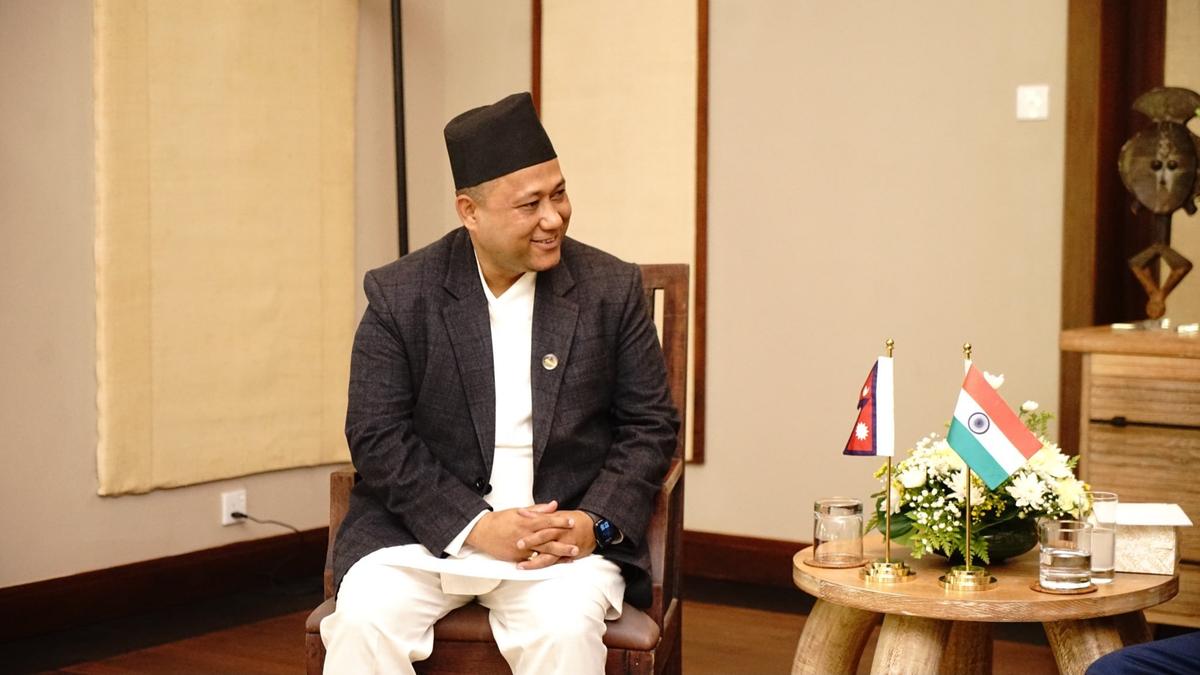
Nepal is currently facing a sharp economic contraction as the 39-day war in West Asia chokes the flow of remittances, the very lifeblood that has sustained the nation’s consumption for decades. Foreign Minister Shishir Khanal, speaking from the sidelines of the Indian Ocean Conference in Port Louis this week, admitted that the landlocked nation is "badly hit" by the regional conflagration. With nearly 2 million Nepali workers stationed across the Gulf and over 40% of the country’s foreign currency earnings tied to these volatile corridors, the conflict has exposed a structural fragility that Kathmandu can no longer ignore.
The immediate math is grim. Economic growth is now projected to plummet to roughly 2.3% for the 2025-26 fiscal year, a staggering drop from the 4.6% seen just a year ago. While the official narrative focuses on "disruptions," the reality is a full-scale freeze of the migration machinery that fuels the domestic economy. If you enjoyed this post, you might want to look at: this related article.
The Fragile Pipeline
For twenty years, Nepal has operated on a simple, dangerous logic: export labor, import cash. This arrangement allowed the country to survive a decade-long civil war, a devastating earthquake, and chronic political instability. But that reliance has now turned into a liability. The current conflict in West Asia is not just a distant geopolitical tremor; it is a direct strike on the Nepali household's wallet.
Around 700,000 Nepalis leave the country every year for foreign employment. Of those, roughly 65% head straight for the Gulf. These workers sent home Rs 1.7 trillion in the last fiscal year alone. To put that in perspective, that is not just "pocket money"—it is the capital that keeps the banks liquid, the real estate market afloat, and the retail sector breathing. When a war breaks out in the Middle East, the first thing to stall is the recruitment of new workers. The second is the ability of those already there to send money through formal channels. For another perspective on this story, see the recent coverage from Forbes.
The Cost of a Single Source
The concentration of labor in a single, conflict-prone geography is a strategic error. When Minister Khanal notes that Nepal is "badly hit," he is referring to the sudden deceleration in new labor permits and the cooling of consumer confidence at home. If the 1.9 million workers currently in the region face even a marginal reduction in wages or safety, the ripple effect hits the streets of Kathmandu within days.
- Gulf Dependency: 41% of all remittances originate from GCC countries.
- Trade Imbalance: Nepal imported Rs 50.31 billion in goods from the Gulf last year, while exporting a mere Rs 3.45 billion.
- Fuel Volatility: As a landlocked nation, Nepal’s transport costs are tethered to global oil prices, which have spiked since the onset of the hostilities.
The Failure of Diversification
Successive governments in Kathmandu have paid lip service to "labor diversification" and "internal job creation." Yet, the numbers show a different story. The economy has remained stuck in a cycle of low productivity and high migration. The manufacturing sector's contribution to GDP continues to dwindle, replaced by a bloated services sector that depends entirely on migrant-funded consumption.
The 2025 unrest, led by a frustrated Gen Z and Alpha generation, was a warning shot. These young people are no longer willing to accept "migration as the only option," yet the domestic industrial base is not ready to absorb them. The current government, led by Prime Minister Balen Shah and featuring technocrats like Shishir Khanal, was elected on a mandate to break this cycle. However, they have inherited an economy that is essentially a hollow shell supported by external wires.
The Invisible Casualties
Beyond the spreadsheets, there is a human cost that the Foreign Ministry is struggling to manage. Millions of Nepalis are currently working in zones that are either active conflict areas or high-risk targets. The government’s ability to evacuate even a fraction of these citizens in a worst-case scenario is practically non-existent. We saw this during the 2023 Israel-Hamas escalation; the panic was palpable, and the logistical response was slow. In a wider West Asian war, the scale would be uncontrollable.
The Myth of Resilient Remittances
There is a common belief among Kathmandu’s elite that remittances are "recession-proof." The theory goes that even in hard times, workers will find a way to send money home. This war is testing that myth. Unlike the 2008 financial crisis or the COVID-19 pandemic, this is a localized physical threat to the infrastructure of the Gulf economies. If the ports close or the construction sites stop, the money stops.
The World Bank’s recent downgrade of Nepal’s growth forecast reflects this reality. The "stay-at-home" economy is failing because it never really existed; it was always an "at-work-abroad" economy. The current slowdown in the services sector—wholesale trade, retail, and real estate—is a direct consequence of families tightening their belts as they wait to see if their sons and daughters in Qatar, Saudi Arabia, and the UAE will keep their jobs.
The Policy Trap
The government’s response has been predictable: call for a ceasefire and hope for the best. But hope is not a fiscal policy. To truly insulate Nepal from the next West Asian crisis, the administration must move beyond emergency statements at international conferences.
The focus must shift to three specific areas:
- Aggressive Energy Export: Capitalizing on the 385 MW added to the grid this year to replace imported fuel with domestic electricity.
- IT and Digital Services: Building a "remote-work" infrastructure that allows Nepalis to export talent without physically crossing borders.
- Agricultural Sovereignty: Reducing the Rs 50 billion import bill by incentivizing large-scale commercial farming in the Terai.
Minister Khanal is right to be worried, but the "war hit" is merely a symptom. The underlying disease is a two-decade-long addiction to easy money from abroad. The 39-day war has merely pulled back the curtain on a nation that has forgotten how to build for itself.
The window for a "soft landing" is closing. As the war in West Asia continues, the flow of cash that built the modern Kathmandu skyline is drying up. The government has the mandate, and for the first time in years, it has the technocratic expertise in the cabinet. What it lacks is time. If Nepal does not pivot toward a production-based economy now, the next regional conflict won't just hit the remittance economy—it will bankrupt the nation.