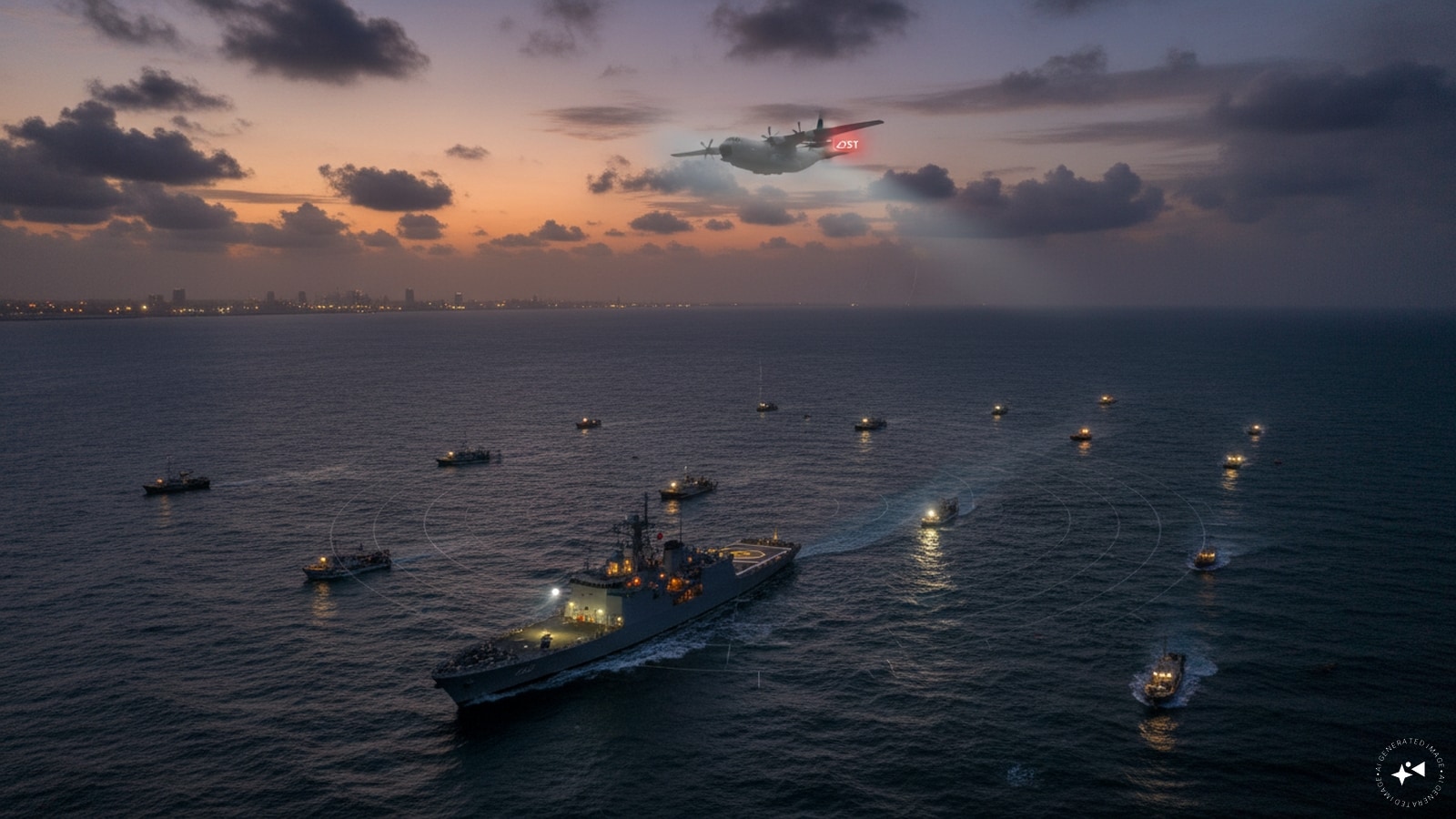
The sea does not care about flight paths. To an aviation radar, the stretch of water cutting into the coast near Karachi is just a set of coordinates, a blank blue void on a screen. But to the families waiting on the shores, and to the rescue crews fighting waves that crash with the force of dropping anvils, that void is an active adversary.
A twin-engine cargo aircraft carrying four crew members vanished from radar over the Arabian Sea. It was a routine flight, the kind of quiet, logistical heartbeat that keeps global commerce moving while the rest of the world sleeps. Then, silence. No distress call. No sudden burst of static over the radio. Just a blip that existed, and then did not.
What follows a disappearance like this is a standard, bureaucratic sequence. Governments issue press releases. Coast guards deploy vessels. Newspapers run cold headers about expanded search parameters. But look closer at the actual mechanics of a maritime search under the assault of a monsoon season, and the story shifts from a technical update to a brutal, human struggle against time and tide.
The Friction of Water
Searching for a downed aircraft in rough seas is nothing like looking for a needle in a haystack. A needle stays where you dropped it. The ocean, however, is a conveyor belt that never stops moving, twisting, and swallowing what it catches.
Consider the physics confronting the Pakistani naval and maritime security teams. When a fuselage impacts water at high speed, it rarely stays intact. It fragments. The heavier components—the engines, the landing gear, the flight data recorders—sink toward the seabed. The lighter debris, along with anything buoyant, floats.
But it does not float in place.
The Arabian Sea during this time of year is governed by aggressive undercurrents and surface winds that slice across the water at thirty knots. Within six hours of an impact, a debris field can scatter across tens of square miles. Within twenty-four hours, that field can distort entirely, pulled in three different directions by conflicting tidal shifts.
The rescue cutters deployed from Karachi are tossing violently, their bows burying into fifteen-foot swells. On board, radar and sonar operators stare at monitors that dance with static. High waves create what mariners call "sea clutter." The crest of every wave reflects radar signals, mimicking the signature of floating debris.
Every metallic glint could be a piece of a wing. Or it could just be the sun hitting a wall of foam.
A Cruel Geometry
To understand the scale of the operation, you have to look at how a search area expands. It is a mathematical nightmare.
On day one, authorities draw a circle around the last known radar position. If that position is certain within a mile, the initial search zone is small. But as the hours tick by, the circle expands exponentially to account for drift.
- Hour 12: The search zone grows to cover an area the size of a major city.
- Hour 36: The zone swells to the size of a small nation.
- Hour 72: The ocean has moved the pieces so far apart that aircraft must fly patterns that take hours just to cross once.
Hovering above this chaos are the spotters in naval helicopters. Their eyes ache. Staring at the shifting, grey-green expanse of the ocean for four hours straight induces a strange kind of hypnosis. The mind plays tricks. A whitecap looks like a life vest. A shadow beneath the surface looks like a hull.
The pilots must fly low enough to see through the haze but high enough to avoid the unpredictable updrafts whipping off the water. The fuel gauges are always ticking down. Every return to base for refueling feels like a betrayal of the men still out there.
The Invisible Stakeholders
Behind the coordinates and the logistical updates are the people who view this tragedy through a completely different lens. For the naval commanders, it is a problem of resource allocation and probability curves. For the families of the four crew members, it is an agonizing suspension of reality.
The maritime shipping lanes outside Karachi continue to churn. Massive container ships pass miles away from the search grids, their crews looking out from high bridges at the distant speck of a navy hull tossing in the surf. Business does not stop. The cargo the missing plane carried was likely meant to connect with a supply chain somewhere down the line, a minor gear in a massive global machine.
But the machine has paused for four families.
There is a specific cruelty to a disappearance at sea. Without wreckage, there is no finality. The mind clings to absurd, beautiful possibilities. Perhaps they managed to ditch safely. Perhaps they are floating on a raft just beyond the line where the helicopters turned back.
The authorities know the math is against them. The survival clock in the open ocean is measured in hours, not days, even if a crew survives the initial impact. Hypothermia, exhaustion, and dehydration are quiet predators. Yet, the search expands. More boats are ordered into the swells. More sonar arrays are lowered into the dark water.
The Horizon Line
The sun dips below the horizon of the Arabian Sea, turning the water from a dull green to a forbidding black. The night does not bring a pause to the work, only a change in tactics. Infrared cameras and searchlights cut through the spray, looking for signatures of heat or reflection that are invisible by day.
The wind shows no signs of relenting. The waves keep building, throwing salt spray high into the superstructure of the rescue vessels, rusting the metal and stinging the eyes of the watchmen.
They will wake up tomorrow and do it again. They will recalculate the drift patterns. They will chart new grids. They will push further out into the deep water, chasing the faint hope that somewhere among the millions of gallons of shifting, angry ocean, something remains to be found.