The sound is not a siren. It is a digital stutter, a frantic, synthesized bleat that cuts through the silence of a Tokyo bedroom at 3:00 AM. It is the J-Alert, and it is designed to bypass the conscious mind, to grab the nervous system by the throat and demand immediate, instinctual action.
For the millions of people who live under the flight path of the northern tensions, this sound does not signify a drill. It signifies the fragility of their existence. It means that somewhere, hundreds of miles away, a machine of steel and fire has been ignited. It means that gravity and trajectory are, for the next ten minutes, the only laws that matter.
We have grown accustomed to the vocabulary of international hostility. We talk about "ballistic missile capabilities" and "geopolitical posturing" as if these were abstract equations written on a dusty chalkboard. We discuss Iran and the United States, the Middle East, the shifting alliances, the drumbeats of war. We look at maps with red lines drawn across them, calculating ranges and potential blast radiuses.
But to look at these events as isolated data points is to miss the human tremor.
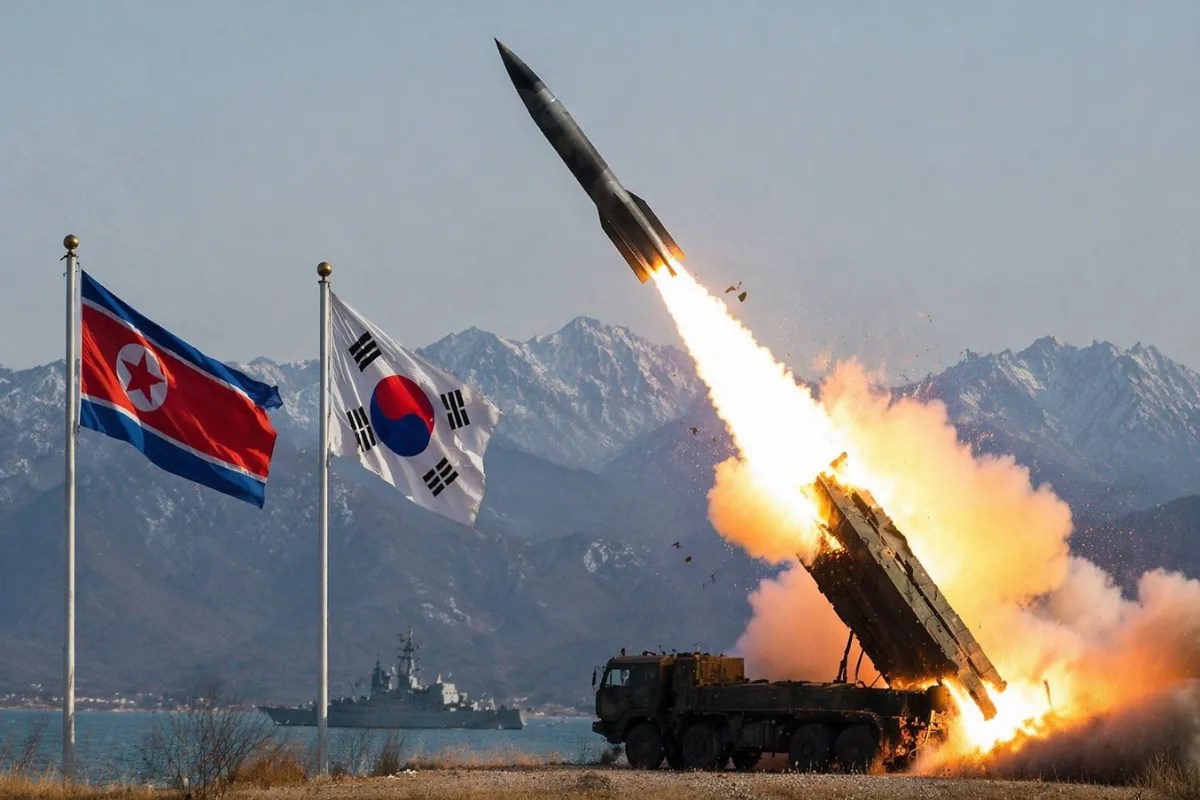
When North Korea fires, they are not merely launching hardware. They are testing the threshold of tolerance. They are conducting a symphony of psychological warfare, orchestrating their notes to harmonize—or clash—with the discord echoing out of the Middle East. Consider the timing. It is never accidental. It is a precise, cynical calculation. When the world’s attention is captured by the high-stakes chess match between Washington and Tehran, when the eyes of the global intelligence community are locked on the Strait of Hormuz or the corridors of power in D.C., the northern regime senses a vacuum.
They strike when the room is distracted.
They know that a singular crisis is a manageable problem for the international order. But two, three, or four crises occurring simultaneously? That stretches the response, dilutes the focus, and breeds a specific kind of paralyzing exhaustion. It is the classic arsonist’s technique: start a small fire in the alleyway so the firefighters are busy when you set the main building ablaze.
Kenji, a salaryman in a crowded ward of Tokyo, doesn't think about global grand strategy when his phone vibrates against his nightstand. He doesn't think about the internal power dynamics of the Workers' Party or the intricate signaling required to extract sanctions relief.
He thinks about his daughter in the next room. He thinks about the subway line he needs to take at 7:00 AM. He thinks about the absurdity of a life lived on the precipice of a sudden, violent, and utterly random ending.
He rises. The air is cold. He checks the screen.
Emergency Warning. Missile launch. Take shelter.
The phrasing is clinical, devoid of empathy. It is the digital equivalent of a shrug from the universe. And in that moment, the geopolitical tension between two distant nations in the Middle East has traveled the curvature of the earth to manifest as a sharp spike of cortisol in a stranger’s bloodstream. This is the interconnected reality of our age. We are not separated by oceans anymore; we are linked by the shared, collective anxiety of the next alert.
The analysts will tell you that this latest launch is a reaction to the shifting sands of global power. They will say it is an attempt to stay relevant, to keep the regime’s seat at the table, to remind the world that they remain a factor in the equation of global security. They will talk about fuel types, re-entry vehicles, and the technical hurdles of miniaturization.
But stripped of the jargon, the reality is far more primitive. It is an act of noise-making. It is the schoolyard bully shouting to ensure that, even while the teachers are busy breaking up a fight on the other side of the playground, he is still the one everyone fears.
There is a profound weariness that settles over a population when the threat becomes the weather. In places like Japan, the missile alert has been integrated into the fabric of daily life, just like typhoon warnings or earthquake drills. There is a terrifying normalization to this. We have built our lives around the potential for our destruction. We check the weather app, we check the train schedule, we check the missile status.
It becomes a ritual. A dark, quiet ritual performed in the pre-dawn darkness.
What does it do to the psyche, this constant, low-frequency hum of impending doom? It creates a form of cognitive dissonance. We go to work. We drink our coffee. We complain about the price of fuel. We argue about the latest viral video. All while carrying the knowledge that a command issued in a bunker thousands of miles away could render everything we are doing—every deadline, every dream, every small, petty frustration—instantly irrelevant.
We have become experts at compartmentalization. We have to be. To live otherwise would be to descend into a state of permanent paralysis. We look at the Iran-US standoff, and we see the potential for a catastrophic rupture in the global order. We look at the missile alerts in Japan, and we see the symptom of a world that has forgotten how to de-escalate.
The danger is not just the explosion. The danger is the erosion of the belief that things can be solved with words.
When diplomacy is treated as a sign of weakness, and when "showing strength" is measured by the length of a trajectory or the destructive yield of a warhead, the distance between conflict and catastrophe shrinks. It becomes a game of chicken played at Mach speed. And the most chilling reality is that the people who hold the keys are rarely the ones who have to pay the price when the doors are blown off their hinges.
The rockets that arc over the Japanese archipelago are fueled by more than liquid propellant. They are fueled by isolation, by grievance, by the perverse desire to prove that no matter how much chaos erupts in the West, the East can always command the spotlight. It is a tragic, repetitive cycle.
Yet, there is a defiance in the routine. When the all-clear sounds—the second, less frantic tone that tells Kenji the threat has passed for now—he does not run into the streets to celebrate. He does not weep. He sighs, puts his phone back on the nightstand, and tries to close his eyes. He has to be up in four hours. The trains will run. The office lights will flick on. The world will continue to spin on its axis, indifferent to the games played by men in bunkers.
There is a stoicism in this refusal to be terrified.
We live in a world where the sirens are always ready to sound, where the alerts are always a push notification away. We watch the chess pieces move on the board of the Middle East, and we feel the vibrations beneath our feet from the testing grounds of the north. We recognize that we are not the players. We are the board.
But even a board can hold its shape. Even a board can endure.
The sun will rise over Tokyo in a few hours. The morning commute will begin. People will board the trains, clutching their bags, staring at their screens, united by a secret, shared knowledge of how fragile the morning really is. They will walk under the same sky, breathing the same air, their hearts beating in the rhythm of a fragile, suspended peace.
They will move forward. They always do. Not because the danger has passed, but because they have learned that to wait for the danger to vanish is to never live at all. They carry the weight of the quiet sky, a burden heavy as iron, yet they walk upright, ignoring the siren’s call to break, choosing instead to witness the sunrise, one more time, as if the dawn were a promise they intended to keep.