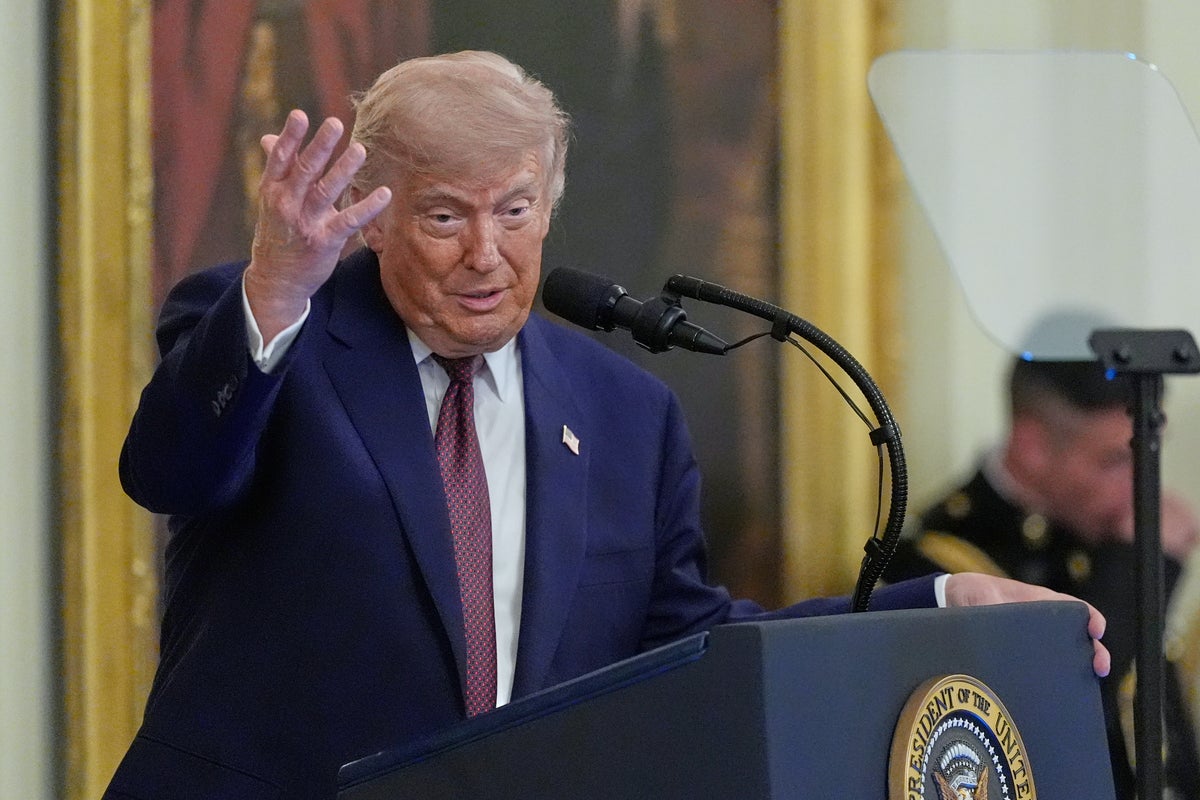
The East Room of the White House possesses a specific kind of silence. It is not the empty quiet of an abandoned building, but a dense, pressurized stillness born from centuries of heavy decisions. Beneath the glittering crystal chandeliers, the air feels thick. On this afternoon, that silence was occupied by a collision of worlds: the raw, timeless valor of the battlefield meeting the sharp, fast-paced machinery of modern American politics.
Donald Trump stepped to the podium. The occasion was the presentation of the Medal of Honor, the highest military decoration the nation can bestow. It is an award meant to transcend politics, a moment where the entire country stops to look at an individual who stared into the mouth of hell and refused to blink. Yet, as the ceremony unfolded, the boundaries between sacred military tradition, economic messaging, and political defense began to blur.
To understand the friction in the room, one must understand what the Medal of Honor demands. It requires an action so distinct, so selfless, that it alters the course of a battle or saves lives at the risk of one’s own. The people receiving it often describe a strange detachment during those fateful seconds. They were not thinking of grand strategies, gross domestic product, or cabinet appointments. They were thinking of the person to their left and the person to their right.
But a president wears many hats simultaneously. He is the Commander-in-Chief, but he is also the chief architect of national morale and the head of a political party.
The transition happened quickly. Between honoring the extraordinary actions of the day's recipients, the speech shifted toward the broader state of the nation. The economy became a central pillar of the address. Numbers were cited. Trends were highlighted. The message was clear: a strong military relies on a booming nation, and the administration wanted the world to know that the engine of American prosperity was firing on all cylinders.
For a moment, the focus drifted from the muddy ridges of distant battlefields to the neon glow of stock tickers and factory floors. The juxtaposition was striking. On one hand, the ultimate sacrifice, paid in blood and youth. On the other, the material metrics of national success.
Then came the mention of Pete Hegseth.
Hegseth, the combat veteran and prominent media figure tapped for leadership within the defense apparatus, has found himself at the center of intense public scrutiny and political battles. His name entering the room changed the energy. The president used the platform to offer a fierce defense of his nominee, weaving Hegseth’s military background and ideological alignment into the larger story of American renewal.
In doing so, the ceremony became a mirror of the current American moment. It was no longer just a retrospective look at individual heroism. It became a living, breathing political event, utilizing the immense moral authority of the Medal of Honor to anchor contemporary political fights and economic theories.
This blending of the sacred and the political is not entirely new, but the intensity has reached a different pitch. For the families of the veterans in attendance, the day remains entirely about a loved one's legacy. For the political observers watching from the back rows, it was a masterclass in narrative control.
The medal itself is surprisingly small. It hangs from a light blue ribbon dotted with white stars. When it is placed around a recipient's neck, the metal makes a faint clinking sound against their uniform buttons. That tiny sound is the only acoustic marker of a legacy that will outlive everyone currently occupying the White House.
When the applause finally faded and the room cleared, the heavy chandeliers remained, reflecting nothing but the quiet geometry of an empty floor. The politics of the day will inevitably shift, replaced by new debates, new economic numbers, and new personnel battles. But the blue ribbon remains constant, a quiet reminder of what happens when the abstract concept of duty becomes a physical reality.


