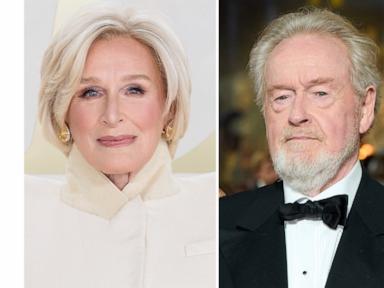
Eight times.
Say it out loud. Eight times she sat in a velvet seat inside a cavernous Los Angeles theater, wrapped in silk that cost more than a mid-sized sedan, forcing a smile for a camera lens hovering three inches from her left cheekbone while someone else’s name was read from an envelope. Eight times Glenn Close applauded with grace, stood up at the after-party, and answered the exact same question from reporters holding microphones like weapons: How does it feel to be the bridesmaid again? Recently making headlines lately: Why the 2026 Rock & Roll Hall of Fame Red Carpet Was Actually a Corporate Funeral.
And four times—or five, depending on whether you count the Best Picture envelope he held when Gladiator won while he stood behind the podium without a personal statue—Ridley Scott watched younger directors take home the brass-and-gold man for shaping worlds that only existed because Scott had built the blueprint twenty years earlier.
Now, the Academy of Motion Picture Arts and Sciences has announced that both of them will receive Honorary Oscars at the upcoming Governors Awards. More information regarding the matter are covered by IGN.
On paper, this looks like a routine press release. A tidy piece of Hollywood housekeeping. Two titans get their overdue flowers in a ballroom off Hollywood Boulevard, far away from the televised chaos of the main Oscar broadcast in March. If you read the standard trade announcements, you get the dates, the board’s statement about "extraordinary distinction in lifetime achievement," and a polite list of credits. You get the facts, drained of all blood.
Look closer, though. Beneath the polite applause of the Governors Awards lies one of cinema’s strangest, most painful paradoxes—a quiet tug-of-war between the art people actually remember fifty years later and the politics of a voting body that routinely mistakes novelty for greatness.
The Anatomy of the Near-Miss
To understand why this specific announcement hits a nerve, you have to understand the particular kind of humiliation that comes with being a perennial nominee.
Imagine—and let us be clear, this is a hypothetical composite drawn from decades of awards-season reality—a veteran stage actor sitting in a dressing room at the Dorothy Chandler Pavilion in 1989. Let’s call him Arthur. Arthur has spent thirty years learning how to hold a room silent with nothing more than a shift in his posture. He is nominated for a performance that required six months of emotional excavation. Across the aisle sits a twenty-six-year-old pop star who made his film debut six months ago playing a charming version of himself. When the envelope opens, the pop star wins because the voters wanted to feel young, or because the studio spent four million dollars on full-page ads in Variety, or simply because everyone assumed Arthur would "have plenty of other chances."
Except the chances eventually run out.
That hypothetical scenario isn't a stretch; it is the exact statistical reality Glenn Close has lived inside for over four decades. Her streak began in 1983 with The World According to Garp, followed in rapid succession by The Big Chill and The Natural. Three nominations in three years. At the time, the industry consensus was obvious: she was Meryl Streep’s primary rival, an inevitable future multi-winner.
Then came 1987 and Fatal Attraction. Alex Forrest wasn’t just a character; she became a cultural noun. You couldn't turn on a television, read a newspaper, or sit in a diner without hearing people argue about that kitchen scene. Close played a woman unraveling with such terrifying, unvarnished ferocity that audiences flinched in their seats. She lost to Cher in Moonstruck.
A year later, she delivered the Marquise de Merteuil in Dangerous Liaisons, a performance built on micro-expressions—a flicker of the eyelid, a tightening of the jaw that spoke volumes about aristocratic rot. She lost to Jodie Foster in The Accused. Decades later, she came back with Albert Nobbs, The Wife, and Hillbilly Elegy. In 2019, after sweeping the Golden Globes, the SAG Awards, and the Critics' Choice Awards for The Wife, the entire industry treated her Oscar win as a mathematical certainty. Her speech was written. Her family was flown in. When Olivia Colman’s name was called instead for The Favourite, the audible gasp inside the Dolby Theatre wasn’t an indictment of Colman—who was brilliant—it was the sound of three thousand people realizing they had just watched an institutional blind spot play out in real time.
Tied with the late Peter O'Toole for the most acting nominations without a competitive win, Close became the reluctant face of Oscar fallibility. Every time she appeared on a red carpet, the conversation wasn't about her craft; it was about her drought. The trophy, meant to honor the work, had turned into a scoreboard that made her career look incomplete.
The Architect Who Never Got the Keys
Ridley Scott’s relationship with the Academy runs along a parallel, equally baffling track, though Scott has always worn his indifference like a tailored Savile Row suit.
When you walk through any modern multiplex today, you are walking inside Ridley Scott’s imagination. The rain-slicked, neon-choked dystopia of Blade Runner (1982) didn't just influence science fiction; it rewired industrial design, video game aesthetics, and urban architecture for forty years. Alien (1979) took a haunted-house slasher plot, bolted it onto a blue-collar space freighter, and gave cinema Ellen Ripley—proving that an action hero didn't need bulging biceps, just grit and survival instinct. Thelma & Louise (1991) detonated the road-movie genre. Gladiator (2000) resurrected the historical epic from a thirty-year grave.
Yet when you look at the Academy’s record on Scott, the math doesn't make sense.
He wasn't even nominated for Best Director for Alien or Blade Runner. Both films were treated upon release as genre exercises—too dark, too weird, too commercial for the taste-makers of the late seventies and early eighties. By the time the Academy realized those two movies were masterpieces, the voting window had closed. He finally earned directing nominations for Thelma & Louise, Gladiator, and Black Hawk Down, losing each time—to Jonathan Demme, Steven Soderbergh, and Ron Howard, respectively.
There is a specific reason directors like Scott get overlooked in competitive voting, and it comes down to a fundamental misunderstanding of what directing actually looks like. Voters love visible effort. They love actors who gain sixty pounds, or directors who shoot a single continuous take in a trench while screaming through a megaphone. Scott operates like a general commanding an army from a tent on a hill. He shoots with multiple cameras simultaneously, moves at a blistering pace that terrifies studio executives, and rarely goes over budget. Because he makes monumental filmmaking look effortless—and because he refuses to campaign for votes by kissing hands at Beverly Hills luncheons—voters historically took him for granted. They treated him like a force of nature rather than an artist making thousands of agonizing micro-decisions every day on set.
Why the Governors Awards Exist at All
To understand what happens when Close and Scott walk onto that stage, we have to look at why the Governors Awards were separated from the main Oscar ceremony in the first place.
For decades, Honorary Oscars were handed out during the live March telecast. On paper, that sounded respectful. In practice, it was often brutal. The producers of the live show, perpetually terrified of running past the three-hour mark and losing East Coast viewers, treated the lifetime achievement segments like commercial interruptions. Legends in their eighties were given ninety seconds to summarize sixty years of blood, sweat, and sacrifice before the orchestra conductor started waving his baton to play them off the stage.
I remember watching broadcasts from the late nineties where giants of the medium—men and women who had built the studios from dirt—looked rushed, confused by the teleprompter, and visibly hurt by the impatience humming from the front rows. It was embarrassing to watch. You could feel the cold transactional air of television ratings overriding basic human dignity.
In 2009, the Academy’s Board of Governors finally admitted the obvious: you cannot compress a human life into a soundbite between a pharmaceutical commercial and a song-and-dance number. They moved the Honorary Oscars to a private, non-televised dinner at the Ray Dolby Ballroom in November.
The change transformed the night instantly. Without the pressure of live television clocks, the room slows down. Peers get up to speak for ten or fifteen minutes without anyone cutting them off. The recipients don't have to worry about thanking their publicist before the music swells. When Peter O'Toole accepted his Honorary Oscar in 2003—initially resisting it because he wanted to "win the lovely bugger outright" before realizing he was being offered an honor, not a consolation prize—he gave a speech of such dry, devastating wit that it overshadowed the competitive winners of that entire year.
That is the room Glenn Close and Ridley Scott are walking into. Not a pity party. Not an apology tour. It is the one night of the year when Hollywood drops the horse-race mentality and actually looks at the body of work sitting in front of it.
The Trap of the "Consolation Prize" Narrative
Still, let’s be honest about the discomfort lingering beneath the headlines. Whenever an Honorary Oscar goes to someone with Close’s nomination count or Scott’s cultural footprint, a cynical murmur ripples through film circles: Is this just an admission of guilt?
It is a fair question, and pretending otherwise would be dishonest. The Academy has a long, documented history of using the Honorary statuette as an eraser for past mistakes.
Consider Alfred Hitchcock, who was nominated five times for Best Director—for Rebecca, Lifeboat, Spellbound, Rear Window, and Psycho—and never won a competitive Oscar. When he finally received the Irving G. Thalberg Memorial Award in 1968, he walked to the podium, looked out at the people who had passed him over for decades, and delivered the shortest, sharpest acceptance speech in history: "Thank you." Then he walked off. Five words. Every single syllable carried forty years of quiet fury.
Think of Deborah Kerr, nominated six times without a win before receiving an honorary statuette in 1994. Think of Spike Lee, whose Do the Right Thing wasn't even nominated for Best Picture in 1989—the year Driving Miss Daisy won—who finally stood on the Governors Awards stage in 2015 to accept an honorary gold statue while reminding the room that Hollywood still hadn't fixed its foundational blind spots.
When you look at that lineage, it is easy to view the Honorary Oscar as a consolation trophy—a participation ribbon dipped in 24-karat gold.
But that reading misses what actually endures in cinema. Nobody remembers who won Best Picture in 1982 (Gandhi), except film trivia buffs. Everyone on earth knows Blade Runner. Few people casually rewatch the films that beat Glenn Close in the eighties, yet Fatal Attraction and Dangerous Liaisons remain masterclasses taught in every acting conservatory from New York to London.
A competitive Oscar measures the temperature of a single winter. It captures momentum, studio marketing budgets, geopolitical moods, and personal popularity during a six-week voting window between January and February. An Honorary Oscar measures permanence. It is the Academy’s way of saying that the work survived the weather.
What We Actually See When We Look at Them
Strip away the industry politics, the nomination tallies, and the breathless speculation about whether Glenn Close might still win a competitive statue next year or the year after. Look instead at the sheer physical toll of what these two people have done to put images on a screen.
Close is seventy-nine years old. She grew up in a deeply insular religious group—Moral Re-Armament—spending her childhood and early twenties in Switzerland and across America before breaking away at twenty-two to study theater at William & Mary. That background isn't trivia; it is the engine of her art. When you spend your formative years learning how to suppress every raw impulse to fit into a rigid social order, you develop an x-ray vision for human repression. Every great Glenn Close performance is a study of what happens when a carefully constructed mask finally cracks. You see it in the way she holds her spine rigid in The Wife while her husband takes credit for her life's work, and you see it in the terrifying vulnerability she brought to Norma Desmond on Broadway, singing until her voice felt like it might tear loose from her throat.
Scott is eighty-eight. While most people his age are sorting through photo albums or complaining about their knees, he is still standing on muddy soundstages in the rain at five in the morning, barking instructions through a headset while operating four cameras at once. Trained as a graphic designer and set decorator at the Royal College of Art in London, Scott never learned how to separate story from visual atmosphere. To him, the rust on a spaceship hull or the dust motes floating through a shaft of sunlight in ancient Rome aren't background decoration—they are the plot. He has directed nearly thirty feature films, launched franchises that generated billions of dollars, and mentored generations of visual effects artists, production designers, and cinematographers who learned their craft simply by trying to keep up with his relentless pace.
Neither of them needed a piece of metal to validate those decades. Close has three Tonys, three Emmys, and a place in the cultural bloodstream that no statuette can expand. Scott has a knighthood from Queen Elizabeth II and a visual vocabulary that defines modern filmmaking.
Yet anyone who tells you the Oscar doesn't matter at all is lying.
There is a reason actors who swear they don't care about awards still weep uncontrollably when they hold one. In an industry built on rejection, ephemerality, and ruthless amnesia—where your last box-office weekend erases thirty years of goodwill—that gold figure is the closest thing Hollywood has to a permanent marker. It says: You were here. You moved the needle. We saw it.
The Quiet Room in November
Picture the scene this November when the lights dim inside the ballroom.
There won't be a red carpet frenzy of fifty million viewers watching at home. There won't be a comedian roasting the front row or a countdown clock flashing red on a monitor at the foot of the stage. Just four hundred peers—writers, grips, editors, actors, directors—sitting at round tables with white tablecloths, glasses of wine half-empty, listening to two people who refused to quit when the door didn't open the first, second, or eighth time.
Glenn Close will walk up those steps, take the statuette in both hands, and feel its surprising weight—eight and a half pounds of solid britannia metal plated in gold, heavier than it ever looks on television. Ridley Scott will take his, likely offering a dry, unsentimental remark before stepping back to let the work speak for itself.
For once, nobody will ask them how it feels to lose. Nobody will compare them to the person sitting three rows behind them. The scoreboard will finally be turned off, leaving only the two things that ever mattered in the dark of a movie theater: a human face holding a secret, and a frame of light cutting through the shadow.