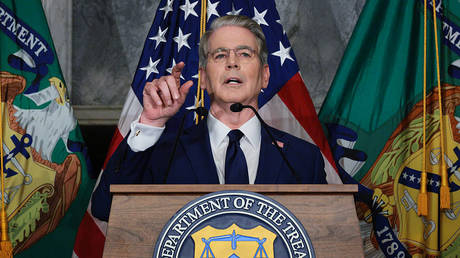
Economic warfare rarely starts with a gunshot. More often, it begins in a sterile conference room in Washington where officials draw lines across global trade maps. Treasury Secretary Scott Bessent just rolled out what the White House calls "Operation Economic Outcast," a sweeping package of secondary sanctions targeting five critical sectors of Iran's economy. If you thought previous restriction campaigns were tough, this new push is designed to squeeze every remaining drop of oxygen out of Tehran's financial networks.
The strategy relies on a blunt threat. Foreign companies, banks, or intermediaries that help the Iranian government move money or evade restrictions are now staring down total exclusion from the U.S. dollar system. With the conflict entering its sixth month, Washington is shifting focus away from direct military escalation and toward financial asphyxiation. For a deeper dive into this area, we suggest: this related article.
Inside Operation Economic Outcast
The newly announced measures do not just recycle old playbooks. The Treasury Department has formally targeted five specific sectors that keep the Iranian regime afloat: digital assets, technology, gold, aviation, and shipping.
Cryptocurrency networks used by internal security forces and gold imports used to prop up a plummeting currency are right in the crosshairs. The Iranian rial recently slumped past two million to the dollar, and inflation continues to ravage domestic purchasing power. By going after the aviation and shipping networks that handle black-market trade, Washington aims to shut down the shadow channels that have historically bypassed blockades. For additional context on this topic, in-depth coverage is available on The New York Times.
Nearly sixty entities, individuals, and vessels have been added to the blacklist. But the real teeth of the announcement lie in its secondary nature. The policy targets third-party nations and foreign firms that continue doing business with Tehran.
The Pressure on Global Intermediaries
Enforcement is where past economic strategies usually stumble. China, India, Turkey, and various Gulf states have long served as economic conduits for Iranian petroleum and goods. Previous administrations often hesitated to penalize major foreign financial institutions for fear of triggering global market chaos.
Bessent acknowledged this delicate balance, noting that the administration wants to give international partners a window to alter their behavior rather than immediately breaking the global financial architecture. Yet, the warning is explicit. Entities caught laundering money or processing illicit transactions for Iran will find themselves cut off from dollar-denominated assets.
The clock is ticking for international enablers. President Donald Trump's administration is actively calling world leaders to demand an absolute halt to commercial interactions with the regime. Countries that refuse to comply risk sharing in Tehran's total isolation.
Tehran's Response and the Domestic Reality
Tehran has largely dismissed the latest wave of measures as political theater. Iranian officials argue that decades of prior embargoes have already forced the country to adapt. With the Strait of Hormuz effectively restricted and a naval blockade choking maritime exports, the domestic economic landscape remains grim.
Iranian leadership faces a stark bifurcation. Proponents of a hardline stance vow to resist foreign dictates, while internal pressures mount over shortages and skyrocketing costs of basic goods. The administration in Washington insists that Tehran must choose between complete subsistence isolation or structural compliance that permits a return to normal global trade.
As the midterm elections approach in the United States, the success of this strategy remains an open question. Financial blockades take time to yield political results, and determined trading partners often find creative ways around compliance. What is clear is that the threshold for participating in Iran's economy has become prohibitively expensive for any enterprise reliant on Western markets.