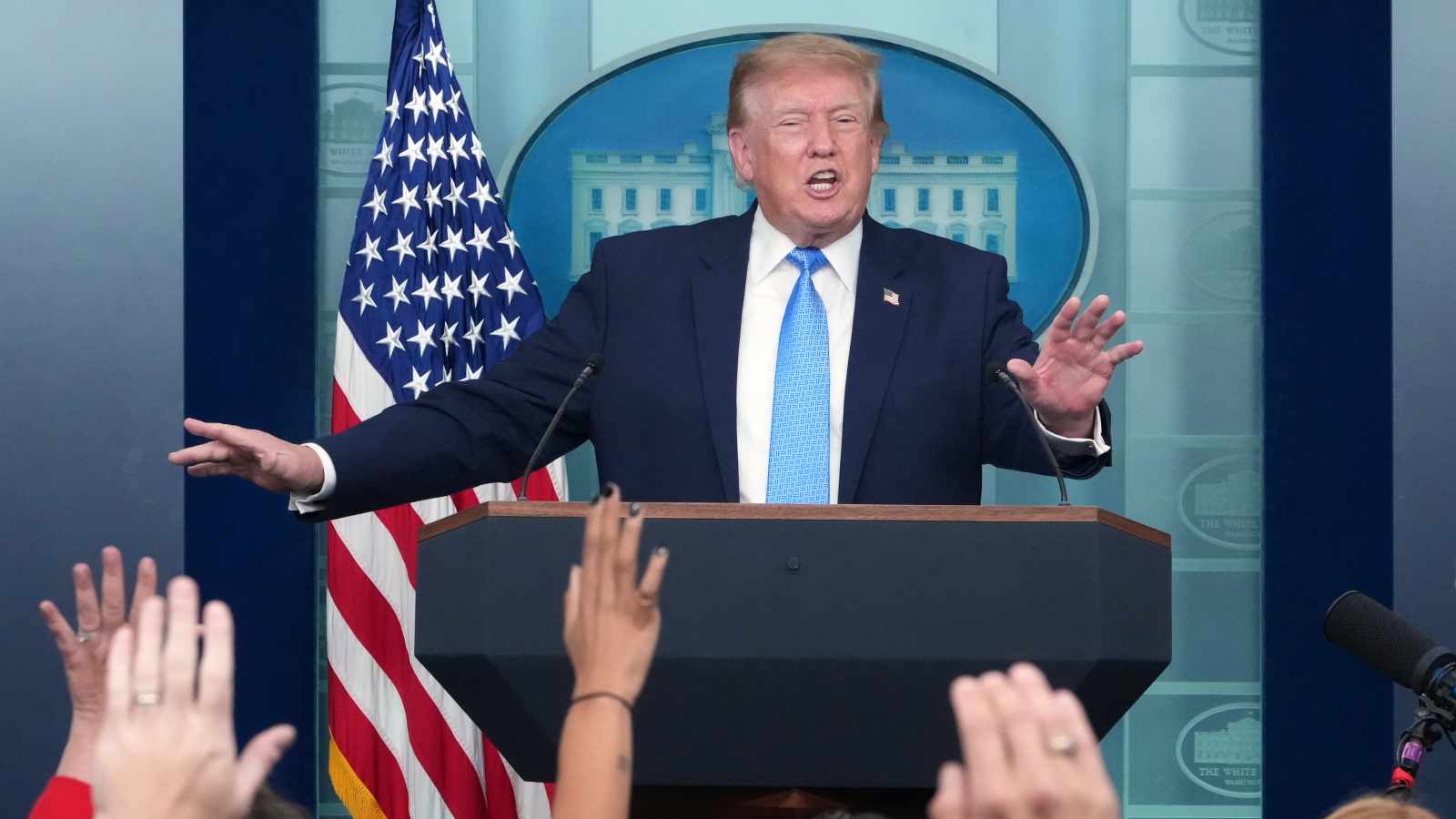
President Donald Trump has declared that the military conflict with Iran is "effectively over," framing recent American operations as a decisive success that has neutralized Tehran's immediate offensive capabilities. Simultaneously, Iranian leadership has rejected any notion of defeat, publicly demanding that the United States "surrender" to its specific geopolitical and economic conditions before hostilities can formally cease. This stark divergence between Washington's victory lap and Tehran's maximalist demands reveals a dangerous diplomatic stalemate where both sides are manufacturing contradictory realities for domestic survival.
The headlines capture the immediate rhetoric, yet they miss the structural mechanics driving this standoff. When two adversaries simultaneously claim victory and demand capitulation, the conflict has not ended. It has merely shifted from conventional kinetic exchanges to a war of attrition, economic strangulation, and strategic messaging.
The Anatomy of Contradictory Declarations
In geopolitical conflicts, the end of active bombing runs rarely equates to the end of the war. President Trump’s assertion that the conflict is "effectively over" relies on a narrow, tactical definition of success. From the perspective of the White House and the Pentagon, the primary objectives—degrading specific military infrastructure, disrupting immediate proxy supply lines, and demonstrating overwhelming conventional superiority without committing ground troops—have been achieved. By declaring the operation complete, Washington attempts to dictate the terms of the narrative, signal stability to global energy markets, and reassure a domestic electorate wary of protracted Middle Eastern entanglements.
Tehran operates under an entirely different strategic calculus. For the Islamic Republic, survival is victory. By absorbing the military strikes without experiencing regime collapse or internal fracture, Iranian leadership views itself as having weathered the storm. Consequently, Tehran’s demand that the United States "surrender" to its conditions is not a literal expectation of an American military capitulation on the battlefield. Rather, it is a calculated assertion that Washington cannot achieve its broader political goals through force alone, and that any lasting regional stability requires meeting Iranian terms.
These terms historically center on three core pillars: the complete lifting of unilateral economic sanctions, the withdrawal of American military assets from key strategic chokepoints in the Persian Gulf, and formal recognition of Iran's regional security architecture. By framing these long-standing policy goals as conditions for American "surrender," Tehran projects defiance to its domestic base and its network of regional allies, ensuring that no faction within the country perceives the government as bowing to Western pressure.
Asymmetric Leverage and the Illusion of Closure
The fundamental disconnect between Washington and Tehran stems from how each capital measures power. The United States relies on conventional kinetic dominance—the ability to project massive, precision-guided firepower across the globe within hours. Once those targets are struck, the American military apparatus naturally looks toward de-escalation and exit strategies.
Iran relies on asymmetric endurance. Lacking a modern air force or blue-water navy capable of matching the United States in a symmetrical fight, Tehran has spent decades building a decentralized deterrence network. This includes ballistic missile stockpiles hardened underground, swarms of low-cost unmanned aerial vehicles, naval mines capable of paralyzing maritime transit, and a web of regional militias operating across Iraq, Syria, Lebanon, and Yemen.
When Washington declares the war "effectively over," it is evaluating the destruction of visible, high-value targets. When Tehran demands American compliance, it is banking on its remaining asymmetric capabilities to impose continuous, low-level costs on the global economy and American regional partners until Washington is forced back to the negotiating table.
Consider a hypothetical scenario illustrating this dynamic. Imagine a heavily armored naval fleet successfully destroying an adversary's coastal radar installations and primary shipyards, then declaring the naval campaign won. If the adversary still possesses hundreds of concealed, mobile anti-ship missile launchers along a rugged coastline, commercial shipping insurers will still refuse to underwrite vessels transiting the nearby strait. The conventional battle is over, yet the strategic blockade remains intact. This is the precise gray zone currently defining US-Iranian relations.
Domestic Pressures Driving the Rhetoric
Neither leader is speaking solely to the other. Both administrations are locked into intense domestic political ecosystems that heavily penalize any appearance of weakness or compromise.
In the United States, the political imperative is clear. Voters across the political spectrum have grown deeply skeptical of open-ended foreign interventions. An administration that enters a military confrontation faces immediate pressure to demonstrate quick, decisive results and avoid a quagmire. Declaring the conflict "effectively over" allows the White House to claim it acted forcefully to protect American interests while avoiding the political toxicity of a prolonged war. It is an effort to close the book on a volatile foreign policy chapter and pivot back to domestic economic priorities.
In Tehran, the internal pressures are existential. The Iranian government faces persistent economic strain, currency devaluation, and periodic social unrest fueled by inflation and decades of international isolation. For the ruling establishment, admitting defeat or accepting a ceasefire without tangible economic relief would severely undermine its legitimacy among hardline supporters and security forces. Therefore, Iranian officials must frame the cessation of American strikes not as a defeat they endured, but as a retreat they forced. Demanding US "surrender" serves as an ideological shield, transforming a defensive posture into an offensive diplomatic posture.
The Chokepoint Dilemma and Global Markets
While politicians trade barbs, the immediate consequences of this unresolved standoff play out in the global commodities and shipping sectors. The Persian Gulf and the Strait of Hormuz remain the vital arteries of global energy supply. Even without active, daily exchanges of missile fire, the mere threat of renewed hostilities creates a persistent geopolitical risk premium.
Maritime insurance rates spike whenever rhetoric escalates. Tanker operators reroute vessels, adding days to transit times and millions of dollars to logistics costs. Energy traders, burned by past cycles of premature optimism, increasingly discount political declarations of peace until they see verifiable, on-the-ground de-escalation.
Furthermore, the ambiguity of a conflict that is "effectively over" yet lacks a formal ceasefire or diplomatic framework leaves commercial actors in limbo. Companies cannot plan long-term investments or supply chain routes when the prevailing peace rests entirely on the unilateral restraint of two deeply hostile governments. A single miscalculation by a local commander in the Gulf, an unattributed drone strike on a regional facility, or a seized commercial vessel could instantly shatter Washington's narrative of closure and drag both nations back into open warfare.
Why Diplomatic Off-Ramps Remain Blocked
Historically, major conflicts end through one of two mechanisms: the total military defeat of one party, or a negotiated settlement mediated by third-party interlocutors. Neither mechanism is currently functioning in the US-Iran standoff.
Total military defeat is off the table. Achieving regime change in a mountainous nation of nearly ninety million people would require a massive, multi-year ground invasion that Washington has zero appetite to undertake and that would destabilize the entire Middle East. Conversely, Iran lacks the conventional power to expel the United States from the region by force.
Negotiated settlement is equally elusive due to a profound trust deficit and incompatible preconditions. Washington insists that Tehran permanently abandon its nuclear ambitions, curb its ballistic missile program, and sever ties with regional proxy groups before comprehensive sanctions relief can be discussed. Tehran maintains that its missile program and regional alliances are non-negotiable pillars of its national defense, especially given the breakdown of previous diplomatic agreements.
Third-party mediators—such as Oman, Qatar, and European diplomatic channels—continue to pass messages between the two capitals. However, backchannel diplomacy cannot bridge a gap when both sides believe time is on their side. Washington believes sustained military deterrence and economic pressure will eventually force Tehran to moderate its behavior. Tehran believes that outlasting American political cycles and exploiting global economic fatigue will eventually force Washington to accept Iran's regional role.
The Precedent of Frozen Conflicts
History offers sobering lessons about wars declared over before their underlying political causes are resolved. Following the 1991 Gulf War, the cessation of major combat operations left the Iraqi regime intact under a strict sanctions and no-fly-zone regime, resulting in twelve years of low-intensity conflict, periodic airstrikes, and eventual full-scale war in 2003. Similarly, the 1953 armistice on the Korean Peninsula halted active ground warfare without a formal peace treaty, creating a permanent state of militarized tension that persists over seventy years later.
The current trajectory between the United States and Iran points directly toward a similar frozen conflict. Active, large-scale military strikes may pause, allowing Washington to claim the acute crisis has passed. Yet the underlying architecture of confrontation—sanctions, cyber warfare, intelligence operations, proxy skirmishes, and naval standoffs—remains fully operational.
The danger of a frozen conflict is the illusion of stability it creates. Policymakers become accustomed to managing the status quo rather than solving it, allowing grievances to fester and capabilities to rebuild until an unforeseen spark ignites a far larger conflagration.
Assessing the Reality on the Ground
To cut through the political theater from both capitals, observers must ignore the press briefings and track concrete, verifiable indicators. True de-escalation leaves an unmistakable operational footprint that cannot be faked by rhetoric.
First, watch the posture of regional proxy forces. If militias aligned with Tehran halt attacks on commercial shipping and regional bases for a sustained period, it signals that Iranian leadership has issued a genuine stand-down order to preserve the pause in hostilities. If sporadic attacks continue, Tehran is actively testing the boundaries of Washington's declaration that the war is over.
Second, monitor American force deployments in the Central Command area of responsibility. A true end to hostilities is eventually followed by the rotation of carrier strike groups, strategic bombers, and expeditionary units back to their home ports. If these high-end assets remain on hair-trigger alert in the region, the Pentagon clearly does not share the White House's assessment that the conflict has concluded.
Third, observe quiet adjustments in economic enforcement. Often, the first real sign of a backchannel understanding between Washington and Tehran is not a public treaty, but a subtle relaxation in the enforcement of oil export sanctions or the unfreezing of specific humanitarian funds held in third-country banks.
Until those operational shifts materialize, the competing claims of victory and demands for surrender remain tools of political warfare. The bombs may have stopped falling for the moment, but the fundamental struggle for dominance and survival in the Middle East is operating at full capacity.