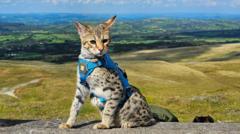
Most cats don't want to go for a walk. They really don't. You've seen the videos on TikTok of a majestic Bengal trotting through a forest or a fluffy Maine Coon perched on a backpack in the mountains. It looks like the ultimate adventure. It looks like "enrichment." But for the average house cat, being strapped into a harness and dragged onto the sidewalk is less of a grand expedition and more of a sensory nightmare.
The trend of "adventure cats" has exploded lately. People want their pets to be more like dogs. They want the companionship of a feline with the outdoor lifestyle of a Golden Retriever. It’s a nice thought. But cats aren't small dogs. Their brains are wired differently. They're both predators and prey. When you take a creature that relies on territory and predictability and shove it into an open, loud, unpredictable world, you're often doing it for your ego, not their happiness.
The Myth of the Indoor Cat Prison
There’s this growing sentiment that keeping a cat indoors is cruel. People argue that they’re bored and need "the wild." This is a misunderstanding of what a cat actually needs. A cat’s home is its kingdom. Every scent mark on the corner of the couch and every hair on the rug is a boundary marker that tells them they’re safe.
Taking them outside destroys that sense of security. Suddenly, the air smells like strange dogs, car exhaust, and rival cats. The ground is hard. The noises are sharp. For many cats, this leads to a state of shut-down. You might think they're "being calm" or "taking it all in" as they crouch low to the ground. In reality, they're likely terrified, waiting for a hawk or a neighbor’s leaf blower to end them.
Jackson Galaxy, the well-known cat behaviorist, often points out that while some cats can handle it, the process of "harness training" is skipped by most owners. They just buy a vest, clip a lead, and head out. That’s a recipe for a panicked cat climbing up your face to get away from a bicycle.
Why Your Cat Thinks the Sidewalk Is a Minefield
Think about the sensory input. A cat's hearing is significantly more sensitive than a human's. They hear frequencies we can't even perceive. A car idling across the street sounds like a jet engine to them. Their sense of smell is roughly 14 times stronger than ours. Every blade of grass holds a story of a stray animal or a chemical fertilizer that could be toxic.
Then there’s the physical danger. Even on a leash, cats aren't safe.
- Off-leash dogs: Even a friendly dog can kill a cat in seconds if its prey drive kicks in.
- Parasites: Fleas, ticks, and heartworm-carrying mosquitoes are everywhere.
- Disease: Feline leukemia and FIV can be picked up from contact with spots where other cats have been.
- The "Bolting" Risk: Cats are liquid. If they get spooked, they can wiggle out of almost any harness. Once they're loose, they don't run to you. They run away.
If you’re doing this because you think your cat is bored, you’re looking at the wrong solution. Most bored cats need more vertical space, interactive play, and window perches, not a trip to the local park.
When Walking Actually Works
I'm not saying it's impossible. A very small percentage of cats—maybe 5 to 10 percent—actually enjoy the outdoors. These are usually high-energy breeds or cats that were socialized to the harness from the time they were kittens.
You can tell if your cat is a candidate by their personality at home. Is your cat the type to run toward the front door when a stranger knocks? Do they spend hours chirping at birds through the glass? If they're bold, curious, and recover quickly from loud noises, they might like a controlled outdoor experience.
But even then, it shouldn't be a "walk" in the human sense. You don't lead a cat. They lead you. It’s more of a "supervised loitering" session. They want to sniff one patch of dirt for twenty minutes. They want to chew on some (safe) grass. If you’re trying to hit a step count with your cat, you’re doing it wrong.
The Social Media Trap
Let's be honest about why this trend is so big. It’s aesthetic. A cat in a tiny backpack with a bubble window looks incredible on Instagram. It gets clicks. It gets comments. But that bubble backpack is often a literal oven. They have poor ventilation and can overheat a cat in minutes on a sunny day. Plus, being trapped in a plastic box with no escape route while being paraded through a crowd is stressful.
Social media creators often hide the hours of struggle, the failed attempts, and the many times their cat hissed or hid under the bed. They show the three-second clip of the cat looking "brave." When regular owners try to replicate this and fail, they feel like they’re failing their pet. You aren't. You're likely respecting your cat’s boundaries.
Better Ways to Give Your Cat Fresh Air
If you really want your cat to experience the outdoors, there are safer, more respectful ways to do it.
The Catio
A screened-in patio or a window box is the gold standard. It gives them the sights, sounds, and smells of the outdoors while maintaining a physical barrier between them and the neighbor's Pitbull. They can go back inside whenever they want. That’s the key: autonomy.
The Stroller
It sounds ridiculous, but a pet stroller is often better than a leash. It provides a "safe base." If the cat gets scared, they stay inside their mesh-covered carriage. They aren't at risk of slipping a harness and vanishing into the bushes.
Targeted Indoor Enrichment
If you can't build a catio, bring the outside in.
- Grow cat grass in a pot.
- Set up a bird feeder outside a secured window.
- Use food puzzles to mimic the "hunt."
- Spend 15 minutes twice a day with a wand toy. This burns more energy than a stressful walk ever will.
How to Start if You Must
If you’ve weighed the risks and still think your cat is the exception, don't just walk out the door today.
Start with the harness inside. Put it on for two minutes. Give them their favorite high-value treat—something they never get otherwise, like plain boiled chicken or a lickable treat. Increase the time daily. If they "pancake" (flop over and refuse to move), they aren't ready. They might never be.
Once they're comfortable moving in the harness, attach the lead. Let them drag it around. Only when they're totally unfazed should you consider the backyard. Not the park. Not the street. Just a quiet, fenced area.
Watch their tail. Is it twitching violently? Are their ears pinned back? Are their pupils huge? These are signs of distress. If you see them, go back inside immediately. Don't push it. You can't "train" fear out of a cat the way you can with some dogs. You only end up breaking their trust.
Stop trying to make your cat an influencer. Most of them are perfectly happy being the king or queen of the living room. If they're sleeping 16 hours a day and purring in your lap, they aren't missing out on the sidewalk. They've already won at life.
Keep the "adventure" to the living room carpet. Buy a better wand toy. Build a cardboard castle. Your cat will thank you by not being stressed out of their mind.