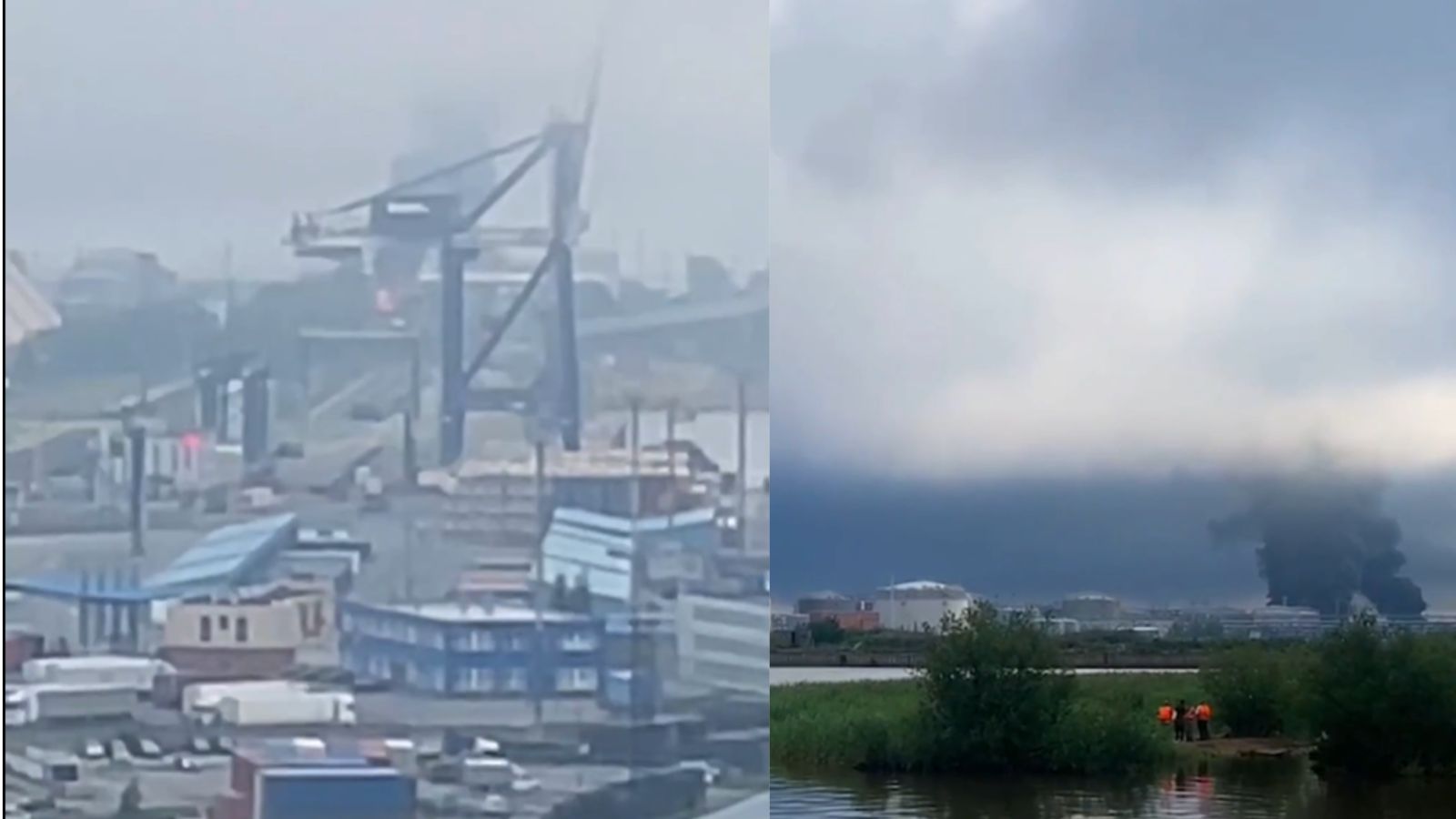
Vladimir Putin wants you to believe his forces are cruising to an easy victory in eastern Ukraine, but a massive fireball near his hometown tells a completely different story. Ukraine just proved it can strike deep inside Russian territory while holding its ground against intense pressure on the eastern front.
If you're trying to make sense of the conflicting reports coming out of the war zone, look at the hard facts from the ground. Ukrainian long-range drones traveled over 500 miles to hit a major oil terminal in St. Petersburg, setting off massive explosions at a facility capable of handling 12.5 million tonnes of fuel products a year. At the exact same time, Kyiv flatly denied a high-profile Kremlin claim that Russian troops had fully captured the critical frontline fortress town of Kostiantynivka.
This double blow exposes the massive gap between Moscow's triumphalist rhetoric and the messy reality of the battlefield. It shows that Kyiv's strategic strike campaign is effectively choking off the energy revenues funding the invasion, even as its infantrymen smash infantry assaults in the Donbas.
The St Petersburg Strike Exposed Major Gaps in Russian Air Defenses
Don't buy the Kremlin line that everything is under control. The drone blitz on the St. Petersburg port infrastructure represents a massive security failure for Moscow. Flying dozens of explosive-laden drones 850 kilometers across heavily defended airspace isn't a fluke. It's proof that Ukraine has cracked the code on bypassing Russia's air defense networks.
Local governor Aleksandr Beglov admitted the terminal took a direct hit. He scrambled to reassure residents while ordering them to stay indoors, even warning of incoming mobile internet disruptions as electronic warfare systems jammed the skies. The Ukrainian military confirmed it didn't just stop at the oil terminal. Long-range drones also battered the highly sensitive naval base at Kronstadt, home to Russia's Baltic Fleet.
President Volodymyr Zelenskyy didn't mince words when he shared video footage of the thick black smoke billowing over the port. He noted that these long-range sanctions target the exact energy hubs generating the cash Putin relies on to sustain his military machine. Ukrainian officials calculate that nearly 43% of Russia's total oil refining capacity is now disabled or degraded from months of relentless asymmetric attacks.
While that specific percentage remains difficult to verify independently, the economic pain is visible. Putin himself recently conceded that domestic fuel shortages are real, and he quickly signed a new law aimed at artificially boosting domestic supply. One of the world's biggest energy giants is now rationing fuel at home because it can't protect its own refineries from cheap, garage-built drones.
The Fake News Surrounding the Battle for Kostiantynivka
While drones lit up the northern skies, a bizarre information war played out over the industrial ruins of Kostiantynivka. Putin personally visited a military command post to announce that his troops had completely captured the strategic city. Kremlin spokesman Dmitry Peskov bragged to journalists that taking the town was a massive milestone toward dismantling Ukraine's entire Sloviansk-Kramatorsk defensive hub.
It turns out the Kremlin jumped the gun. Ukraine's General Staff quickly shot down the narrative, confirming that the 19th Army Corps and associated defensive units still firmly hold their lines inside the town. Military spokesperson Maj. Andriy Kovalyov clarified that while small Russian infantry groups had managed to slip into the outer edges of the city, Ukrainian troops were actively clearing them out. Moscow launched 11 separate heavy assaults on the city in a single day, and every single one failed to break the defensive perimeter.
Zelenskyy used the moment to mock the Russian leader on social media. He pointed out that if Kostiantynivka were truly under Russian control, Putin shouldn't have any issue meeting him right there on the streets to talk peace. The Kremlin's angry response was telling. Instead of providing photographic proof of a victory, Peskov snapped back that Zelenskyy was welcome to come to Moscow instead.
Why This Specific Frontline Town Matters So Much
You might wonder why both sides are fighting so fiercely over a battered industrial town that had a pre-war population of just 67,000. It's because Kostiantynivka is the southern anchor of Ukraine's fortress belt in the Donetsk region.
[Sloviansk] -> [Kramatorsk] -> [Druzhkivka] -> [Kostiantynivka]
These four urban strongholds form a connected defensive wall. If Kostiantynivka falls, Russian forces gain a direct highway to push north and roll up the entire axis of Ukraine's eastern defense. By holding this line, Ukrainian soldiers are preventing a total collapse of the industrialized Donbas region.
Moscow tried to paint the massive drone strike in St. Petersburg as a desperate attempt by Kyiv to distract from setbacks in the east. But the reality is exactly the opposite. Ukraine is using a coordinated two-pronged strategy. They're using highly effective local defense to bleed Russian infantry units dry in the Donbas, while using advanced long-range technology to starve the Kremlin's treasury half a continent away.
If you want to track where this conflict goes next, stop listening to political speeches and watch the energy infrastructure. Keep an eye on how effectively Ukraine maintains its grip on the remaining fortresses of the Donbas belt, and look for whether Russia can successfully redeploy its air defense systems away from the front lines to protect its economic heartland. The coming weeks will show whether Moscow can actually secure its skies, or if its economic engine will keep burning out in public view.