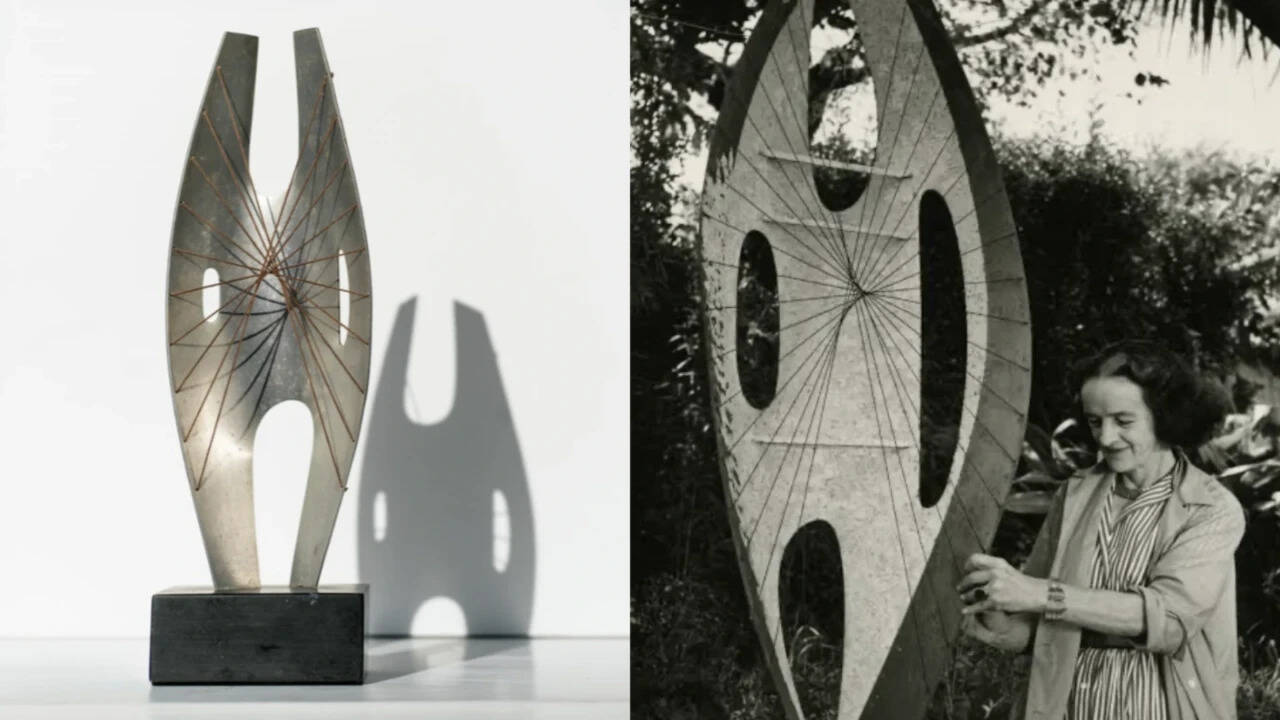
The appearance of a 13-inch aluminium-and-string maquette by Barbara Hepworth on the Cornwall auction block—carrying a pre-sale estimate of up to £80,000—exposes the mechanics of modern fine art valuation. Standard market commentary treats high estimates for preparatory sculptures as sentimental anomalies driven by celebrity provenance. In reality, the pricing of Hepworth’s study for Winged Figure operates on a strict economic formula governed by three variables: structural rarity, direct line of provenance, and spatial indexation to a canonical public monument.
The Structural Economics of the Preparatory Maquette
To understand why a 13-inch working model achieves a valuation ratio of roughly £6,150 per vertical inch, one must separate the artistic function of a maquette from its market function as a financial asset.
In sculptural production, a maquette is an engineering prototype. Before scaling an abstract form to architectural dimensions—such as the 19-foot Winged Figure mounted on the John Lewis department store facade on Oxford Street in London—the artist must solve problems of tension, balance, and negative space at a fraction of the material cost. Hepworth utilized sheet aluminium and string to test how light would cut across concave planes and how taut linear elements would create visual volume without adding physical mass.
From an asset-pricing perspective, this engineering phase creates extreme supply inelasticity. While an artist may authorize an edition of six, nine, or twelve bronze casts for a finished commercial sculpture, a working maquette is almost always unique. There is no foundry editioning process for a hand-cut aluminium-and-string study. The supply curve is vertical at a quantity of one.
When a unique prototype corresponds directly to a globally recognized public landmark, it absorbs what economists call indexical value. Collectors cannot buy the 19-foot monument on Oxford Street; it is permanently fixed to an architectural elevation and held within a corporate or public trust. The maquette functions as the sole liquid proxy for that immovable monument. Buyers are not merely acquiring 13 inches of bent metal and cord; they are acquiring private ownership of the intellectual genesis behind a landmark of post-war British modernism.
Deconstructing the Valuation Drivers
Art market pricing is frequently dismissed as opaque, yet auction house specialists rely on quantifiable comparative metrics to establish an estimate ceiling like £80,000. Four distinct mechanisms drive this specific valuation:
- Monumental Correlation: Preparatory works tied to unexecuted projects trade at a steep discount compared to studies for realized, famous commissions. Because Winged Figure (completed in 1962–1963) is one of Hepworth’s most visible public works, seen daily by thousands in central London, the maquette possesses immediate art-historical validation. The market does not need to speculate on the importance of the form; the finished monument already proved its canonical status.
- Material Authenticity: Hepworth’s reputation rests heavily on her mastery of "pierced form" and stringed sculpture—a technique she pioneered in the late 1930s alongside Naum Gabo. A maquette executed in aluminium and string captures her primary formal innovations in their rawest state. Unlike a plaster cast, which shows only volume, an aluminium-and-string model preserves the exact tactile decisions of the artist's hand, including tool marks, bends, and string tensioning.
- Unbroken Non-Commercial Provenance: The work was gifted directly by Hepworth to her personal physician. In the secondary art market, "fresh-to-market" provenance—meaning a work has remained in a single private collection since leaving the artist's studio—eliminates two major friction costs: authentication risk and market fatigue. Works that cycle through auction houses every five to seven years suffer price erosion because dealers view them as "burned" inventory. A direct gift from artist to doctor bypasses decades of dealer markups and establishes an unimpeachable chain of title.
- Geographic Clustering and Regional Premiums: Offering the work in Cornwall—specifically within the St Ives orbit where Hepworth lived and worked at Trewyn Studio from 1949 until her death in 1975—taps into concentrated regional liquidity. While major London salesrooms (Sotheby’s, Christie’s) capture global institutional buyers, regional Cornish auctions attract dedicated collectors of the St Ives School who aggressively bid on works with local biographical ties.
The Provenance Risk Discount and How Gifts Eliminate It
A critical bottleneck in the twentieth-century sculpture market is attribution and authenticity verification. Forgeries and unauthorized posthumous casts plague the secondary market for major modernists, forcing buyers to factor legal and forensic due diligence into their bidding limits.
When a work enters the market through a standard commercial gallery channel, the buyer relies on paper trails—invoices, exhibition labels, and catalogue raisonné entries. Each transfer of ownership introduces a statistical probability of clerical error or misattribution.
Direct personal gifts operate outside this commercial friction. Hepworth frequently gifted small works, drawings, and maquettes to members of her immediate Cornish community, including medical professionals, local craftsmen, and neighbors. These transactions occurred outside the gallery system, meaning the works were rarely documented in contemporary sales ledgers.
This creates a temporary information asymmetry that benefits the auction house and the initial buyer:
- Phase One (Discovery): The work surfaces from the recipient's estate. Because it has been off the market for half a century, it lacks recent auction comparables.
- Phase Two (Verification): Auction specialists cross-reference the maquette's dimensions, materials, and structural geometry against archival photographs of Hepworth’s studio and the finished Winged Figure commission. Once verified by estate experts or matched to historical records, the "unrecorded" status flips from a liability into a scarcity premium.
- Phase Three (Price Discovery): Collectors pay a premium for the privilege of being the first commercial owner. The absence of prior public auction records means there is no historical price anchor to cap bidding enthusiasm.
Material Fragility as a Valuation Variable
While aluminium and string elevate the aesthetic and historical appeal of the Winged Figure study, they simultaneously introduce physical liabilities that suppress the estimate relative to bronze equivalents of similar dimensions.
Bronze is chemically stable and structurally rigid; a 13-inch bronze Hepworth from the early 1960s can easily command well into six figures because it requires minimal conservation and resists environmental degradation. Conversely, sheet aluminium is prone to oxidation, denting, and warping under improper handling.
The string element presents an even sharper conservation constraint:
- Tension Degradation: Over six decades, organic or early synthetic cords lose elasticity, sag, or snap due to fluctuations in ambient humidity and temperature.
- The Restringing Dilemma: If original strings break, the owner faces a difficult conservation choice. Leaving the strings broken destroys the spatial geometry Hepworth intended. Replacing the strings alters the physical integrity of the original artifact, potentially reducing its value to purist collectors unless the restringing is performed by a recognized estate conservator using period-correct materials.
Consequently, an £80,000 upper estimate reflects a risk-adjusted price. The market discounts the figure to account for future conservation overhead and the strict climate-controlled display environments required to preserve mixed-media studio prototypes.
Scale Versus Value The Non-Linear Pricing Curve
Novice observers frequently assume art pricing scales linearly with physical size—that a 19-foot sculpture should simply cost roughly 17.5 times more than a 13-inch model. Fine art economics operates on a non-linear curve dictated by buyer demographics and installation logistics.
Monumental sculptures (over six feet) face a severely restricted buyer pool. Very few private individuals possess the estate grounds, structural engineering capacity, or crane logistics required to install and insure a 19-foot aluminium relief. Monumental works rely almost entirely on museums, corporate campuses, and sovereign wealth funds, where acquisition committees move slowly and budgets are heavily scrutinized.
Works in the 10-to-18-inch range occupy the domestic liquidity sweet spot:
- Zero Infrastructure Cost: A 13-inch sculpture requires no specialized rigging, reinforced flooring, or exterior weatherproofing. It fits on a standard domestic plinth or bookshelf.
- Global Portability: It can be packed into a standard air-freight crate and shipped internationally within days, bypassing the maritime freight delays and customs complexities that burden large-scale sculpture.
- Broadened Bidder Pool: At an £80,000 price point, the asset is accessible not only to institutions, but to thousands of mid-tier wealth managers, private collectors, and corporate art funds.
Higher bidder density at the lower end of the size spectrum drives up the price per square inch, compressing the valuation gap between the miniature prototype and the full-scale monument.
Strategic Framework for Acquiring Studio Prototypes
For collectors and institutional buyers evaluating studio maquettes like the Winged Figure study, bidding discipline requires separating emotional biographical narratives from verifiable asset fundamentals.
First, audit the geometric fidelity between the maquette and the final monument. In Hepworth’s working process, early maquettes often differed significantly from the executed commission as engineering realities forced structural compromises. A maquette that closely mirrors the final proportions of the Oxford Street Winged Figure holds substantially higher historical weight than an abandoned preliminary sketch.
Second, establish the conservation baseline prior to bidding. Require a high-resolution condition report detailing whether the stringing is original to Hepworth’s studio or a later replacement, and inspect the aluminium surface for pitting or structural creases near the drill holes where the strings anchor. Factor a 10% to 15% capital reserve for museum-grade acrylic casing to protect the open aluminium edges and exposed cords from dust and accidental contact.
Finally, recognize the arbitrage window presented by regional salesrooms. Works sold in Cornwall rather than London frequently attract lower international marketing budgets from the auction house, resulting in conservative pre-sale estimates designed to stimulate competitive floor and telephone bidding. Buyers who complete their archival due diligence early can secure canonical modernist prototypes at regional clearing prices before those assets inevitably migrate to the global secondary hubs in London and New York, where dealer markups immediately reprice the work to international market parity.