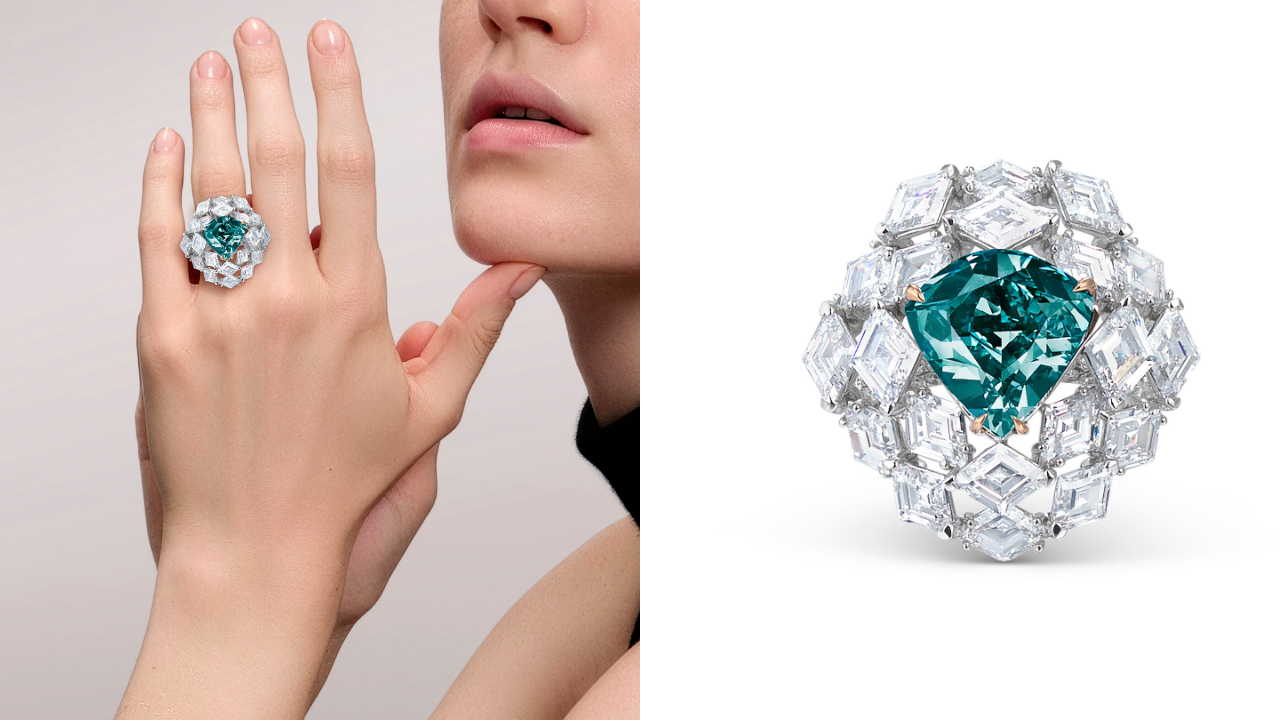
The May 2026 sale of the 5.5-carat Ocean Dream diamond at Christie’s Geneva for $17.3 million—roughly double its $8.5 million realization in 2014—is not an anomaly of luxury retail, nor is it simply a reflection of inflation. It is the predictable output of an illiquid, non-fungible asset class governed by geological scarcity, optical physics, and asymmetric wealth concentration. When an asset appreciates by 103.5% over a twelve-year holding period, yielding an annualized compound growth rate (CAGR) of approximately 6.1%, market observers frequently misattribute the price action to subjective branding. In reality, high-end fancy colored diamonds operate under rigid structural economics where supply is permanently capped at zero growth, and demand is dictated by ultra-high-net-worth (UHNW) balance sheet diversification.
To understand why the Ocean Dream doubled in nominal value between 2014 and 2026, one must strip away the romanticism of auction house marketing and examine the underlying asset mechanics. Standard diamond valuation relies on the linear, industrialized metrics of the Rapaport Diamond Report, which prices colorless stones based on predictable supply chains. Fancy colored diamonds, particularly those exhibiting natural blue-green hues, exist entirely outside this pricing matrix. They are priced as unique sovereign-grade collectibles, closer in market behavior to Old Master paintings or trophy real estate than to commercial gemstones.
The Physics of Scarcity and Geological Bottlenecks
The foundational driver of the Ocean Dream’s valuation is an absolute supply constraint rooted in crystal lattice physics. A diamond’s color is determined by trace impurities or structural anomalies within its carbon matrix during formation deep within the Earth's mantle.
- Nitrogen Impurities (Yellow/Brown): The most common alteration, occurring when nitrogen atoms replace carbon atoms in the crystal lattice.
- Boron Impurities (Blue): Extremely rare, occurring when boron atoms substitute for carbon, absorbing red, yellow, and green light wavelengths to transmit blue.
- Natural Irradiation (Green): The rarest geological mechanism, requiring the diamond to sit near naturally occurring radioactive rocks or fluids over millions of years. The alpha, beta, or gamma radiation displaces carbon atoms from their lattice positions, creating vacancies known as GR1 centers that absorb red light and reflect green.
A natural Fancy Deep Blue-Green diamond requires the simultaneous or sequential occurrence of two distinct, low-probability geological events: boron incorporation during crystallization and subsequent exposure to natural radiation without overheating (which would anneal the lattice and turn the stone brown or olive).
Because this dual-mechanism formation cannot be replicated at scale in nature, the supply curve for natural blue-green diamonds over 5 carats is entirely vertical. Unlike gold, where rising prices incentivize increased mining capital expenditure and extraction, a 100% price increase in blue-green diamonds produces zero additional supply. The closure of major mines—most notably the Argyle mine in Western Australia in 2020, which produced the vast majority of the world's fancy colored diamonds—further compressed the primary market, forcing all acquisition activity into the secondary auction circuit.
Deconstructing the 2014–2026 Price Trajectory
Evaluating the Ocean Dream’s jump from $8.5 million in 2014 to $17.3 million in 2026 requires isolating the financial variables driving the transaction. At 5.5 carats, the stone’s price per carat escalated from approximately $1.54 million to $3.14 million.
Nominal vs. Real Appreciation
A 6.1% CAGR over twelve years must be stress-tested against monetary expansion. Between 2014 and 2026, global M2 money supply expanded aggressively, particularly during the 2020–2022 monetary interventions. Adjusted for cumulative US Consumer Price Index (CPI) inflation over that twelve-year span, the real purchasing power gain is compressed, though still decidedly positive. For an UHNW buyer, the asset functioned effectively as an inflation hedge and a store of value, preserving purchasing power without generating taxable yield during the holding period.
The Portability Premium
Ultra-rare gemstones carry a unique structural advantage over other hard assets: extreme value density. Storing $17.3 million in physical gold requires roughly 200 to 250 kilograms of secure vault space, incurring continuous custody, insurance, and transport friction. Storing $17.3 million in fine art requires climate-controlled logistics, specialized crating, and public exhibition tracking. A 5.5-carat diamond weighs 1.1 grams. It requires zero maintenance, cannot be degraded by environmental exposure, and can be transported across jurisdictions in a pocket. In periods of heightened geopolitical friction and capital control scrutiny, institutional and private buyers pay a substantial liquidity and portability premium for non-registered, high-density bearer assets.
The Auction House Duopoly and Price Discovery
The venue of the May 2026 sale—Christie’s Geneva—is central to the price realization. In the secondary market for trophy stones, price discovery does not happen through continuous order books; it occurs via curated, high-friction English auctions managed almost exclusively by Christie’s and Sotheby’s.
This duopoly controls price realization through three specific operational mechanisms:
- Provenance Anchoring: Once a stone is named ("The Ocean Dream") and certified by the Gemological Institute of America (GIA) as the largest of its specific color grade, it ceases to be a commodity. The 2014 sale established a public floor price. In 2026, bidders were not valuing a 5.5-carat stone; they were bidding against a historical benchmark, knowing that failing to acquire the asset meant waiting an indeterminate number of years—potentially decades—for a comparable substitute to surface.
- Asymmetric Bidding Dynamics: Trophy auctions require only two motivated buyers to detach a price from intrinsic valuation models. Because the supply is singular, the second-highest bidder sets the clearing price, while the winner pays one increment above that threshold. When two billionaires compete for a unique asset, the marginal utility of an extra $1 million is negligible compared to the permanent loss of the asset.
- Synthetic Insulation: The proliferation of lab-grown diamonds (CVD and HPHT) between 2014 and 2026 decimated the commercial market for colorless diamonds, driving wholesale prices down across standard retail tiers. Counterintuitively, this technological disruption strengthened the top end of the natural fancy colored market. As commercial diamonds became commoditized industrial products, UHNW capital fled generic stones and concentrated exclusively on museum-grade natural anomalies whose geological provenance could be verified via advanced spectroscopy.
Structural Limitations and Risk Vectors
Treating the Ocean Dream’s 103.5% return as a guaranteed template for gemstone investment introduces severe analytical blind spots. The fancy colored diamond market is structurally flawed for standard portfolio allocation due to four primary friction points.
Severe Illiquidity and Transaction Drag
Unlike equities or sovereign debt, a $17.3 million diamond cannot be liquidated on demand without accepting a catastrophic haircut. Exiting a position requires aligning with the biannual Geneva or Hong Kong auction calendars—a timeline of six to nine months from consignment to settlement. Furthermore, auction houses extract substantial transaction fees, typically combining a buyer’s premium (often 14.5% to 26% depending on the hammer price tier) with negotiated seller commissions. For an investor to break even on a round-trip auction transaction, the underlying asset must appreciate by roughly 20% to 30% just to cover intermediation costs.
Grading Subjectivity and Laboratory Risk
The entire valuation edifice rests on the GIA grading report. The distinction between "Fancy Intense Blue-Green" and "Fancy Deep Blue-Green," or the precise ratio of secondary hues, can shift a stone’s valuation by millions of dollars. While the GIA is the industry standard, gemological grading remains an assessment conducted by human eyes under standardized lighting, supplemented by spectroscopic data. Any future revision in grading standards, or the emergence of undetectable color-enhancement treatments that compromise market confidence, poses an existential risk to asset values.
Thin Market Vulnerability
The buyer pool for $15 million-plus gemstones is extraordinarily narrow, likely comprising fewer than 500 active individuals or family offices globally. Consequently, the market is hyper-sensitive to localized macroeconomic shocks. A liquidity crunch in Asian real estate, regulatory crackdowns on luxury consumption in key emerging markets, or shifts in sovereign tax policies regarding wealth transfers can instantly evaporate bidding depth at the top tier, resulting in stones failing to meet their reserve prices ("buying in") and suffering long-term stigma on the secondary market.
Capital Allocation Strategy for Non-Fungible Assets
For family offices and private capital allocators evaluating ultra-rare colored diamonds based on the 2014–2026 performance of the Ocean Dream, standard financial metrics like Sharpe ratios or discounted cash flow models are useless. The asset produces no cash flow and exhibits erratic, event-driven volatility.
To deploy capital into this sector without falling victim to transaction drag or peak-cycle overpaying, acquirers must execute a disciplined acquisition framework:
- Mandate the "Best-of-Category" Rule: Never allocate capital to mid-tier fancy colored diamonds (e.g., sub-2-carat stones with weak saturation or heavy modifying brown/gray tones). Those segments behave like retail luxury goods and suffer severe depreciation upon resale. Capital must be restricted exclusively to "superlative" stones—assets that hold a verifiable record in weight, purity of hue, or historical provenance. The Ocean Dream doubled in value precisely because no direct substitute exists.
- Enforce a Minimum 10-Year Horizon: Because buyer’s premiums and auction logistics create an immediate 20%+ frictional loss upon entry, short-term flipping is mathematically unviable. Acquisitions must be underwritten as multi-generational wealth preservation vehicles, holding through at least two full macroeconomic cycles to allow monetary expansion and supply attrition to absorb the initial transaction costs.
- Bypass Public Auctions on Entry: The highest valuations occur in the competitive heat of Geneva and Hong Kong auction rooms. Institutional buyers should utilize private treaty sales—acquiring stones quietly through major dealers or auction house private sales departments during periods of high interest rates, when leveraged collectors are forced to raise cash—and reserve the public auction stage strictly for the exit event during periods of peak global liquidity.