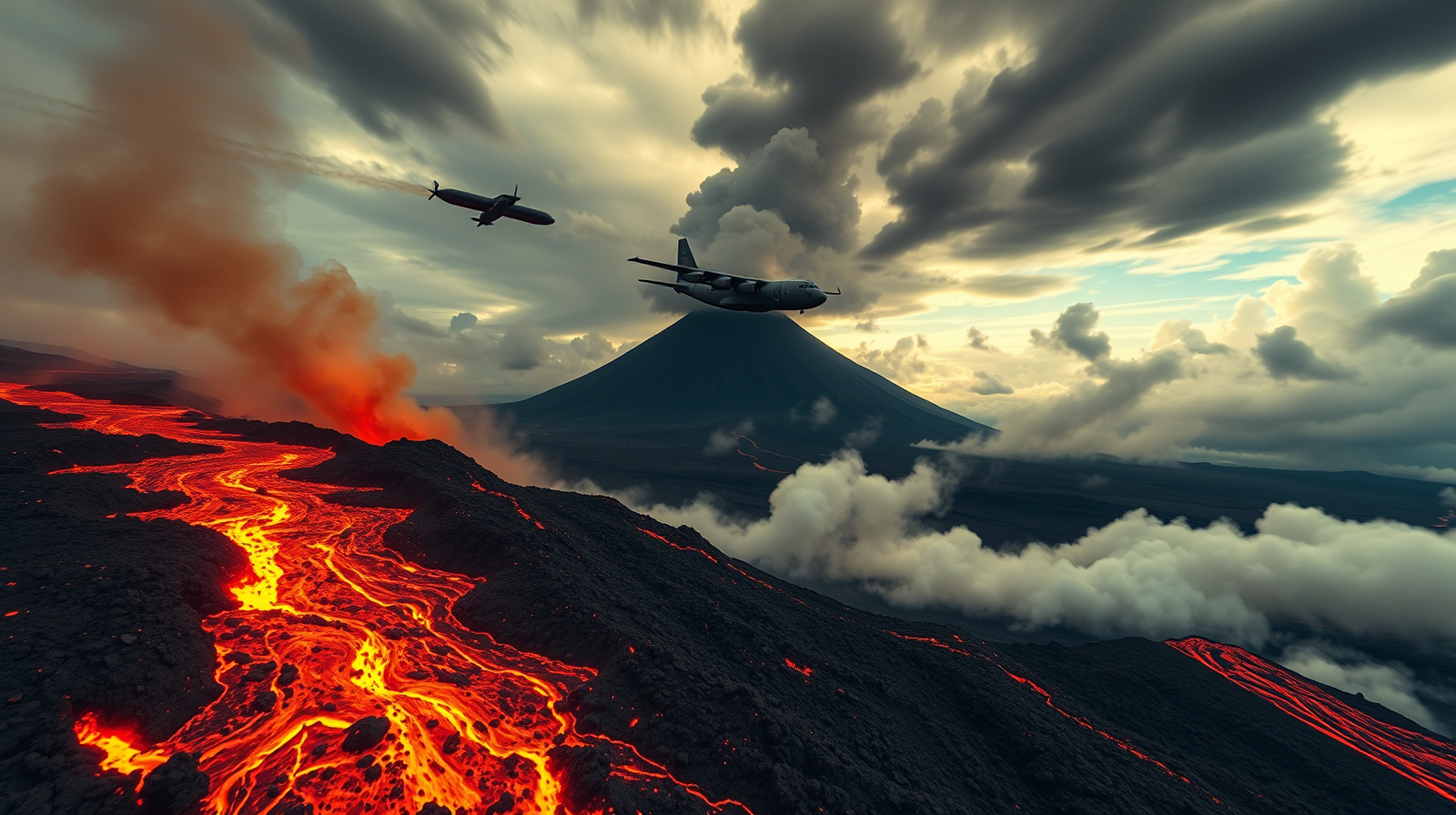
In December 1935, a river of molten rock threatened to wipe the port city of Hilo off the map. To stop it, the United States military flew bombing runs straight into active volcanic plumes. Thomas Jaggar, founder of the Hawaiian Volcano Observatory, spearheaded a radical plan. He convinced Lieutenant Colonel George S. Patton Jr.'s future boss and fellow commanders that dropping high explosives directly into Mauna Loa lava channels could shatter the crust, divert the flow, and save civilian infrastructure.
Forty demolition bombs hit the mountain. The operation sparked decades of debate about whether the explosives actually worked or if the eruption simply ran out of fuel on its own. Understanding this bizarre historical intervention requires looking at the mechanics of fluid dynamics, the limits of human intervention against geological forces, and how a desperate experiment reshaped modern hazard mitigation.
The Anatomy of a Threat
Mauna Loa is the largest active volcano on Earth. When it erupts, it typically produces basaltic lava with low viscosity. This material flows fast and far compared to sticky, silica-rich magma found in continental arc volcanoes.
In late 1935, a fissure opened on the northeast rift zone. Molten rock pooled and channeled itself directly toward the Wailuku River, the primary water source and immediate geographic barrier protecting Hilo.
Communities downstream faced total destruction. Evacuation routes were primitive. Economic ruin loomed over the sugar plantations and small businesses underwriting the local economy.
Jaggar understood the physics of the flow. A basaltic river crusts over on top while superheated liquid continues to rush through subterranean tubes and troughs. Block that channel or fracture the levees, he reasoned, and the system fails. Gravity dictates that fluid takes the path of least resistance. If you break the natural walls holding the river of fire, the contents should spill out prematurely, lose momentum, and stall.
Inside the 1935 Air Operation
The logistics were chaotic by modern standards. The US Army Air Corps stationed at Wheeler Field deployed Keystone B-3 and B-4 bombers. These were twin-engine, fabric-covered biplanes carrying hundreds of pounds of high explosives per flight.
Pilots navigated blind through thick sulfur dioxide fogs and violent updrafts generated by the sheer thermal output of the vent. Visibility was near zero.
Bombardier crews targeted the source vents and the main channels feeding the upper reaches of the flow. They dropped 600-pound demolition bombs packed with TNT. The explosions rocked the caldera walls. Chunks of cooled basalt flew into the air, and massive clouds of ash obscured the target zones.
Eyewitness accounts from the ground noted immediate disruptions. In places where the bombs hit, the hardened crust shattered. Liquid lava spilled out over adjacent dry terrain, spreading out horizontally rather than continuing down the linear trench.
Yet, military reports at the time were cautious. The Air Corps claimed success, pointing to the stagnation of the flow days later. Geologists remained skeptical. They argued that the eruption rate at the fissure simply decreased naturally around the same time, starving the river of new material.
The Scientific Autopsy
Decades later, volcanologists revisited the 1935 Mauna Loa bombing mission using modern remote sensing, fluid mechanics models, and historical records. The verdict is more nuanced than a simple win or loss.
Explosives cannot stop a major eruption. The sheer volume of magma discharging from the Earth's mantle dwarfs human arsenals. A single day of eruption can output energy equivalent to multiple nuclear warheads. Trying to stop a volcano with bombs is like trying to stop a tidal wave with a bucket.
However, tactical diversion is a different matter.
If an eruption is waning or steady, localized channel manipulation can buy time. By breaching levees, engineers force the fluid to widen its footprint. Spreading the lava increases surface area cooling, which accelerates the solidification process.
The 1935 mission did not stop the volcano. It disrupted specific feed channels just as the eruption cycle began to naturally taper off. Both factors likely contributed to saving Hilo. The bombs cracked the hydraulic geometry of the flow, and the dying source provided the grace period necessary for complete stagnation.
The Modern Legacy of Volcanic Interventions
The audacity of the 1935 mission permanently changed how authorities view hazard response. Governments stopped looking at volcanoes purely as acts of God to endure and started treating them as physical systems subject to engineering manipulation.
Decades later, Icelanders used similar tactics during the 1973 Eldfell eruption on Heimaey. Firefighters pumped millions of gallons of cold seawater directly onto advancing lava fronts to build artificial barriers and deflect the flow away from the town's harbor. That intervention worked because the volume was manageable and the water supply from the ocean was limitless.
In Italy, barriers have been constructed around Mount Etna to catch and divert slow-moving flows. But heavy earth-moving equipment replaces the biplanes of the past. Bulldozers and engineered earthen dykes are safer, cheaper, and more predictable than dropping high explosives from the sky during zero-visibility atmospheric conditions.
The 1935 Mauna Loa mission remains a monument to human desperation meeting raw planetary power. It proved that while we cannot conquer the underworld, we can occasionally alter its path just enough to slip out of the way.


