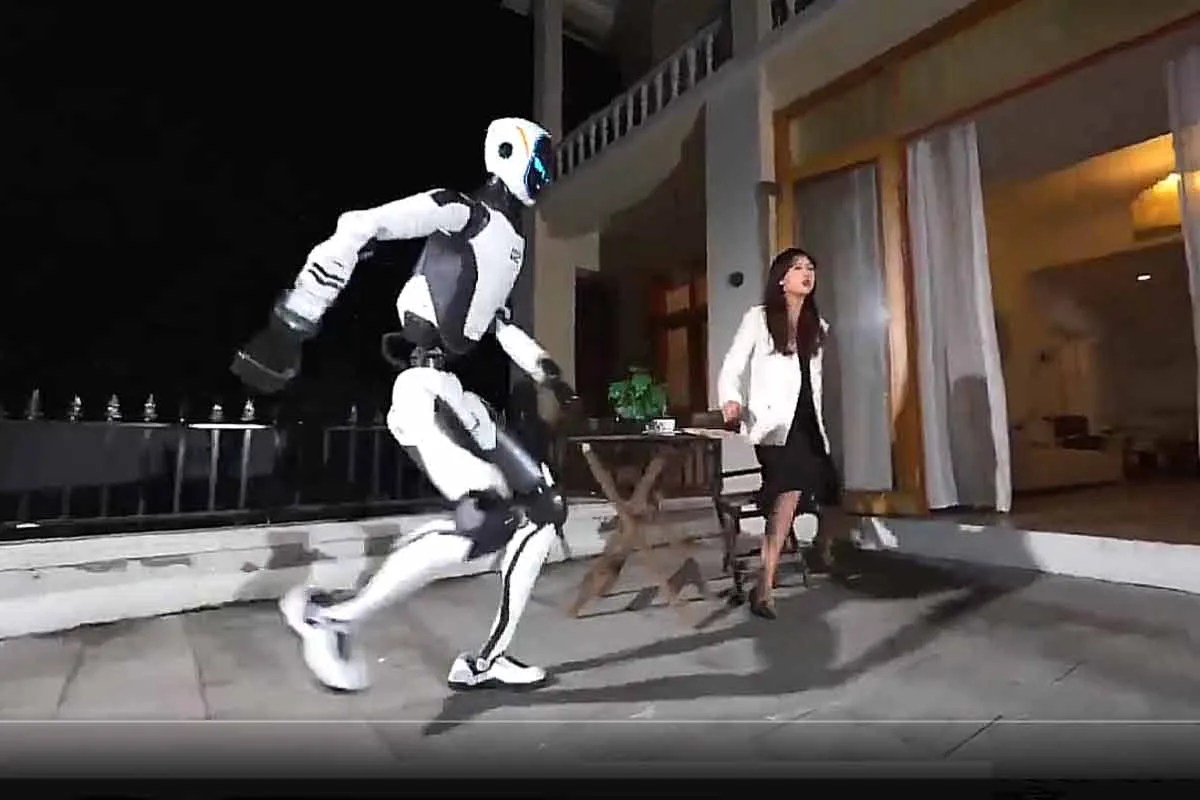
The Unitree H2-X is a full-size humanoid robot unveiled by Hangzhou-based Unitree Robotics, positioned in viral clips as a martial-arts-inspired security guardian capable of confronting attackers and straining against heavy loads like a car. In reality, the platform carries 31 degrees of freedom, roughly 7 kg of rated arm payload (up to about 15 kg peak), and an estimated runtime of up to eight hours. It is a serious mechanical step forward for Unitree, yet the gap between staged spectacle and real-world security work remains wide.
Social media loves a superhero machine. Footage of a sleek bipedal frame moving with fluid martial-arts posture and pushing or lifting against a vehicle triggers instant awe, followed by lazy assumptions that private security guards are obsolete. Anyone who has spent years watching robotics demos knows better. Choreographed balance, controlled camera angles, and staged resistance are worlds apart from an unscripted altercation in a crowded lobby or a chaotic street at night.
What Viral Clips Hide About Strength and Torque
Numbers on a spec sheet tell a much quieter story than a dramatic highlight reel. Across published technical listings for the H2-X, arm ratings sit around 7 kg for continuous or rated work and roughly 15 kg at peak, paired with joint torque figures reported at up to 150 N·m on arms and 300 N·m on legs in European distributor specs, or 120 N·m and 360 N·m in industry breakdowns. Those are respectable actuators for a 65-to-70 kg bipedal frame. They are not magic levers that let a humanoid deadlift a sedan off the pavement.
When a robot appears to lift or push part of a car, physics is doing heavy lifting behind the scenes. Most of a vehicle's mass stays supported on its wheels or suspension. A humanoid braced at a low angle with both legs planted and its torso engaged can transfer force into a bumper or frame without actually hoisting the entire car into midair.
Peak torque in a joint is a momentary ceiling, not a license to treat a 70-kilogram machine like a forklift.
Push a high-torque actuator past its thermal and mechanical limits during an unplanned struggle, and two things happen fast. Heat builds inside the motor windings and gear drives. Even with aerospace-grade aluminum, titanium or high-strength alloys, and air cooling, sustained high-load output eats into battery reserves and stresses structural joints.
Inside the H2-X Hardware and Compute Stack
Strip away the "guardian" branding and look at the engineering architecture. The Unitree H2-X packs 31 degrees of freedom—typically six per leg, seven per arm, three in the waist, and two in the head—giving it the articulated range needed to crouch, step over obstacles, and coordinate upper-body reach with foot placement.
Perception relies on stereo/binocular depth vision in the head and a wide-angle camera in the chest, alongside microphones, speakers, and an LED matrix face or status display. On the compute side, configurations scale from base onboard processing up to secondary modules such as an Intel Core i7 or NVIDIA Jetson Orin NX, and higher-tier options like Jetson Orin AGX or Jetson Thor, with industry coverage pointing to high-TOPS AI capability for embodied models.
- Dual-battery endurance: Published figures cite up to roughly eight hours of operation with hot-swappable batteries and magnetic charging support, a marked jump over the roughly three-hour runtime listed for the base H2.
- Modular tiers: Distributor listings separate base remote- and app-operated units from developer editions equipped with an SDK and extra compute, plus optional dexterous or tactile hands sourced across the ecosystem.
- Clearance warnings: Even Unitree's own safety guidance advises keeping a safe distance of roughly two to three meters from powerful humanoid hardware.
Eight hours sounds like a full shift on paper. In practice, runtime depends heavily on gait speed, payload, terrain, and whether the robot is idling or executing dynamic maneuvers. A security patrol walking flat corridors at a steady pace draws far less power than a machine sprinting, absorbing impacts, or holding a deep squat.
Why Bodyguard Duty Is the Hardest Test Possible
Factory pick-and-place is forgiving compared to human protection. If a warehouse robot drops a tote or pauses to recalculate a path, a supervisor walks over and resets the line.
Security is an adversarial environment. An attacker does not follow clean training distributions. A person might feint, grab a limb, swing an object, shove a bystander, or move through poor lighting and tight doorways. Every one of those variables turns a smooth laboratory policy into a high-stakes edge case.
Force Control vs. Liability
A human bodyguard relies on judgment, de-escalation, and proportional force. If a guard tackles someone too hard on concrete, there are legal consequences, yet a human feels resistance through skin, muscle tension, and instinct.
A 65-to-70 kg metal-and-composite humanoid moving with high-torque joints is a blunt instrument if its control loop misreads a situation. Too little force, and an intruder walks right past it. Too much force, and a stiff collision can break bones or cause severe head trauma. Liability insurers will demand years of empirical reliability data before treating any bipedal robot as a certified physical security asset.
The Autonomy Gap Behind Martial Arts Demos
Dynamic movement does not equal autonomous threat assessment. Teaching a humanoid via reinforcement learning or motion retargeting to throw a kick, hold a stance, or recover from a push is a control problem. Deciding whether a fast-moving person is a jogger late for a train or an active threat is a perception, context, and ethics problem.
A robot that can strike a pose on command is not the same thing as a machine that knows when to hold back.
In many public demonstrations, operators or pre-trained policies run in controlled settings where obstacles, lighting, and human reactions are predictable. Real-world emergencies rarely offer clean lighting or cooperative subjects.
Unitree's Real Playbook Volume and Cost
To understand why Unitree pushes theatrical demos, look at its broader commercial strategy rather than security hype alone. Unitree built its reputation by making agile quadrupeds and humanoids at prices far below traditional Western robotics labs, while scaling manufacturing output—with company leadership pointing to five-figure cumulative production on platforms like the G1.
European distributor pricing for the Unitree H2-X starts around €36,713 to €39,650 excluding VAT for a base configuration, climbing past €54,000 for developer editions and well over €100,000 when outfitted with advanced multi-fingered or tactile hands. Compared to paying a human security officer year after year with wages, benefits, and shift coverage, those numbers catch an executive's eye.
- Training and simulation: Humanoids are increasingly bought by labs, integrators, and enterprises as data-collection and embodied-AI platforms rather than turnkey bodyguards.
- Patrol and presence: Deterrence, perimeter checks, and escorted facility monitoring are far more realistic early roles than close-quarters combat.
- Ecosystem lock-in: Offering optional compute tiers, SDK access, and third-party dexterous hands lets Unitree capture both hardware margins and developer mindshare.
What Buyers Should Demand Before Signing a Check
If you run a security firm, industrial site, or research lab eyeing the Unitree H2-X, treat viral clips as marketing, not an acceptance test. Insist on seeing continuous duty-cycle logs under realistic loads, thermal throttling behavior during sustained exertion, and clear documentation on fall recovery and emergency shutoffs.
Ask hard questions about who owns liability if a robot trips into a pedestrian or misjudges a human gesture. Start pilot programs in fenced or low-risk operational zones with human oversight, measure real uptime rather than brochure hours, and keep a trained human professional in the loop until the hardware and software prove they can handle messy reality without a script.