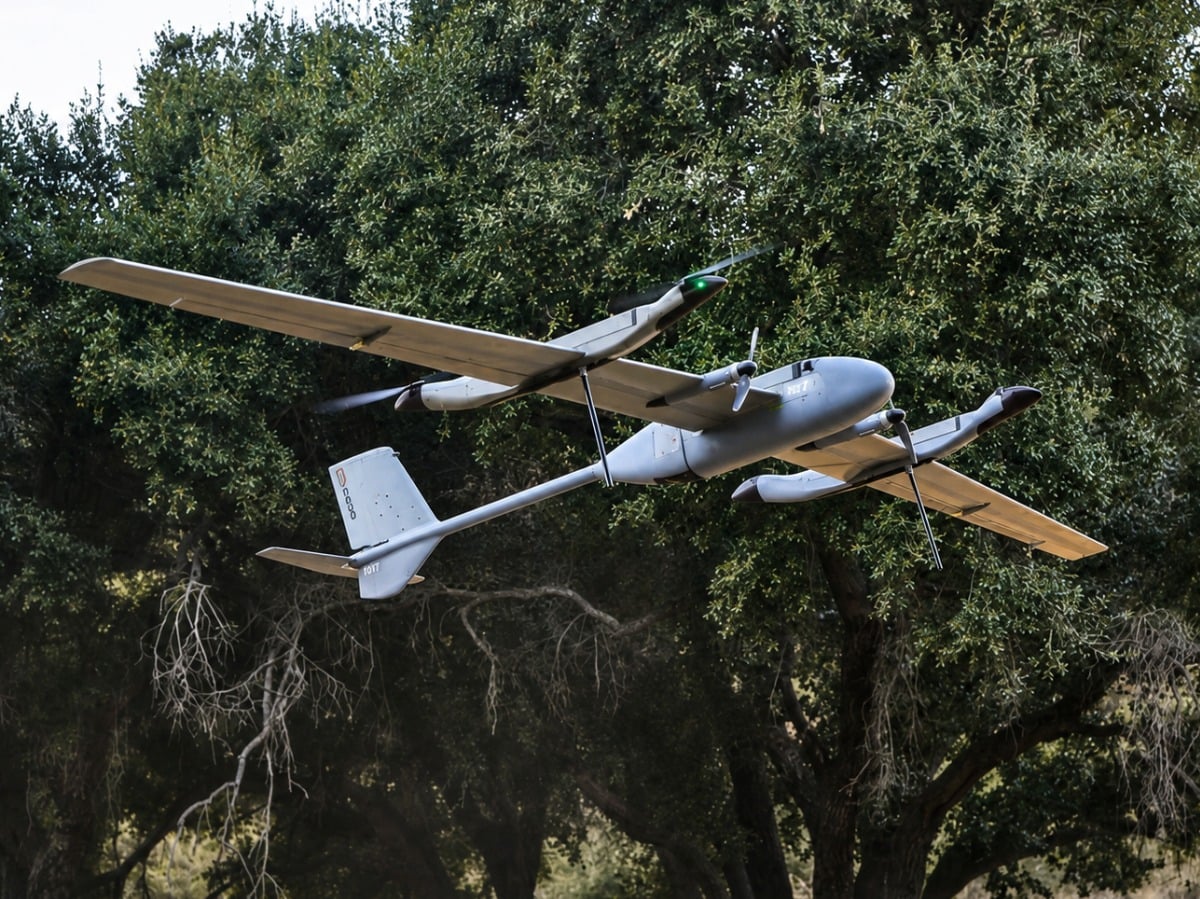
The United States Department of Defense’s recent $117 million contract for 82 P550 unmanned aerial systems (UAS) exposes a profound shift in modern military procurement: the transition from capital-intensive, multi-decade hardware programs to software-defined, rapid-attrition asset portfolios. At first glance, a unit cost of approximately $1.42 million per drone appears anomalously high for a platform categorized outside of traditional strategic reaper-class systems. However, evaluating this transaction through a standard commercial lens misinterprets the structural realities of defense economics. This acquisition must be evaluated through three distinct vectors: total lifecycle unit economics, systemic interoperability premiums, and the strategic mandate of the Replicator initiative.
The underlying math requires deconstructing the $117 million gross contract value into its constituent components. In military aerospace procurement, the headline contract figure rarely represents the flyaway cost of the airframe alone. Instead, the transaction represents an enterprise-level capability injection, governed by a cost function that encompasses three distinct variables.
$$C_{total} = N \cdot (C_{airframe} + C_{payload}) + C_{infrastructure} + C_{sustainment}$$
Where:
- $C_{total}$ is the aggregate contract value ($117 million)
- $N$ is the quantity of units (82)
- $C_{airframe}$ represents the baseline structural and propulsion mechanics
- $C_{payload}$ isolates the optical, electronic warfare, and sensor suites
- $C_{infrastructure}$ captures ground control stations, launch mechanisms, and transport systems
- $C_{sustainment}$ accounts for long-term parts provisioning, technical training, and software licensing
By applying this framework, the raw $1.42 million per-unit figure dissolves. A significant portion of the capital is allocated to non-recurring engineering costs, software deployment, and command-and-control infrastructure designed to outlive the initial 82 airframes.
The Payload-to-Airframe Cost Asymmetry
Modern autonomous defense systems reverse historical aerospace cost distributions. Historically, the physical platform—the aluminum, titanium, and turbine mechanics—consumed the majority of the budget. In the case of the P550, the physical airframe represents a minority fraction of total value. The primary cost drivers are concentrated within the intelligence, surveillance, reconnaissance, and targeting (ISRT) payload bay and the underlying software architecture.
This asymmetry is driven by specific operational requirements:
- Modular Open Systems Architecture (MOSA): The US Army requires platforms to feature interchangeable hardware payloads. This prevents vendor lock-in but requires expensive, hardened, universal digital interfaces that can seamlessly integrate disparate technologies, from signals intelligence pods to thermal imaging arrays.
- Edge-Compute Artificial Intelligence: The P550 does not merely transmit raw video feeds back to a human operator; it processes telemetry at the tactical edge. This demands ruggedized, high-throughput graphics processing units capable of executing computer vision algorithms under severe thermal and vibration stress. This hardware stack must identify, classify, and track localized threats autonomously in GPS-denied environments.
- Electronic Warfare and Counter-Jamming Resiliency: The communication architecture relies on frequency-hopping spread spectrum radios and anti-jamming GPS antennas (such as M-code receivers). The cost of these secure, encrypted communication modules routinely exceeds the cost of the electric propulsion systems powering the drone itself.
The airframe is ultimately a depreciable delivery vehicle for a highly sophisticated, reusable electronic sensor suite.
Strategic Context: The Replicator Doctrine and Attrition Warfare
To understand why the Army is paying a premium for this specific tier of UAS, one must analyze the broader shift in Pentagon acquisition strategy, specifically the Replicator initiative. The objective is to counter mass with mass—deploying thousands of attritable, autonomous systems to deter or win in high-intensity operational theaters.
The P550 occupies a critical node in this doctrinal shift, sitting directly between small, short-range First-Person View (FPV) loitering munitions and large, exquisite platforms like the MQ-9 Reaper. The strategic positioning of this asset tier can be mapped across a matrix of survivability, cost, and operational utility.
- Group 1-2 UAS (e.g., FPVs, Skydio X2D): Low cost ($1,000 - $50,000), short endurance (under 45 minutes), zero survivability in contested electronic warfare environments. These are tactical consumables.
- Group 3-4 UAS (e.g., P550, RQ-7 Shadow): Medium-to-high cost ($500,000 - $2,000,000), medium endurance (6-12 hours), modular payload capacity, designed for high-end operational integration. These are attritable but highly capable assets.
- Group 5 UAS (e.g., MQ-9 Reaper, RQ-4 Global Hawk): Extreme cost ($30,000,000+), long endurance (24+ hours), completely unsustainable loss rates in contested airspace. These are capital preservation assets.
The $117 million contract indicates that the US Army is prioritizing Group 3 platforms capable of operating autonomously when satellite communications and GPS are completely severed. The P550 is intended to bridge the gap: cheap enough to be risked in high-threat environments where a Reaper would be instantly destroyed, yet sophisticated enough to generate actionable targeting data for long-range precision fires.
Operational Risk Analysis and Strategic Limitations
Despite the rigorous technological specifications, this procurement strategy contains systemic vulnerabilities that defense planners must navigate. The primary risk factors are not mechanical, but industrial and architectural.
The first limitation centers on industrial supply chain elasticity. Producing 82 units under a $117 million contract suggests low-rate initial production (LRIP). In a peer-to-peer conflict, attrition rates for unmanned systems are measured in hundreds per week, not dozens per year. If the manufacturing pipeline for the P550 cannot scale rapidly from low-rate custom assembly to high-rate automated manufacturing, the platform remains a niche tactical luxury rather than a scalable deterrent. The complexity of the supply chain for its high-end thermal sensors and specialized semiconductors creates a natural bottleneck that cannot be solved solely by injecting more capital.
The second bottleneck is software obsolescence. Unlike traditional hardware, which degrades physically over decades, autonomous software suites degrade technologically over months as adversarial counter-measures evolve. The Army's contract must be evaluated on whether it includes continuous software delivery pipelines. If the $117 million does not guarantee ongoing algorithmic updates to combat evolving electronic warfare threats, the system's operational utility will decay long before the physical airframes reach their structural life limits.
The Long-Term Procurement Vector
The financial structure of this deal indicates that the US Army is establishing a new baseline for tactical intelligence units. This contract should not be viewed as a one-time equipment purchase, but as the foundational architecture for a broader, multi-regiment deployment.
Future procurement efficiency will depend entirely on decoupling hardware manufacturing from software integration. If subsequent contracts can lower the airframe acquisition cost while maintaining the same modular software core, the unit economics will scale favorably. If the vendor retains proprietary control over the interface standards, the Army will face compounding modernization costs over the lifecycle of the platform. The strategic play moving forward is the aggressive enforcement of open-architecture standards, forcing hardware components to commoditize while treating the mission software as the primary long-term asset.