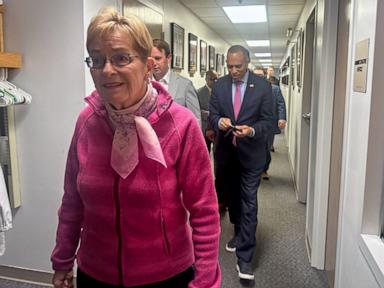
Control of the United States House of Representatives rarely hinges on the predictable corridors of power. It is fought out in the gritty, post-industrial fringes of the Midwest, where local labor economies clash against national partisan currents. When House Democratic leader Hakeem Jeffries flew into Toledo, Ohio, to stump for veteran incumbent Marcy Kaptur, he was not merely supporting a single member of his caucus. He was executing a calculated maneuver to crack open the structural math that has long dictated midterm congressional volatility.
To understand why a Brooklyn-based party leader spent crucial autumn days sitting in a Toledo church pew, one must look past the superficial talking points of typical campaign reporting. The real battle for the lower chamber is an exercise in demographic friction. Districts like Ohio's 9th present a unique analytical puzzle for national strategists. They feature working-class roots, heavy union histories, and a growing tilt toward Republican presidential candidates, yet they retain fierce loyalty to entrenched local incumbents who have mastered the art of personal branding.
Jeffries understands that holding the line in the Rust Belt requires more than nationalized messaging on economic anxiety. It requires a granular defense of local machinery. For months, political analysts treated the House majority as a simple game of arithmetic, assuming that presidential preference in a given zip code dictates down-ballot survival. That assumption ignores the staying power of institutional longevity. Marcy Kaptur has weathered political realignments for decades by maintaining an identity independent of Washington orthodoxy. When a party leader descends upon these battlegrounds, the objective is to anchor that local identity against the relentless undertow of a nationalized culture war.
Republicans, meanwhile, deployed their own heavy artillery, hoping to flip these very seats by binding Democratic incumbents to an unpopular national brand. Derek Merrin's repeat challenge in Ohio was designed as a referendum on national economic policy rather than local representation. Every dollar spent on airwaves in the Toledo media market was an attempt to overwrite twenty years of constituent service with a single, generalized narrative about inflation and federal overreach.
This creates a high-stakes standoff where conventional campaign logic frays. In past cycles, a district that voted decisively for a Republican president would inevitably pull the lever for the congressional challenger down the ballot. Ticket-splitting has faced severe downward pressure as hyper-polarization nationalized every corner of the ballot. Yet, the persistent survival of split-ticket anomalies proves that retail politics still retains a pulse. Voters in these districts often draw a sharp mental line between the person fixing local infrastructure or protecting regional manufacturing interests and the faceless legislative body operating two thousand miles away.
The strategic gamble made by Democratic leadership involves expanding the battlefield into territory that conventional models write off too early. By investing resources in districts that lean right at the top of the ticket, the party forces the opposition to spend defensive capital protecting seats they expected to secure cleanly. It is a war of attrition played out across suburban housing developments and union halls alike.
As the returns rolled in and the broader map shifted, the outcome in these gritty congressional districts revealed the true fault lines of modern American governance. National waves matter, but local defensive walls built over decades can bend without breaking. The math of the House majority is ultimately written in the margins of places like northwest Ohio, where every single precinct operates by its own set of rules, defying the clean projections of distant pundits.



