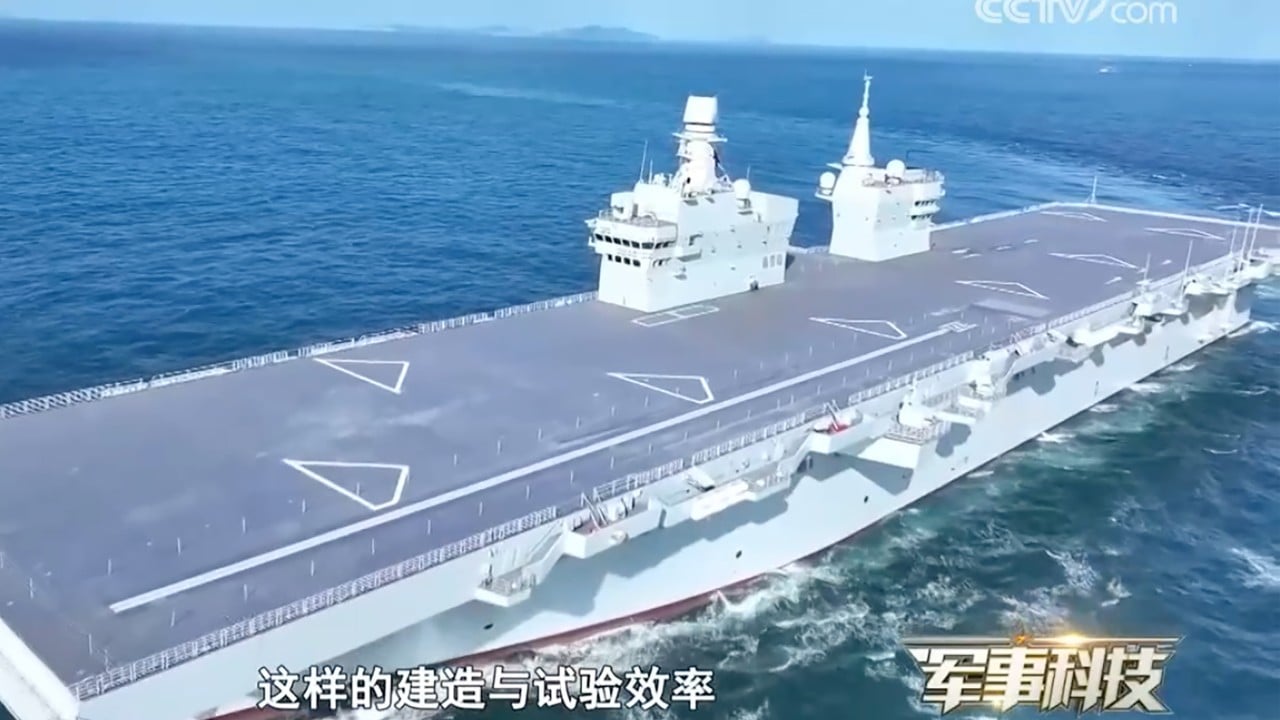
Everybody in the defense commentary ecosystem is having a collective meltdown over a deck marking and a steam puff.
The defense media looks at China’s Type 076 amphibious assault ship, spots an electromagnetic catapult carved into a flat flight deck, and immediately screams that Beijing has built a light carrier through the back door. They write breathless analyses about power projection, fixed-wing naval aviation, and the erosion of American maritime dominance. Building on this theme, you can find more in: Inside the Humanoid Robot Ban Nobody Expected.
They are wrong. They are missing the entire point of naval architecture, and they are falling for a superficial aesthetic trap.
A flat deck with an electromagnetic launch system does not turn a landing platform dock into a fleet carrier any more than putting wings on a bus makes it a fighter jet. The Type 076 is not a budget aircraft carrier. It is something much more specific, much weirder, and far more dangerous if you happen to live across a narrow strait from the mainland. Analysts at Engadget have shared their thoughts on this matter.
The Fatal Flaw in the Carrier Analogy
Let us start with the lazy consensus. The standard defense journalism narrative treats the Type 076 as an intermediate step between a helicopter carrier and a supercarrier like the Fujian. The logic goes like this: China put a catapult on the Type 075, therefore the Type 076 is designed to launch heavy fighter jets like the J-15 or stealth fighters like the J-35 to fight air supremacy battles over the open ocean.
This logic collapses under basic physical and logistical reality.
An aircraft carrier is not just a floating runway. It is a hyper-specialized, deeply compromised industrial ecosystem. To run fixed-wing fighter operations efficiently, you need massive aviation fuel storage, extensive ordnance magazines for air-to-air and air-to-ground strike packages, heavy-duty maintenance bays for high-stress airframes, and a complex below-deck hangar architecture designed to move multi-ton birds around via high-speed elevators without bottlenecking flight ops.
An amphibious assault ship has a completely different structural DNA. Its primary job is not to win dogfights three hundred miles away from friendly shores. Its job is to vomit armor, heavy artillery, and thousands of marines onto a hostile beachhead, and then keep those troops supplied while they establish a beachhead.
To do that, the hull of a Type 076 is hollowed out in a completely different way. A massive portion of its internal volume is dedicated to a well deck—a flooded garage that houses heavy amphibious landing craft, air-cushioned landing craft, and armored personnel carriers. You cannot simply delete the well deck to make room for jet fuel and bomb elevators without fundamentally breaking the ship's core purpose. You end up with a Franken-ship that is too fragile for a serious amphibious assault and too thinly supported for a high-intensity carrier air wing.
So why put an electromagnetic catapult on it? Because everyone is asking the wrong question.
Stop Asking About Fighters and Start Asking About Swarms
The question is not "What kind of fighter jet will launch from the Type 076?"
The correct question is "What kind of capability requires a high-energy launch mechanism, a flat deck, and massive secondary vehicle storage, but does not require a pilot in the cockpit?"
The answer is heavy, long-endurance unmanned aerial systems and loyal wingman platforms.
Imagine a scenario where a fleet needs twenty-four-hour persistent airborne early warning, electronic warfare jamming, and massive strike saturation, but cannot afford to risk human pilots or tie up precious supercarrier decks for routine surveillance loops.
The Type 076 is optimized for the unmanned era. Electromagnetic aircraft launch systems excel at launching things that do not have human spine-load tolerances. You can accelerate a heavy, uncrewed combat air vehicle or a massive logistics drone at forces that would black out a human pilot, using less track length and less raw energy than a heavy manned fighter.
By integrating an electromagnetic catapult onto an amphibious platform, the builders in Shanghai have created a mothership for distributed maritime disruption. It carries the heavy armor and landing craft needed to take an island, but it replaces the traditional helicopter complement with heavy autonomous reconnaissance and strike assets.
This is not a light carrier. It is an amphibious drone carrier designed for high-attrition, high-information warfare.
The Operational Reality Check
Let us look at the trade-offs, because every military design is a compromise wrapped in steel. If my contrarian take is right—that this hull is meant for heavy uncrewed systems alongside traditional marine landing forces—what are the operational bottlenecks?
First, maintenance. Unmanned systems are software-heavy and sensor-dense. Salt spray, high humidity, and heavy vibrations on a naval deck are absolute enemies of delicate electronics. If you pack a ship with sixty heavy drones and expect them to maintain high sortie rates without dry-dock-level clean rooms nearby, you are living in a simulation.
Second, command and control. Managing a swarm of autonomous or semi-autonomous combat drones while simultaneously coordinating a complex amphibious landing and marine logistics push creates an electromagnetic signature and a cognitive load that will stress any combat information center.
Third, vulnerability. A ship doing double duty as an amphibious transport and an uncrewed aviation hub carries immense strategic value. If you lose a Type 076, you do not just lose a flight deck; you lose your entire beachhead's immediate air support and its heavy landing craft in one fiery strike. It becomes an ultra-high-value target that the enemy will prioritize above almost everything else in the theater.
The Strategic Misdirection
The brilliance of the Type 076 design is not just technical; it is psychological.
By building a large deck with a visible catapult, defense planners knew exactly how Western analysts would react. They knew the think tanks would immediately fire up their modeling software, classify it as a light carrier, and start panicking about carrier-to-carrier ratios in the Western Pacific.
It draws attention, triggers endless panel discussions, and forces adversaries to waste intellectual and financial capital preparing to counter a traditional carrier threat that doesn't actually exist in the way they think it does.
Meanwhile, the real revolution happening inside these hulls is about mass, autonomy, and logistics. It is about shifting the economics of coastal projection away from multi-billion-dollar manned air wings toward distributed, disposable, and deeply integrated uncrewed systems operating right off the shoreline.
The defense establishment loves simple categories because simple categories fit into PowerPoint slides. They want every flat-top to be a carrier. They want every large surface combatant to fit neatly into a Cold War spreadsheet.
The Type 076 refuses to cooperate. It represents a blurring of lines between amphibious assault, naval aviation, and autonomous warfare that the old guard simply refuses to understand.
Stop looking at the catapult as a weapon to launch yesterday's fighter jets. Look at it as the starting gun for a completely different kind of naval conflict.