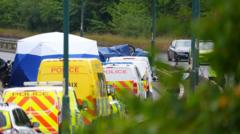
Two million pounds is enough money to pay the starting salaries of dozens of newly minted police constables for an entire year. It is enough to fund specialized collision-investigation units, replace worn-out patrol vehicles, and keep neighborhood stations staffed through the quietest, coldest winter nights. Yet on a spreadsheet somewhere in the corridors of policing, that sum sits as an unpaid debt—a ghost ledger tied to a catastrophic collision on the A66.
Wait.
Think about what happens when a major highway crash erupts in the north of England. Blue lights slice through wet tarmac and wind-lashed moorland. Traffic halts for miles. Family liaison officers prepare for the worst knock on a front door. Forensic investigators measure skid marks and piece together shattered glass in freezing air. Every single one of those actions costs money—real money, drawn from public budgets already stretched thin by rising demand, complex digital investigations, and relentless inflation.
When a commissioner states that police have yet to receive £2m following an A66 crash, it sounds like an accounting footnote. A dry line in a budget report. A bureaucratic delay that only finance directors care about.
That reaction misses the point entirely.
I have spent years reporting on public institutions and talking to people who work inside them when the cameras turn off. You hear the same quiet exhaustion in different accents across the country: officers covering wider patches with fewer backup units, civilian staff juggling overtime to clear backlogs, commissioners trying to explain to skeptical taxpayers why a force feels stretched even when headline funding figures look neat on paper. When two million pounds goes missing from a police budget—even if it is owed rather than stolen, delayed rather than lost—the pressure has to go somewhere.
To see how a bookkeeping delay turns into a street-level squeeze, consider a hypothetical scenario. Picture "Claire," a hypothetical police finance manager staring at a quarter-end projection screen on a gray Tuesday morning. Her force has already fronted the overtime for traffic officers, collision analysts, and emergency response teams tied to a major incident on the A66. The bills have been paid to staff and suppliers, or absorbed into existing operational lines. The reimbursement—the £2m—has not arrived. Claire cannot simply conjure cash out of thin air. Either reserves take a hit, other planned spending gets paused, or the force carries the weight while waiting for intergovernmental transfers, insurance settlements, or central claims to clear.
That is a hypothetical illustration meant to show the mechanics of cash flow, not a claim about any single person's desk. Yet the underlying tension is as real as worn brake pads.
Why does money owed to police after a major road collision take so long to materialize?
Unlike a simple retail transaction where goods are handed over and a card reader beeps within seconds, major incident cost recovery is a slow, tangled maze. When a serious crash shuts down a vital artery like the A66, multiple agencies and insurers may be involved. There are questions of liability, overlapping statutory responsibilities, central government funding mechanisms, and multi-layered approval chains. Everyone agrees that public safety matters. Nobody moves at emergency-response speed when signing off a seven-figure transfer.
Here is the trap: emergencies happen at ninety miles an hour, while financial reimbursements often move at a walking pace.
Think of a public budget like a household checking account with a strict overdraft limit. If an unexpected roof leak costs two thousand pounds and you have to pay the roofer today while waiting months for an insurer to reimburse you, your grocery money and heating bill feel the pinch right now. Scale that household up to a regional police force managing hundreds of millions of pounds in annual expenditure, and a £2m delay becomes a genuine operational headache. Two million pounds is not rounding error. It is real purchasing power sitting in limbo.
And there is a deeper, more uncomfortable question hiding behind the headline: Who is actually bearing the risk while that £2m sits uncollected?
When public bodies wait on delayed funds, taxpayers effectively act as an interest-free buffer. If the money eventually arrives, the crisis looks tidy in hindsight—a mere timing issue between fiscal quarters. If part of it is disputed, reduced, or delayed across financial years, front-line capacity feels the friction first. Recruitment slows, overtime gets scrutinized harder, and commissioners face pointed questions from local panels about value for money and financial resilience.
I admit something freely: police funding formulas and intergovernmental cost-recovery rules can feel labyrinthine even to people who read budgets for a living. Most residents do not wake up wanting to debate special grant claims, cost-sharing agreements, or reserve drawdowns. They want a simple bargain. They pay their taxes, obey the law within reason, and expect a visible, capable police service when danger strikes on a dark highway or a quiet residential street.
When a commissioner speaks out about £2m still owed after an A66 crash, that bargain is being tested in public view.
Consider what happens next when a commissioner puts a number like £2m into the open. It is rarely just a complaint about a late payment. It is a warning flare about how fragile public finances can look under pressure. Every major incident—whether a pile-up on a windswept trunk road, a complex multi-agency operation, or an unexpected surge in demand—exposes the gap between immediate operational duty and delayed financial settlement.
Historically, policing in Britain has always walked a tightrope between local accountability and central funding realities. From the days of parish constables and local rates to modern police and crime commissioners balancing tight multi-year settlements, the central question has stayed remarkably consistent: how do you fund an unpredictable service with predictable budgets?
A major crash on the A66 proves how quickly predictability evaporates. One moment, traffic is flowing west toward the coast or east toward the Pennines. The next, emergency responders are managing a high-consequence scene that demands immediate resources without waiting for an accountant's sign-off. Duty comes first. The paperwork follows later—sometimes much later.
That is why cold news headlines about unpaid sums deserve a warmer, sharper reading. Behind every figure in a police commissioner's update is a chain of real consequences: officers stretched across shifts, planners trying to keep reserves healthy, and communities wondering whether the safety net beneath them has enough slack when something goes wrong.
Two million pounds on paper looks like digits after a pound sign.
On the ground, it is shifts, equipment, time, and trust.
And until that money actually lands where it is needed, the ledger on the A66 remains unfinished business—a quiet reminder that even after the road reopens and the wreckage is cleared, the real cost of a crisis can linger long after the blue lights fade.


