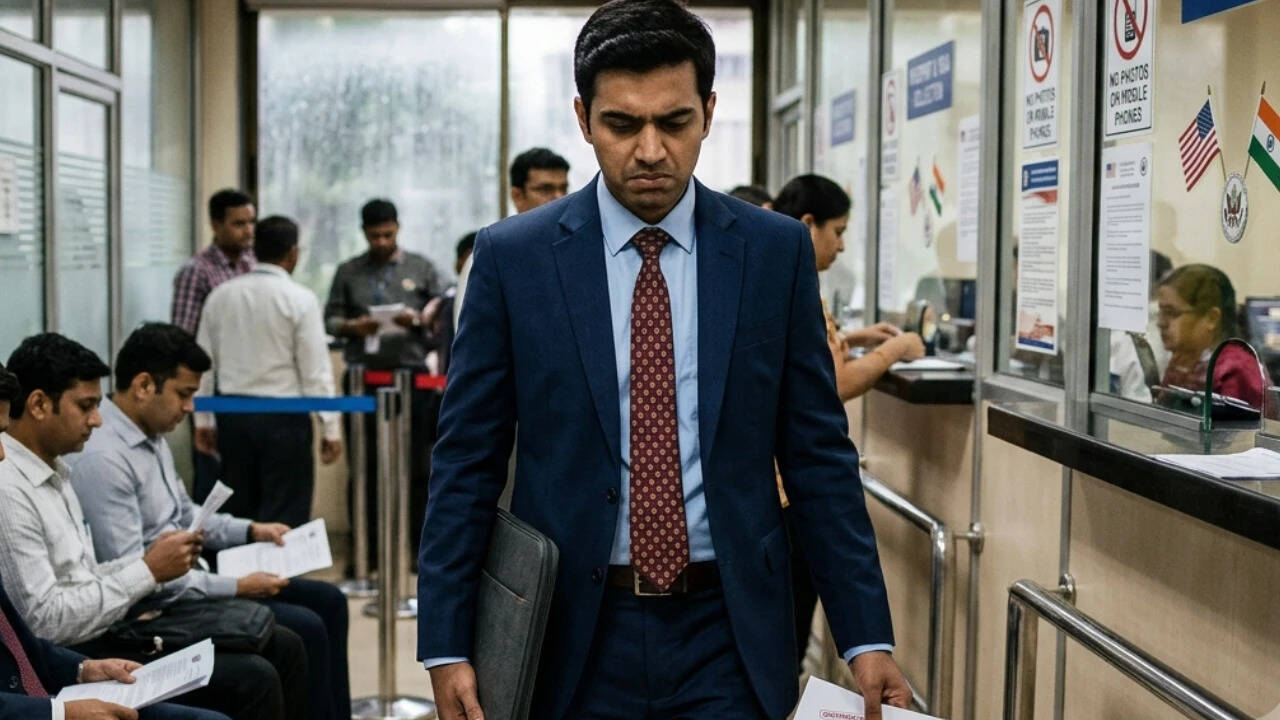
An Indian Public Sector Undertaking employee walks out of a United States consulate office, clutching a rejection slip after an interview lasting a mere twenty seconds. The official behind the glass did not look at the meticulously gathered files, the multi-million-dollar government backing, or the letters from corporate partners. A single glance at a passport and a cursory scan of a computer screen sealed the outcome. The public outcry that followed focused on bruised national pride and the humiliating nature of modern consular processing. Yet the deeper story lies entirely elsewhere.
This twenty-second interaction represents an invisible machinery operating under strict statistical mandates rather than individual evaluation. When a government employee with stable ties to a major domestic institution gets turned away without explanation, it lays bare the blunt-force mechanics of contemporary consular screening. The system is not broken by accident. It operates precisely as intended by risk-averse bureaucracies prioritizing speed and aggregate denial metrics over contextual accuracy.
The Mechanics of Mass Rejection
Bureaucracy abhors complexity. Consular officers across global missions face crushing daily caseloads, leaving them with precious little time to adjudicate individual human stories. Under Section 214(b) of the United States Immigration and Nationality Act, every applicant is presumed to be an intending immigrant until they prove otherwise. That single legal presumption shifts the burden of proof entirely onto the traveler, transforming a tourist visa application into an uphill battle against an invisible ceiling of suspicion.
Consider the arithmetic. A typical consular officer may process over one hundred applications daily. Simple division reveals the brutal reality: allocate two minutes per person, and the day is gone. In practice, many decisions materialize in seconds. Officers look for rapid-fire markers of risk, stability, and intent. If an applicant hails from a demographic or occupational tier historically associated with overstay rates, the electronic screening tool or the officer's mental heuristic swings closed.
This creates a pervasive sense of arbitrariness. A state-owned enterprise engineer holding a stable government salary, a secure pension, and deep family roots in their home country looks like a safe bet on paper. To an algorithm or an exhausted adjudicator trained to spot anomalies, however, that same profile might trigger administrative caution due to high regional non-immigrant visa refusal statistics.
The High Cost of Institutionalized Cynicism
The ripple effects of these rapid-fire rejections extend far beyond bruised egos. International diplomacy and cultural exchange rely on reciprocal mobility. When mid-career professionals, academics, and corporate leaders from fast-growing economies encounter summary dismissals, institutional trust erodes.
Tourism boards and hospitality sectors in Western nations frequently bemoan the loss of high-spending travelers. They focus on marketing campaigns while ignoring the structural friction at the consulate door. Money cannot bypass a visa stamp. If an affluent traveler decides that the humiliation of an arbitrary consular interview is simply not worth the expense, they take their vacation budget elsewhere. Europe, Southeast Asia, and domestic luxury circuits readily absorb the displaced capital.
Furthermore, professional mobility suffers. Global conferences, technology summits, and corporate training programs depend on face-to-face interaction. When routine business travel turns into a lottery where success depends on the mood of an anonymous adjudicator, companies begin restructuring their operational models. They hold conferences in third-party neutral locations or bypass American partners altogether to avoid logistical nightmares.
Why the System Refuses to Adapt
Pressure for reform routinely hits a brick wall of national security rhetoric and political posturing. Immigration policy in major Western democracies functions as a domestic political football. Lawmakers rarely win votes by advocating for streamlined visa processing for foreign nationals. Instead, political incentives favor restriction, deterrence, and the appearance of border fortification.
Consular guidelines rarely adjust for the shifting economic realities of the developing world. Thirty years ago, a citizen of a developing economy applying for a tourist visa might well have been motivated by a desire to seek clandestine employment abroad. Today, many citizens of nations like India enjoy robust domestic career paths, rising living standards, and competitive local markets. They travel to see sights, attend conferences, or visit family, with every intention of returning home to their established lives.
Consular databases and training manuals, however, lag behind these socio-economic shifts. They rely on legacy risk profiles that treat entire nationalities through a lens of generalized suspicion. Until administrative bodies update their evaluation criteria to reflect modern economic realities, skilled professionals will continue to be processed through an assembly line designed for an entirely different era.
The Psychological Toll on the Applicant
Beyond the economic and diplomatic fallout lies the deeply personal indignity of the process. For many applicants, a US visa interview is their first direct encounter with foreign bureaucratic power. They spend weeks assembling tax documents, employment letters, property deeds, and invitation letters. They pay non-refundable application fees that represent a significant chunk of discretionary income in many local economies.
To watch an officer dismiss that entire dossier without opening a single folder creates a lasting psychological impression. It signals that personal integrity, professional standing, and institutional backing count for nothing against a faceless administrative wall. For the public sector employee mentioned earlier, the vow never to apply again is not merely an emotional outburst. It is a rational withdrawal from a transaction where the costs, both financial and emotional, vastly outweigh any potential reward.
Navigating the Impasse
Fixing a bureaucratic apparatus of this scale requires more than polite suggestions. It demands structural overhauls that few governments are willing to fund or politically risk.
True reform would necessitate separating high-trust applicants—such as established civil servants, tenured academics, and verified corporate executives—from the general applicant pool. Trusted traveler programs already exist for frequent flyers crossing physical borders; a similar tiered vetting process could streamline tourist and business authorizations for vetted professionals. By offloading low-risk profiles into expedited verification channels, consular services could redirect their scarce human resources toward genuine security concerns.
Yet, institutional inertia remains powerful. Ministries of foreign affairs protect their turf, and security agencies resist any measure that smells of relaxation. The status quo persists because the primary victims of the system—foreign nationals seeking temporary entry—have no vote in the countries denying them access.
Until political leaders recognize that modern economic diplomacy requires welcoming skilled temporary visitors rather than repelling them with twenty-second rejections, the glass partition will remain a symbol of bureaucratic alienation. The traveler walks away. The system keeps ticking. And the invisible wall grows higher.