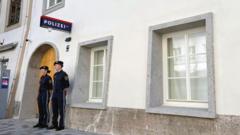
Bureaucrats in Vienna genuinely believe they can arrest history.
By turning Adolf Hitler’s birthplace in Braunau am Inn into a fully operational police station, the Austrian government isn't neutralizing a neo-Nazi shrine. They are committing an act of institutional cowardice. They are spending tens of millions of euros on architectural amnesia, convincing themselves that if you slap enough drywall, fresh paint, and administrative authority over a dark past, the ghost simply vacates the premises. Meanwhile, you can explore similar developments here: Why Canadian Agriculture Is Facing Trump's Biggest Tariff Threat Yet.
It is a comfortable lie. It is also completely ineffective.
The mainstream consensus around this decision celebrates it as a triumph of "neutralization"—a clever policy maneuver designed to strip the site of its symbolic power. Mainstream media covers the project as a tidy, sensible solution to a uncomfortable problem. To explore the full picture, check out the recent analysis by Associated Press.
That consensus is lazy, historically illiterate, and fundamentally misunderstand how ideological symbolism works. You do not destroy a site’s mythos by handing the keys to the state apparatus. You merely prove that the state is terrified of its own shadow.
The Myth of Neutralization
Let’s define what is actually happening here. Austria has spent decades struggling with its narrative as the "first victim" of National Socialism—a convenient myth constructed after World War II to evade accountability. While the country has made genuine strides toward historical honesty in recent years, the handling of the Braunau house exposes a lingering, toxic impulse: the urge to sanitize.
When a government decides to "neutralize" a space of historical trauma, it usually means one of three things:
- Demolishing the structure entirely to create a blank space.
- Converting the space into a museum or educational memorial.
- Repurposing the space for mundane administrative tasks to force obscurity.
Austria chose the third path. The logic sounds appealing on paper. If the building becomes a place where ordinary cops write traffic tickets and process paperwork, far-right extremists won't be able to assemble or treat it as a sacred site without immediately running into the law.
Except extremist subcultures don't care about administrative functions.
Symbolism is sticky. It attaches to coordinates, not floor plans. Neo-Nazis do not pilgrimage to Braunau am Inn to admire the architecture of the house; they go because of what happened inside those walls in April 1889. Turning the building into a precinct doesn't erase the coordinate. It merely surrounds the coordinate with uniforms. In the inverted logic of extremist ideology, placing the police at the exact birthplace of their idol doesn't sanitize the location—it turns the state into an unintended guard force for the site itself.
The Cost of Architectural Amnesia
I have tracked public policy responses to controversial heritage sites for over two decades. Time and again, governments fall into the same trap. They treat physical structures as radioactive material that must be encased in lead and buried, rather than as instructional sites that force a public confrontation with uncomfortable truths.
Imagine a scenario where Germany had decided to turn the remains of the Dachau concentration camp into a local municipality office to "neutralize" its grim atmosphere. The public outcry would be immediate and deserved. We would rightly identify it as an attempt to bury uncomfortable memory beneath the mundane routines of civil service.
Why, then, do we celebrate the exact same logic when applied to Braunau?
The Austrian government’s own commissioned survey revealed that a significant portion of the population favored turning the building into a center dedicated to human rights or historical reflection. Experts in memory politics, including prominent historians, argued that neutralizing the building through administrative re-use sends a message of evasion.
Instead, the government opted for the path of maximum erasure. They hired architects to alter the facade, stripping away historical features to make the building look as bland, modern, and uninspired as possible.
This isn't civic responsibility. It is bureaucratic vandalism.
+-----------------------------------------------------------------------+
|                       THE DUALITY OF MEMORY                           |
+-----------------------------------------------------------------------+
|  SANITZATION APPROACH (Vienna's Choice) | CONFRONTATION APPROACH      |
+-----------------------------------------+-----------------------------+
|  • Alters facade to force obscurity     | • Preserves structural context
|  • Replaces history with bureaucracy    | • Establishes education hub |
|  • Treats the public like children     | • Demands civic maturity    |
|  • Feeds extremist mythology            | • Demystifies the myth      |
+-----------------------------------------------------------------------+
When you alter a historical building to make people forget what it was, you admit that your society lacks the stomach to look at its own history without flinching. You signal weakness.
Why Extremists Love Bureaucracy
Here is the counter-intuitive reality that policymakers continuously fail to grasp: Efforts to hide history always weaponize the hidden object.
Forbidden fruit burns brighter. By spending millions of euros to re-architect the building, file eminent domain seizures, and hold international design competitions just to disguise a three-story house, the Austrian state has validated the location's significance. They have signaled to every far-right actor in Europe that this specific patch of dirt possesses so much latent power that the entire machinery of state must mobilize to contain it.
If you want to kill a myth, you don't build a fortress over it. You demystify it. You expose it to light until it becomes entirely ordinary, pathetic, and understood.
Consider how other nations handle sites of infamy:
- The Educational Pivot: Transforming sites of perpetrator history into critical learning centers that dissect how ordinary societies slide into barbarism.
- The Open Wound Strategy: Leaving structures intact while surrounding them with explicit context that strips away romanticism and replaces it with cold, hard documentation.
- The Total Exposure: Allowing full access under strict, unflinching historical framing, turning what was meant to be a shrine into a mirror of national shame.
Instead of turning the Braunau house into a police precinct, Austria should have turned it into a cold, clinical museum documenting the mechanics of Austrian complicity during the Anschluss. It should have been a place where every schoolchild in the region goes to learn how local citizens cheered in the streets when the Nazi regime took power.
That approach takes courage. It forces a population to confront the reality that monsters are not born out of thin air in quiet border towns; they are created by societal choices.
Putting a precinct there allows everyone to walk past, dust off their hands, and say, "Problem solved. The police are in charge now."
The Flawed Questions We Keep Asking
When public debates erupt over sites like Braunau, the questions asked by journalists and politicians are almost always wrong.
They ask: How do we stop neo-Nazis from gathering here?
That is a security question, not a historical or cultural one. If your primary goal is police management, you have already ceded the moral high ground. The real question should be: How do we use this space to make sure the ideology born here is completely dismantled in the minds of future generations?
They ask: Won't a memorial or educational center turn the town into a permanent spectacle?
The town is already a spectacle. It has been a spectacle since 1938. You cannot opt out of history because it is inconvenient for local real estate values or town marketing. Pretending the building is just another precinct house does not stop tourists from taking discreet photos from across the street. It just ensures those tourists leave without learning a single useful thing.
The Reality of Civic Courage
There is a cost to my argument, and I won't pretend otherwise.
Maintaining perpetrator sites as educational hubs is expensive, politically exhausting, and invites constant friction. It requires ongoing security, continuous updating of educational materials, and a willingness to endure local backlash from residents who just want their quiet town to be known for something—anything—else.
It is infinitely easier to sign a construction contract, bring in the concrete mixers, and post a few patrol cars at the front door.
But ease is not a civic virtue.
By choosing the easy way out, Austria is setting a dangerous precedent for how modern democracies handle uncomfortable history. We are seeing this pattern repeat globally: when history becomes too complicated, too offensive, or too dangerous, the institutional response is to paint over it. We rename the streets, tear down the walls, fill the spaces with neutral civil servants, and congratulate ourselves on our maturity.
It is not maturity. It is cowardice wearing a suit.
Real strength doesn't hide the house where the monster was born. Real strength leaves the door wide open, turns on every light in the building, and shows the world exactly how small the monster actually was.
Strip the police logo off the door. Take down the fresh scaffolding. Put the history back inside where it belongs, and force the world to look at it.


