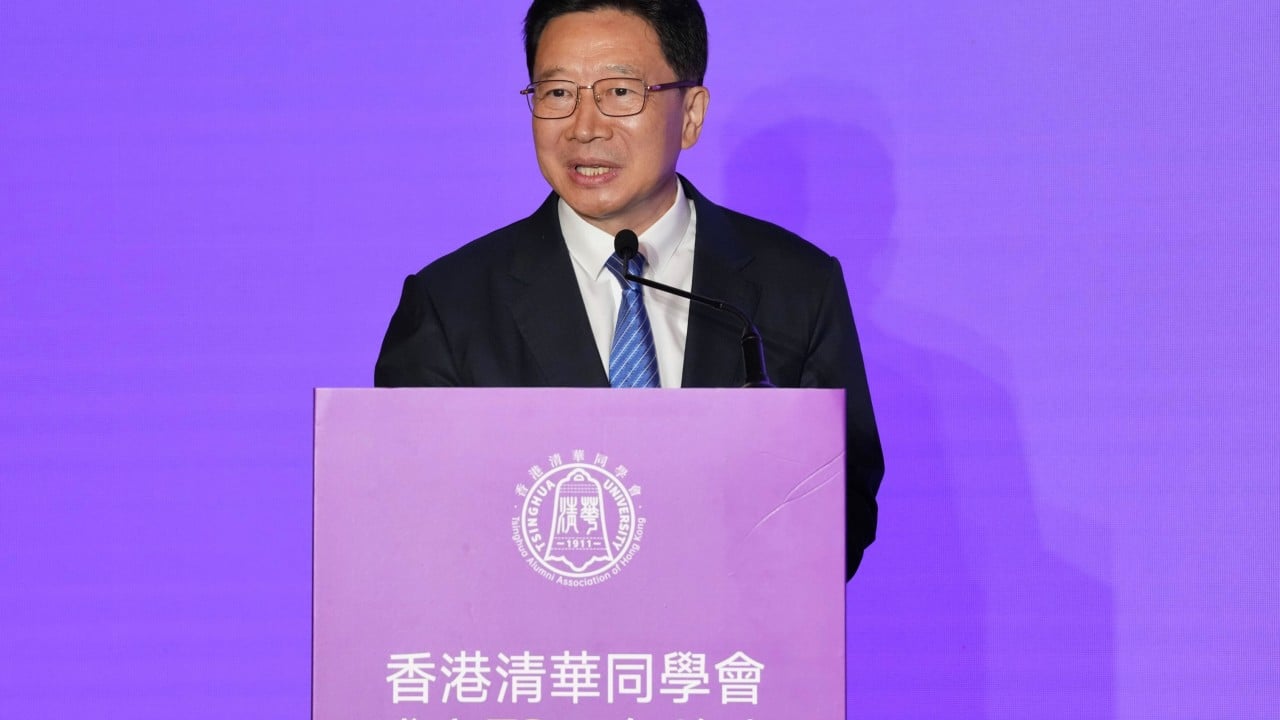
The recent call by Zheng Yanxiong, director of the Liaison Office of the Central People's Government in Hong Kong, for Tsinghua University alumni to spearhead the city’s integration into national development is not merely a polite suggestion. It is a directive. While mainstream coverage treated the meeting as a ceremonial gathering of academics, the underlying reality is far more consequential. Beijing is moving to replace the old colonial-era professional class with a new elite forged in the fires of mainland China’s premier technological and political incubator.
Hong Kong currently finds itself at a precarious crossroads. For decades, the city relied on its unique position as a bridge between the West and the East, powered by a civil service and business elite educated at Oxford, Cambridge, and the Ivy League. That era is ending. The new mandate requires Hong Kong to transform into a global innovation and technology hub, specifically to bypass Western sanctions and secure China’s "self-reliance" in critical sectors like semiconductors and artificial intelligence. This shift requires a different kind of operative—one who understands the nuance of international markets but maintains absolute loyalty to the national strategic objectives of the mainland.
The Strategic Displacement of the Old Guard
For over a century, the power structure in Hong Kong was predictable. Law, finance, and administration were the domains of the locally born, Western-educated elite. However, this group has struggled to adapt to the "Northern shift." Their expertise in British Common Law and global finance remains useful, but it is no longer sufficient for a city that must now function as a cog in the Greater Bay Area machine.
Tsinghua alumni represent the perfect solution for the Liaison Office. Tsinghua is not just a university; it is the "cradle of red engineers." Its graduates occupy the highest echelons of the Chinese government and the boardrooms of the country's most powerful tech giants. By encouraging these individuals to take up influential roles in Hong Kong’s technology parks, universities, and government advisory boards, Beijing is effectively installing a "shadow management" layer. These are individuals who speak the language of the Party and the language of the lab with equal fluency.
This is a calculated displacement. As the Western-educated elite feels increasingly alienated by the city's political trajectory, the Tsinghua cohort is stepping in to fill the vacuum. They bring with them something the old guard lacks: direct, high-level connections to the central government and a deep understanding of how to navigate the mainland’s massive industrial subsidies and state-led venture capital.
Why Hong Kong Needs a New Brain
The push for Tsinghua involvement stems from a harsh realization within the Liaison Office. Hong Kong's attempt to diversify its economy away from real estate and finance has been, at best, sluggish. The city has plenty of capital, but it lacks the "hard tech" DNA required to compete in the 21st century.
The Innovation Gap
While Hong Kong boasts world-class universities, their research has historically been academic rather than industrial. There is a disconnect between the laboratory and the marketplace. Tsinghua graduates, particularly those with experience in Beijing’s Zhongguancun tech hub, are seen as the "connectors" who can fix this. They are expected to:
- Commercialize Research: Translating the theoretical breakthroughs of Hong Kong’s scientists into tangible products that can be manufactured in Shenzhen.
- Secure Talent: Acting as magnets for mainland Chinese researchers who might otherwise choose Silicon Valley or Singapore.
- Direct Capital: Guiding Hong Kong’s vast private wealth into "strategic" sectors rather than another luxury residential tower.
This isn't about soft power. It's about building a fortress. As the United States tightens export controls on sensitive technologies, Hong Kong must become a "clearing house" for innovation that can survive outside the Western orbit. The Tsinghua network is the infrastructure for this new reality.
The Governance of Networks
Zheng Yanxiong’s appeal to the "Tsinghua spirit" highlights a fundamental change in how Hong Kong is being governed. We are moving away from a model of open, transparent consultation toward a model of networked governance. In this system, decisions are made through a web of alumni associations, state-owned enterprises, and cross-border committees.
The Tsinghua University Hong Kong Alumni Association is no longer just a social club for graduates to reminisce about their days in Beijing. It has become a vetting ground for future political leaders and a platform for coordinating state policy. When the Liaison Office chief tells these alumni to "serve the nation," he is instructing them to act as the primary interlocutors between the city and the central government.
This creates a dual-track system. On the surface, the Hong Kong government continues to operate. Beneath the surface, the real strategic planning is happening within these specialized networks of mainland-educated professionals who have been "parachuted" into the city's critical sectors.
The Risks of a Homogenous Elite
While the influx of Tsinghua talent provides a much-needed boost to Hong Kong's technical capabilities, it carries significant risks that the Liaison Office rarely acknowledges. The primary strength of Hong Kong has always been its pluralism—its ability to absorb influences from all over the world.
If the city’s elite becomes a monolith of mainland-educated technocrats, it risks losing the very "internationality" that makes it valuable to China in the first place. If Hong Kong simply becomes "another Chinese city" managed by the same people who manage Beijing or Shanghai, its utility as an offshore financial and legal center evaporates.
Furthermore, there is the issue of local resentment. The "Lion Rock" spirit of self-made Hong Kongers is being tested by a new class of arrivals who appear to have an inside track to power and funding. If the perception grows that the highest rungs of the ladder are reserved for those with the right mainland pedigree, the city could face a persistent brain drain of its own home-grown talent, who may see better prospects in London, Sydney, or Vancouver.
The Technical Execution of Integration
How does this look on the ground? It manifests in the massive "Northern Metropolis" project—a development plan that will turn the border regions of Hong Kong into a tech megalopolis. This is where the Tsinghua alumni will exert the most influence.
We are seeing a shift in how land is allocated and how grants are awarded. The criteria are increasingly aligned with the "Five-Year Plans" of the central government. If you are a startup founder in Hong Kong today, your chances of success are significantly higher if your board includes individuals with deep ties to the mainland establishment. This is not necessarily a "corruption" of the system, but a fundamental realignment of its incentives.
The goal is to create a "closed-loop" ecosystem. Research starts in a Hong Kong lab (funded by state-linked grants), is developed by a team led by a Tsinghua-educated CTO, and is then scaled up in a mainland factory using components sourced through a network of alumni-owned suppliers.
The Geopolitical Buffer
We must view this through the lens of the current global conflict. Hong Kong is being prepared as a "lifeboat" for Chinese technology. In the event of a total decoupling between the US and China, Beijing needs a territory that maintains some level of international recognition but is firmly under its operational control.
The Tsinghua cohort is the "technical crew" of this lifeboat. Their mission is to ensure that Hong Kong’s financial systems can handle digital yuan transactions, its internet remains connected but filtered, and its legal system can protect Chinese patents while navigating international disputes. They are the bridge builders who are currently dismantling the old bridge and replacing it with a more secure, state-monitored alternative.
The Price of Admission
For the Tsinghua alumni themselves, the call to "serve" comes with immense pressure. They are being asked to navigate a city that is culturally distinct and, in many quarters, skeptical of their presence. They must prove they can deliver the economic "miracle" that has eluded Hong Kong for the last two decades.
The Liaison Office is betting that the discipline and technical prowess of these graduates will succeed where the laissez-faire policies of the past failed. They are betting that a planned, state-led innovation economy can replace the chaotic, market-driven energy that once defined the city.
This is a high-stakes experiment in urban reengineering. If it works, Hong Kong becomes the high-tech crown jewel of the Greater Bay Area, a city that functions with the efficiency of a motherboard. If it fails, it becomes a hollowed-out administrative zone, staffed by an elite that is disconnected from the local population and redundant to the needs of the global market.
The directive from the Liaison Office is clear: the old Hong Kong is being archived. The new Hong Kong is being coded, and the programmers have all been trained in the same classrooms in Beijing. The only question remains whether the "software" they are installing is compatible with a city that has always thrived on its own unpredictable, unruly spirit.
The transformation is already well underway. You can see it in the changing demographics of the science parks, the shift in the language used in policy addresses, and the quiet exit of the Western-oriented middle class. The "Tsinghua-ization" of Hong Kong is not a future possibility; it is the current operating reality.
Investors and professionals who fail to recognize this shift are looking at a map of a city that no longer exists. The power centers have moved. The gatekeepers have changed. Success in the "new" Hong Kong requires understanding that the road to influence no longer runs through the colonial-era clubs of Central, but through the alumni networks of the mainland’s elite institutions.
Identify the connectors. Watch the board appointments. Follow the research grants. The blueprint for the city's future is being written in the dialect of the technocrat, and there is no room for translation errors.