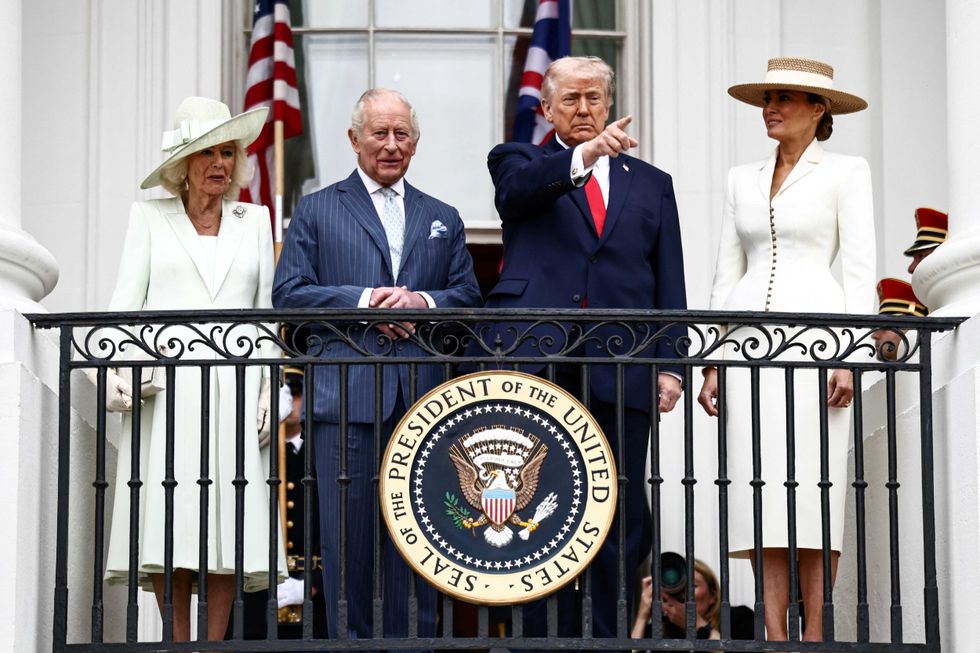
Watching a world leader stumble through a formal state visit usually triggers a wave of second-hand embarrassment. When Donald Trump greeted King Charles III and Queen Camilla on the White House South Lawn this week, the internet expected the usual protocol breaches—maybe a missed bow or a heavy-handed pat on the back. Instead, we got something that left seasoned medical observers genuinely rattled.
Psychologists and cognitive experts aren’t just talking about "bad manners" anymore. They’re pointing to a specific, observable shift in how the 79-year-old president processes social cues. If you’ve ever cared for an aging parent, some of these "gaffes" might look hauntingly familiar. It isn't about being "anti-Trump" or "pro-monarchy." It's about basic brain health and what happens when the internal GPS for social behavior starts to glitch. Also making waves lately: The Brutal Truth About Defensiveness And Why Your Arguments Always Fail.
The royal gaffe that set off alarm bells
During the April 2026 welcome ceremony, Trump reportedly veered off-script with a series of remarks that left the King visibly unsettled. According to reports cited by RadarOnline, this wasn't just the typical Trump bravado. It was a failure to recognize the gravity of the setting—a phenomenon experts call "loss of social decorum."
In the medical world, specifically when discussing neurodegenerative conditions, this is often a red flag. Dr. John Gartner, a former Johns Hopkins University Medical School professor who has tracked Trump’s behavior for years, has been vocal about these slips. He notes that when a person loses the ability to "read the room," it’s frequently because the frontal lobes of the brain—the parts responsible for impulse control and social appropriateness—are beginning to thin. More insights regarding the matter are detailed by National Institutes of Health.
It’s not just about the King
While the media focuses on the insult to the British Crown, the real story is the breakdown of "executive function." You see it in the way he walks, the way he repeats stories he told five minutes ago, and his increasing tendency toward "confabulation."
Confabulation isn't just lying. It’s when a brain with memory gaps creates "false memories" to fill in the blanks, and the person believes them entirely. When Trump confuses world leaders or mixes up historical dates, he isn't trying to deceive you; his brain is honestly trying to make sense of a reality that’s becoming increasingly fragmented.
Phonemic paraphasias and the tell-tale signs
If you listen closely to his recent rallies or that awkward exchange with the royals, you’ll hear something called phonemic paraphasias. This happens when a person uses "non-words" or mixes up syllables in a way that sounds like a slip of the tongue but occurs with alarming frequency.
- Substituting "mish-mosh" for "mission"
- Slurring through multi-syllable words
- Losing the thread of a sentence mid-way and pivoting to a familiar, "safe" anecdote
The image above shows the areas most commonly affected by various forms of dementia. When the frontal lobe (the blue area at the front) deteriorates, social filters disappear. You say exactly what pops into your head, regardless of how inappropriate or nonsensical it is. When the temporal lobe (the green area on the side) is affected, language starts to crumble.
The MoCA test isn’t an IQ test
Trump has famously bragged about "acing" a cognitive screening, often confusing it with a standard intelligence test. It’s a point Dr. Gartner and other experts have repeatedly corrected. The Montreal Cognitive Assessment (MoCA) is designed to detect significant impairment. It asks you to identify an elephant, draw a clock, and remember five words.
For a sitting president to brag about passing a test designed to check if you know what year it is... well, it’s like a marathon runner bragging they passed a "can you walk to the mailbox" test. The fact that he was taking the test at all suggests that his medical team—or he himself—noticed something was off.
Why this matters for the next few years
We’re at a point where the conversation around presidential health needs to move past political spin. We’ve seen this movie before. Think back to the later years of Ronald Reagan’s presidency. History eventually confirmed what many doctors suspected at the time: the "Great Communicator" was battling the early stages of Alzheimer’s while holding the nuclear codes.
What we’re seeing now is an escalation. The royal gaffe is just the latest symptom in a pattern that includes:
- Gait changes: The wide-based, shuffling walk often seen in vascular dementia.
- Semantic collapse: Using fewer unique words and relying on a "word salad" of superlatives.
- Disinhibition: An inability to stop oneself from making aggressive or bizarre outbursts, even in formal settings.
It’s easy to dismiss these things as "Trump being Trump." But if you look at footage from 2016 and compare it to 2026, the difference is stark. The 2016 version was a punchy, aggressive debater. The 2026 version is someone who frequently looks lost in the middle of his own stories.
What you should watch for next
Don't just take a pundit’s word for it. Keep an eye on his unscripted moments. Teleprompters can hide a lot of cognitive rot, but the "gaffes" happen in the margins. Watch the way he reacts when he's corrected. Look for "perseveration"—the repetitive repetition of a specific word or phrase over and over because the brain can't find the "off" switch.
If you’re concerned about a loved one showing similar signs, the best first step is a formal evaluation by a neurologist, not just a GP. Cognitive decline isn't a "normal" part of aging; it’s a medical condition. For a president, the stakes are just a bit higher than they are for the rest of us.
Pay attention to the language. Pay attention to the walk. The signs are there if you're willing to see them.