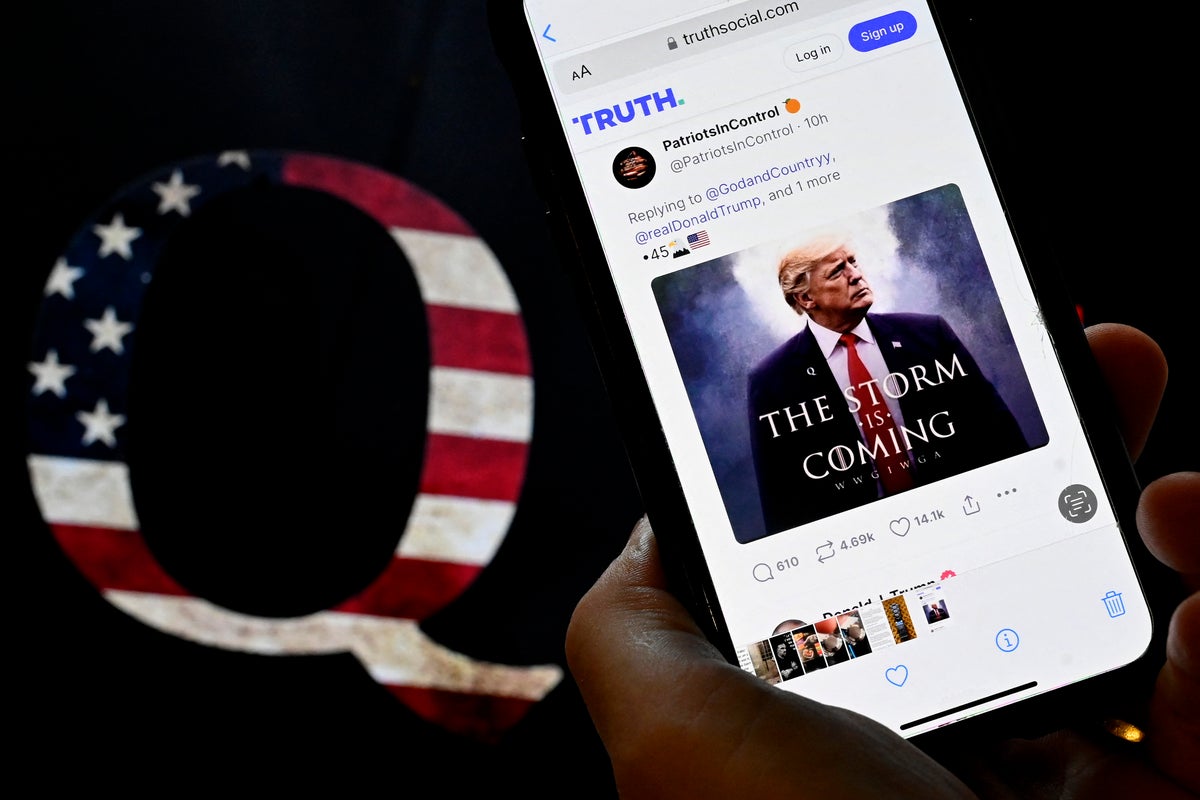
Donald Trump just reminded everyone that he hasn't moved on from the fringe. Late Tuesday night, the former president fired off a series of posts on Truth Social that didn't just nod to QAnon—they practically gave it a bear hug. We aren't talking about a casual "like" or a vague comment. We're talking about a targeted signal to a movement that thinks a secret cabal of "deep state" pedophiles runs the world.
If you're wondering why a major political figure is still playing footsie with a conspiracy group labeled a domestic terrorism threat by the FBI, it's not because he's bored. It's a calculated play for a very specific, very loyal base that never left his side. You might also find this similar coverage useful: The Failed Experiment of Russian Security in Mali.
The midnight posting spree explained
The latest activity wasn't a one-off. Trump shared an image that featured a prominent "Q" and the slogan "Where We Go One, We Go All" (WWG1WGA). To the uninitiated, it looks like alphabet soup. To his core followers, it's a "comms" check.
People often ask if Trump actually believes this stuff. Honestly, it doesn't matter. What matters is that he knows they believe it. By sharing this content, he’s effectively saying, "I see you, and I’m with you." It’s a low-cost way to maintain an army of digital soldiers who will defend him against any indictment or political setback. As discussed in detailed reports by The New York Times, the effects are notable.
This isn't the first time he's done this, but the timing is interesting. Following the recent security scares at the White House Correspondents' Dinner and the ongoing tensions regarding international strikes, Trump is leaning back into the "only I can save you" narrative. It’s the "Storm" all over again—the idea that a massive purge of his enemies is just around the corner.
Why the "Deep State" narrative still works
You might think the QAnon energy would’ve fizzled out after 2021. It didn't. It just shifted. The movement has become more baked into the general MAGA platform. When Trump talks about "the swamp" or "rogue elements" in the DOJ, he’s using language that overlaps perfectly with QAnon's "Great Awakening."
- The Martyr Angle: Trump frequently posts images of himself as a victim of a corrupt system. This fits the QAnon theory that he’s a secret warrior suffering for the sake of the people.
- The Digital Soldiers: Unlike traditional voters, Q adherents spend hours "decoding" every post. This creates a level of engagement that most politicians would kill for.
- Mainstream Creep: Theories once confined to 8chan are now echoed by sitting members of Congress. This gives the movement a veneer of legitimacy it never had in 2017.
It’s easy to dismiss this as "late-night nonsense," as some pundits do. But that’s a mistake. These posts act as a bat-signal. They keep the most radicalized part of his base on high alert, ready to mobilize—whether that’s for a primary or something more chaotic.
The real-world consequences of a post
We’ve seen what happens when conspiracy theories move from a screen to the streets. The events of January 6th showed that people are willing to act on these digital breadcrumbs. When Trump "re-truths" a QAnon meme, he isn't just entertaining a fan; he’s validating a worldview that sees political opponents as literal monsters.
The FBI’s 2019 warning about domestic terrorism wasn't just flavor text. It was based on the fact that this ideology can drive people to violence. By elevating these voices, Trump is playing with fire in a room full of gasoline. He’s signaling to his followers that the "official" version of reality is a lie and that only his Truth Social feed contains the real story.
What you should watch for next
Don't expect a formal apology or a "clarification" from the Trump camp. That’s not how this works. Instead, look for these patterns:
- Increased use of Q-adjacent music at live rallies. We’ve already seen him use "Wwg1wga" style tracks to close out events.
- Strategic deletions. Sometimes he posts something, lets it sit for an hour to get screenshotted and shared, then deletes it. This allows him to claim "accidental" sharing while the message is already delivered.
- Vague "Storm" references. Keep an ear out for mentions of the "calm before the storm" or "imminent justice."
If you’re trying to keep your head on straight, stop looking for deep logic in the "drops." These posts are about emotion, not evidence. They're designed to make you feel like you're part of a secret club that knows something everyone else is too "blind" to see.
The best thing you can do is check the source. If a post contains a giant "Q" or cryptic slogans, it's not a policy statement—it's a loyalty test. Stay grounded in verified reporting and don't get sucked into the "decoding" rabbit hole. It’s a game where the rules change whenever the house starts losing.
Keep an eye on his Truth Social activity over the next few weeks. If the legal pressure on his administration or his campaign increases, the conspiracy posts will likely get louder. It's his go-to defensive crouch.