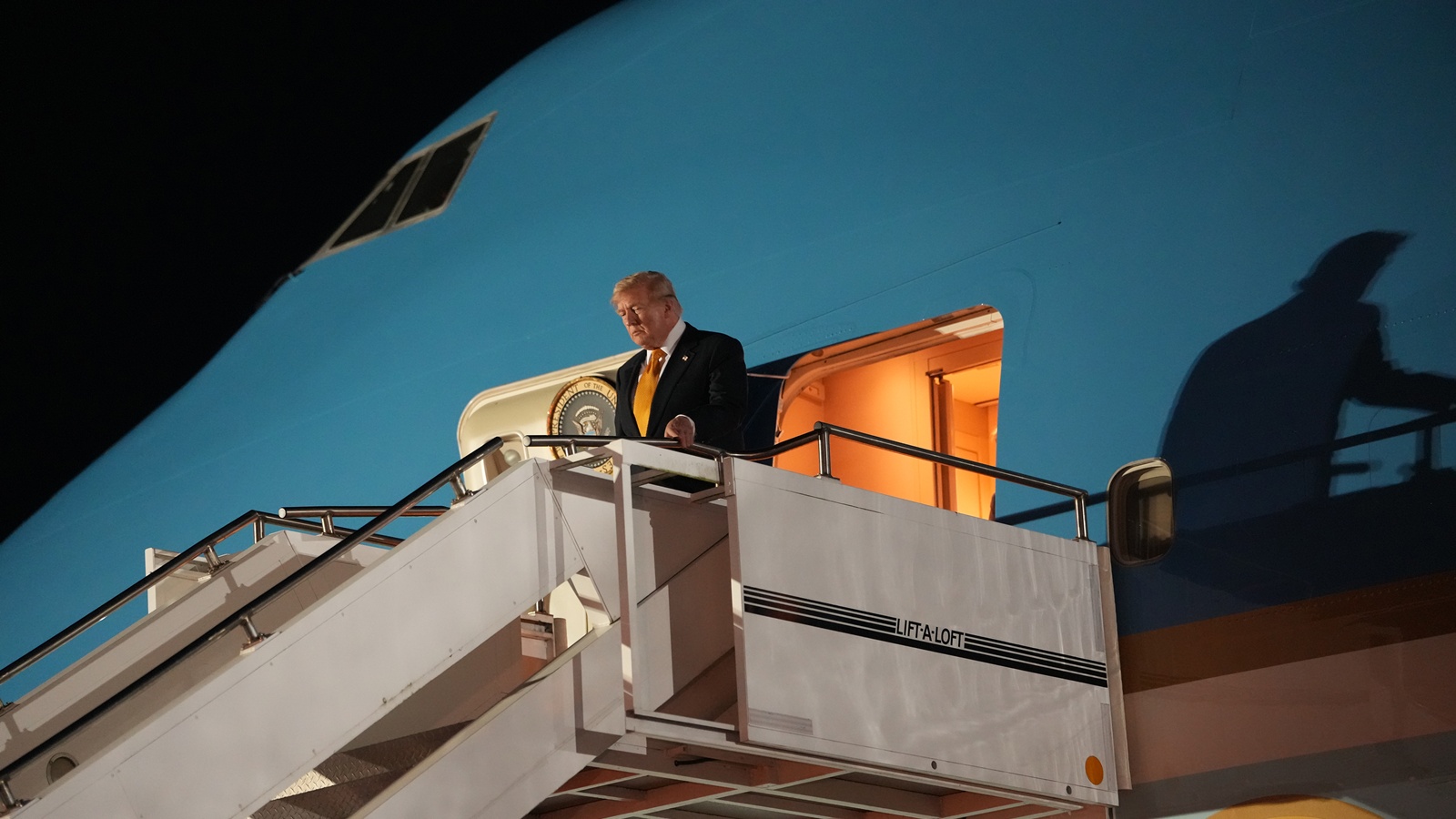
Every time a president boards a flying fortress, the media treats the event like a high-stakes sci-fi thriller. When Donald Trump reportedly swapped aircraft during a NATO summit due to a phantom Iranian threat against Air Force One, the pundit class lost its collective mind. They framed it as a heart-pounding spy thriller moment, a narrow escape orchestrated by hyper-vigilant Secret Service details and military planners dodging an assassin's crosshairs.
It is a fantastic story. It also completely misunderstands how modern state-level threat mitigation actually operates. Recently making headlines in related news: The Structural Mechanics of US Iran Negotiations and Strategic Calculus.
I have spent years consulting on high-value asset protection and secure communication protocols. I have watched organizations burn millions of dollars chasing ghosts while leaving their actual front doors wide open. This narrative about a sudden, dramatic plane swap isn't a masterclass in tactical evasion. It is a textbook exercise in political theater, designed to project constant danger while relying on mundane, unsexy logistics that have zero to do with an active missile lock.
Let us dismantle the lazy consensus. Further information regarding the matter are covered by The Washington Post.
The Myth of the Mid-Summit Ambush
The mainstream narrative assumes that a commercial or foreign intelligence apparatus can track, target, and strike a designated presidential transport mid-flight based on a sudden intel tip. That assumption belongs in a cheap airport paperback, not a serious security analysis.
Air Force One is not a single airplane. It is a designation given to any Air Force aircraft carrying the President of the United States. Usually, it is one of two heavily modified Boeing 747-200B variants, officially designated as VC-25A. But the government rarely travels light. When the president crosses international airspace, a redundant decoy aircraft—often identical in paint scheme and configuration—finesse the skies nearby or stages strategically.
When people gasp at a plane swap, they are reacting to a standard, routine operational redundancy.
Imagine a scenario where a corporate executive routinely travels in an armored motorcade with two identical decoy vehicles trailing behind. If security shifts the executive from car alpha to car beta because of a minor mechanical hiccup or a routine threat assessment update, nobody calls it a miraculous escape from an ambush. It is Tuesday.
Yet, when the president does it during a NATO summit, the security apparatus feeds the press a polished narrative of imminent peril. Why? Because an administration that appears hunted always looks powerful, urgent, and relentlessly defended. The threat matrix is real, but the theatrical execution of the response is engineered for public consumption.
The Real Vulnerability is Never in the Air
Focusing on airborne missile threats to Air Force One ignores where adversaries actually strike. If a hostile nation-state or a sophisticated non-state actor wants to disrupt a president during an international summit, they do not waste resources trying to shoot down a multi-billion-dollar military asset equipped with state-of-the-art electronic countermeasures, chaff, flare dispensers, and fighter jet escorts.
The physics of shooting down a VC-25A cruising at thirty-five thousand feet are brutal. It requires sophisticated surface-to-air missile systems or an interceptor jet with beyond-visual-range capabilities. Pulling that off against a United States presidential flight profile is an act of war that guarantees immediate, total annihilation of the aggressor state. No rational actor—not even the most hawkish elements in Tehran—takes that gamble over a temporary diplomatic spat.
The real vulnerabilities lie on the tarmac, not in the stratosphere.
The greatest risks to any head of state occur during the transition phases. Ground operations, motorcade transits through foreign cities, and local tarmac security managed by host nations present exponentially higher vectors for disruption. A cyberattack on ground-handling logistics, a compromised fuel truck, or an insider threat among local contractors offers a hundred times the yield of an impossible airborne strike.
By hyper-focusing public attention on a dramatic mid-summit plane swap, the security apparatus successfully distracts everyone from the messy, unglamorous reality of ground-level intelligence gaps.
The Economics of Paranoia
Security budgets do not expand by telling the truth. If the Pentagon or the Secret Service admitted that international airspace is heavily monitored, highly predictable, and overwhelmingly safe for American leadership, funding requests would face awkward questions.
Instead, cultivating an aura of perpetual, invisible danger justifies infinite spending. It rationalizes the procurement of next-generation replacements, the deployment of redundant communications hubs, and the endless expansion of specialized tactical units.
I have seen corporate boards fall into this exact psychological trap. They panic over improbable, high-impact cyber-scenarios hyped by vendors selling fear, while their internal employees routinely click on basic phishing links. They spend six figures on advanced perimeter defense and leave their database passwords on sticky notes.
The Air Force One threat narrative is the geopolitical equivalent of that corporate panic. It trades on the fear of the exotic to obscure the failure to manage the mundane.
What Actually Happened
Strip away the Hollywood veneer from the NATO summit incident, and you find a standard administrative pivot. Threat intelligence is constantly flowing, aggregating millions of data points from signals intelligence, human intelligence, and open-source monitoring. When a blip registers—perhaps a spike in chatter, a suspicious radar sweep near a regional border, or simply an abundance of caution—the risk matrix shifts from green to yellow.
Standard operating procedure dictates redundancy. If plane A has a minor maintenance quirk, or if planners decide that altering the visual signature of the departure adds an extra layer of friction for potential spotters on the ground, they make the switch hours before wheels up.
It is logistical hygiene. It is not an action-movie climax.
When the media turns a routine operational adjustment into an epic tale of survival against an Iranian threat, they are performing a dual service: feeding the news cycle with adrenaline and protecting the mystique of the presidency.
Stop buying the hype. The real danger to leadership has never been a missile screaming toward a jumbo jet at Mach 2. It is the steady, quiet erosion of operational competence on the ground, masked by a shiny metal bird and a good press release.