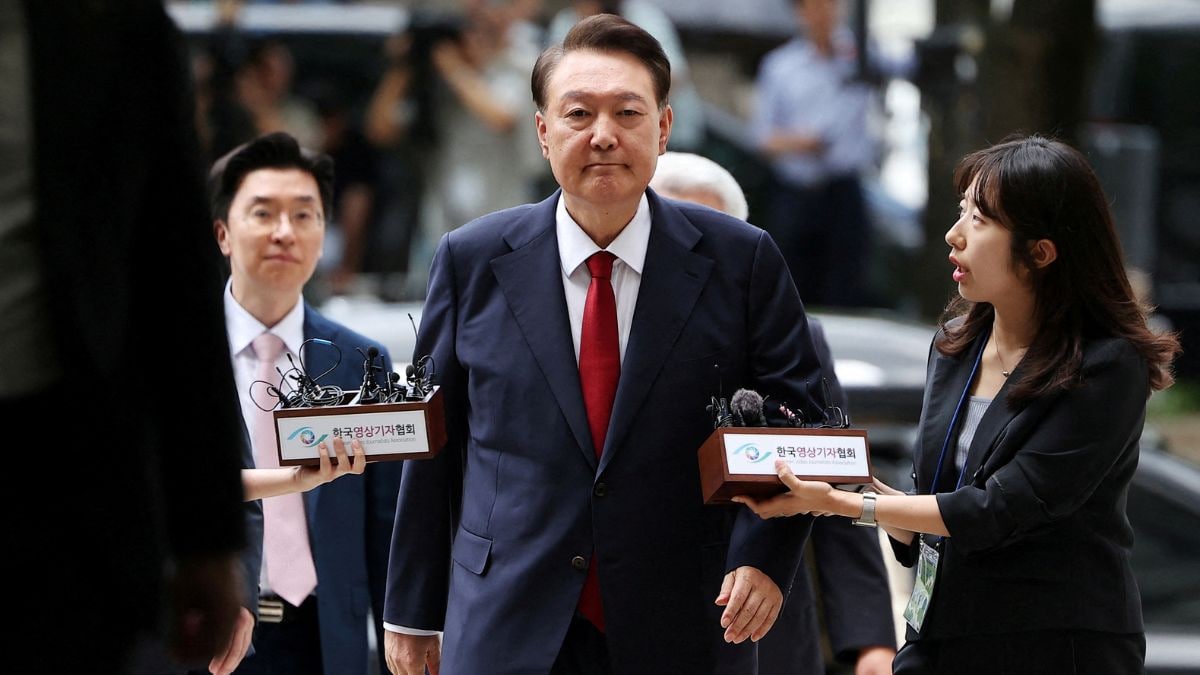
Former South Korean President Yoon Suk Yeol has been sentenced to 30 years in prison for orchestrating a clandestine military drone infiltration into North Korea. The Seoul Central District Court ruled that the high-stakes operation was not a legitimate defense measure against Pyongyang, but a calculated ploy to manufacture a national security crisis.
The court found that Yoon deliberately authorized the drone incursions to provoke a military retaliation from North Korea, intending to use the resulting panic as a pretext to declare domestic martial law and crush his political opponents. This landmark 30-year sentence adds to a previous life sentence handed down in February for leading an insurrection during his short-lived martial law decree on December 3, 2024.
The Architecture of a Manufactured Crisis
The legal downfall of a former top prosecutor turned president has exposed a deeply troubling abuse of military command. According to court records from the Seoul Central District Court’s Criminal Division 36, the conspiracy began taking shape far earlier than previously understood.
Evidence presented by special counsel Cho Eun-suk revealed that as early as March 2024, Yoon held private meetings with then-Defense Minister Kim Yong-hyun and Yeo In-hyung, the former head of the Defense Counterintelligence Command. During these consultations, the trio discussed the mechanics of emergency powers and the necessity of creating a geopolitical flashpoint severe enough to justify suspending constitutional rule.
The chosen mechanism was the Drone Operations Command. In October and November 2024, South Korean military drones were ordered to cross the heavily fortified Demilitarized Zone (DMZ) and penetrate deep into North Korean airspace. Their destination was the capital city of Pyongyang.
The drones did not carry munitions. Instead, they dropped hundreds of thousands of anti-regime propaganda leaflets directly over the North Korean seat of power. It was a tactical provocation designed to strike at the paranoid core of Kim Jong Un’s regime.
[The March 2024 Blueprint] -> [Oct/Nov 2024 Drone Flights] -> [Dec 2024 Martial Law Order]
To the public, the escalating tensions in late 2024 looked like the standard, volatile cycle of inter-Korean relations. Behind closed doors, it was a scripted sequence.
The prosecution successfully argued that the primary objective was never intelligence gathering or psychological deterrence. The objective was to bait Pyongyang into a localized kinetic response—such as an artillery strike or a border skirmish—that would plunge South Korea into chaos, providing the perfect cover for a domestic military takeover.
Overriding the Joint Chiefs
A critical revelation during the trial was the systemic bypassing of standard military guardrails. The court established that the drone infiltrations were ordered by Defense Minister Kim Yong-hyun even during windows when North Korea had temporarily halted its own grey-zone provocations, such as the infamous trash-carrying balloons.
More damning still was the explicit resistance from professional military planners. The Joint Chiefs of Staff raised formal objections to the Pyongyang drone flights, warning of unpredictable escalatory dynamics and the extreme risk to national security.
These warnings were ignored. The civilian executive branch, working in tandem with a select group of compromised military officials, overrode the nation's top operational commanders to execute the mission.
Handwritten notes recovered from Commander Yeo In-hyung’s office provided the prosecution with an undeniable paper trail. The memos contained phrases like "seize the created opportunity" and "targeting reputation damage."
The court interpreted these records as definitive proof that the administration was actively looking to exploit military tension for political survival rather than managing a legitimate external threat.
The Verdicts and the Sentences
The judicial response has been swift and severe, reflecting the gravity of using state military assets to undermine the constitutional order. The legal fallout extends far beyond the former president.
| Defendant | Former Role | Sentence | Court Finding |
|---|---|---|---|
| Yoon Suk Yeol | President of South Korea | 30 Years Imprisonment | General Treason, Abuse of Authority, Benefiting the Enemy |
| Kim Yong-hyun | Defense Minister | 30 Years Imprisonment | Co-conspirator, Overriding Joint Chiefs of Staff |
| Yeo In-hyung | Head of Defense Counterintelligence Command | 15 Years Imprisonment | Operational planning, documenting the conspiracy |
| Kim Yong-dae | Chief of Drone Operations Command | 3 Years (Suspended for 5) | Execution of unlawful orders, destruction of military property |
Yoon’s defense team maintained throughout the trial that the drone deployments were entirely defensive, framed as a proportionate response to North Korea's persistent balloon campaigns. The three-judge panel rejected this narrative entirely.
The court ruled that the actions amounted to a fundamental betrayal of the public trust, noting that the president and the defense minister weaponized the military for personal political preservation rather than legitimate national defense.
The Gray Area of Autonomous Provocation
The integration of unmanned aerial vehicles (UAVs) into this political conspiracy highlights a modern vulnerability in international security. Drones offer plausible deniability and a lower threshold for deployment compared to manned aircraft or conventional artillery.
In this case, the technology allowed a small circle of conspirators to initiate a highly provocative international incident without the massive troop movements or logistical footprints that typically alert intelligence agencies and legislative oversight committees.
This misuse of tech complicates the ongoing regional security environment. While the domestic political crisis in Seoul appears to be resolving through constitutional and judicial processes, the precedent remains.
The weaponization of military tech for domestic political leverage has shattered the long-held assumption that democratic South Korea’s military apparatus was entirely insulated from partisan manipulation.
Yoon, currently in custody following his previous conviction, filed an appeal against the 30-year sentence hours after the verdict. The legal battles will continue through the higher courts, but the political reality is already set.
The strategy of manufacturing a foreign war to secure domestic power failed because the institutional checks of South Korea's democracy—its parliament, its independent judiciary, and its citizens—held firm against the executive overreach.
The ultimate lesson of the Pyongyang drone incursions is that the mechanisms meant to protect a nation from external enemies cannot be turned inward without collapsing the entire structure of governance.