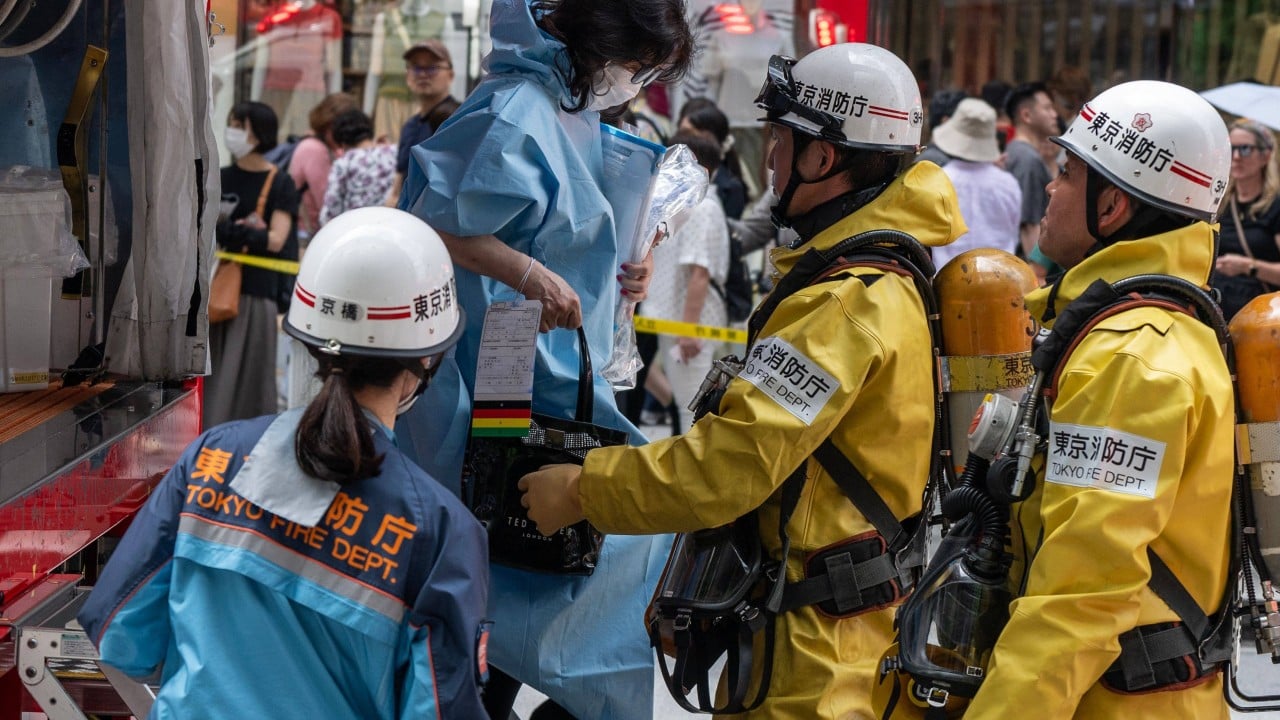
The headlines practically wrote themselves. Media outlets rushed to paint the recent incident in a Tokyo shopping center—where dozens were left gasping and injured after a man dispersed a foul-smelling liquid—as a terrifying breach of public safety. The standard narrative immediately defaulted to panic, demand for increased surveillance, and predictable lamentations over the decay of public order.
They are missing the point entirely.
This was not a failure of security. It was a stark demonstration of a psychological blind spot that modern cities refuse to acknowledge. The lazy consensus demands more cameras, more guards, and more high-tech screening at the entrances of commercial spaces. But doubling down on visible security theater does absolutely nothing to mitigate the actual risk. It merely creates a false sense of compliance while leaving the underlying system completely exposed to anyone with a plastic bottle and a grudge.
The Myth of the Hardened Perimeter
For two decades, urban security experts have peddled the illusion that public spaces can be sealed like airport terminals. They cannot. The moment a retail hub attempts to implement strict access control, it ceases to be a functional commercial space.
When a minor chemical irritant or a crude, malodorous substance disrupts an entire district, the chaos isn't caused by the substance itself. It is caused by the systemic inability to handle low-tech, asymmetric disruptions.
The Asymmetry of Low-Tech Chaos
Consider the mechanics of the Tokyo incident. No high-grade military compounds were used. No sophisticated delivery mechanisms were deployed. It was a low-tech assault that leveraged human psychology—specifically, the immediate, contagious nature of public panic.
- The Stimulus: A pungent, irritating substance is introduced into a high-traffic, enclosed environment.
- The Reaction: Immediate physical discomfort triggers a secondary, far more dangerous psychological stampede.
- The Systemic Failure: Emergency protocols designed for catastrophic, overt violence fail to scale down effectively for ambiguous, low-level threats.
I have spent years analyzing urban crowd dynamics and crisis response frameworks. Time and again, major entities waste millions implementing facial recognition software and AI-driven behavior analysis tools designed to catch the "obvious" threat. Yet, they remain utterly defenseless against an individual carrying an everyday item that happens to contain a noxious chemical.
The harsh reality is that our current defensive posture is built entirely backward. We build high walls to look for monsters, while completely ignoring the vulnerability of the open door.
Dismantling the "People Also Ask" Illusions
Whenever these events occur, the public discourse falls into a predictable pattern of flawed questions. Addressing these queries directly exposes just how deeply misunderstood the problem is.
Can We Screen Everyone Entering Public Spaces?
The short answer is no. The long answer is that attempting to do so destroys the economic viability of the space you are trying to protect.
If a shopping center introduces bag checks or chemical sniffers at the door, friction skyrockets. Retail relies on fluid, frictionless foot traffic. Introducing airport-level security to a mall kills the venue faster than any isolated incident ever could. The trade-off is asymmetric: you incur a 100% guarantee of economic friction to prevent a 0.01% probability event. That is bad math.
Why Didn't Automated Ventilation Systems Prevent the Exposure?
Commercial HVAC architecture is optimized for thermal comfort and energy efficiency, not CBRN (Chemical, Biological, Radiological, and Nuclear) defense.
Standard HVAC Cycle: Air Intake -> Filtration (Dust/Particulates) -> Conditioning -> Distribution
Standard filtration catches dust, pollen, and dander. It does not neutralize volatile organic compounds or aerosolized irritants instantly. To build a ventilation system capable of instantaneously scrubbing or purging localized chemical releases requires massive over-engineering, industrial-grade carbon scrubbing, and positive-pressure zoning. Expecting a commercial landlord to install chemical-weapons-grade airflow management is completely detached from financial and engineering reality.
The Dangerous Allure of Hyper-Surveillance
The immediate knee-jerk reaction from tech vendors after an incident like Tokyo is to sell more cameras. They promise that advanced video analytics can spot a perpetrator before they act.
This is a salesman's fantasy.
An individual walking through a crowded Tokyo station or shopping center with a bottle in their hand does not look anomalous. They look like a commuter. Behavioral analytics excel at identifying historical patterns, but they are functionally blind to the micro-actions that precede a low-tech disruption.
Data Ingestion -> Pattern Matching -> Outlier Detection -> False Positive / Delayed Alert
By the time the system flags an anomaly—if it even does—the liquid is already on the floor, the vapor cloud has expanded, and the crowd is already moving toward the exits. The technology functions as a digital autopsy tool, not a preventative shield. Relying on it to stop an incident is a dangerous misallocation of capital.
Flipping the Script: Decentralized Resilience Over Hardened Security
If hardening the perimeter is impossible and high-tech surveillance is ineffective at prevention, what is the alternative?
The answer lies in shifting the philosophy from absolute prevention to rapid containment and localized resilience. We must stop trying to build unbreakable bubbles and instead focus on creating systems that degrade gracefully under pressure.
1. Dynamic HVAC Zoning and Immediate Isolation
Instead of attempting to scrub all air simultaneously, modern building automation must be decoupled into independent micro-zones.
When a sensor detects a rapid drop in air quality, or when an emergency pull-station is activated in a specific quadrant, the system must instantly isolate that zone’s air supply while maximizing exhaust velocity in that localized area only. This prevents a localized incident from contaminating an entire multi-story complex via shared ductwork.
2. Tactical Decentralization of First Response
The traditional model relies on central security offices monitoring walls of screens, who then dispatch personnel to a scene. This creates a fatal latency loop during a fast-moving incident.
Incident Occurs -> Reported to Command Center -> Verification -> Dispatch -> Arrival at Scene
This sequence takes minutes. In a chemical or irritant release, seconds dictate the scale of exposure.
Security personnel should not be centralized. They must be distributed throughout the space, equipped not just with physical restraint tools, but with immediate-response mitigation gear—neutralizing agents, localized extraction vacuums, and clear, authoritative communication tools to direct crowd flow before panic takes root.
3. Radical Transparency in Public Communication
The primary damage in the Tokyo shopping center incident wasn't caused by the toxicity of the liquid; it was amplified by the unknown. When people smell something strange and see others coughing, the mind immediately jumps to worst-case scenarios—sarin gas, terrorist attacks, lethal pathogens.
The antidote to panic is instant, accurate, localized data. Public infrastructure needs to utilize targeted, real-time public address systems that do not rely on vague, panicked announcements. Broadcasters must state exactly what is known, what areas to avoid, and where to walk.
The Cost of True Security
Implementing a strategy of decentralized resilience is not a magic solution. It has real, uncomfortable downsides that most organizations are hesitant to admit.
- Higher Operational Overhead: Training front-line staff to handle ambiguous environmental threats requires continuous investment, not a one-time software purchase.
- Frequent System Testing: Dynamic HVAC isolation protocols require regular testing, which can temporarily disrupt business operations or comfort metrics.
- The Acceptance of Risk: This approach forces an organization to accept that incidents will happen. It trades the comforting lie of "zero tolerance" for the grim reality of damage control.
Most executives prefer to buy a flashy software package because it allows them to shift blame to a vendor if things go sideways. "We bought the best system available," they will say to the board. Accepting a resilience framework means taking absolute ownership of the messy, unpredictable reality of human behavior and physical space.
Stop Treating Symptoms
The Tokyo incident should serve as a wake-up call for the entire urban security apparatus, but not for the reasons currently being discussed in mainstream boardrooms.
As long as we continue to treat public safety as a problem that can be solved by adding more friction at the door or more cameras on the ceiling, we will remain completely vulnerable to the simplest disruptive tactics. The threat vector has evolved past the point of physical barriers. The venue of conflict is no longer the perimeter; it is the atmospheric integrity of our enclosed spaces and the psychological stability of the crowds within them.
Stop trying to lock the doors of spaces designed to be open. Stop investing in surveillance systems that only watch disasters happen in high definition. Optimize for the inevitable breach. Build systems that can swallow a disruption, isolate the damage, and keep the heart of the city beating without missing a step. Everything else is just expensive theatre.