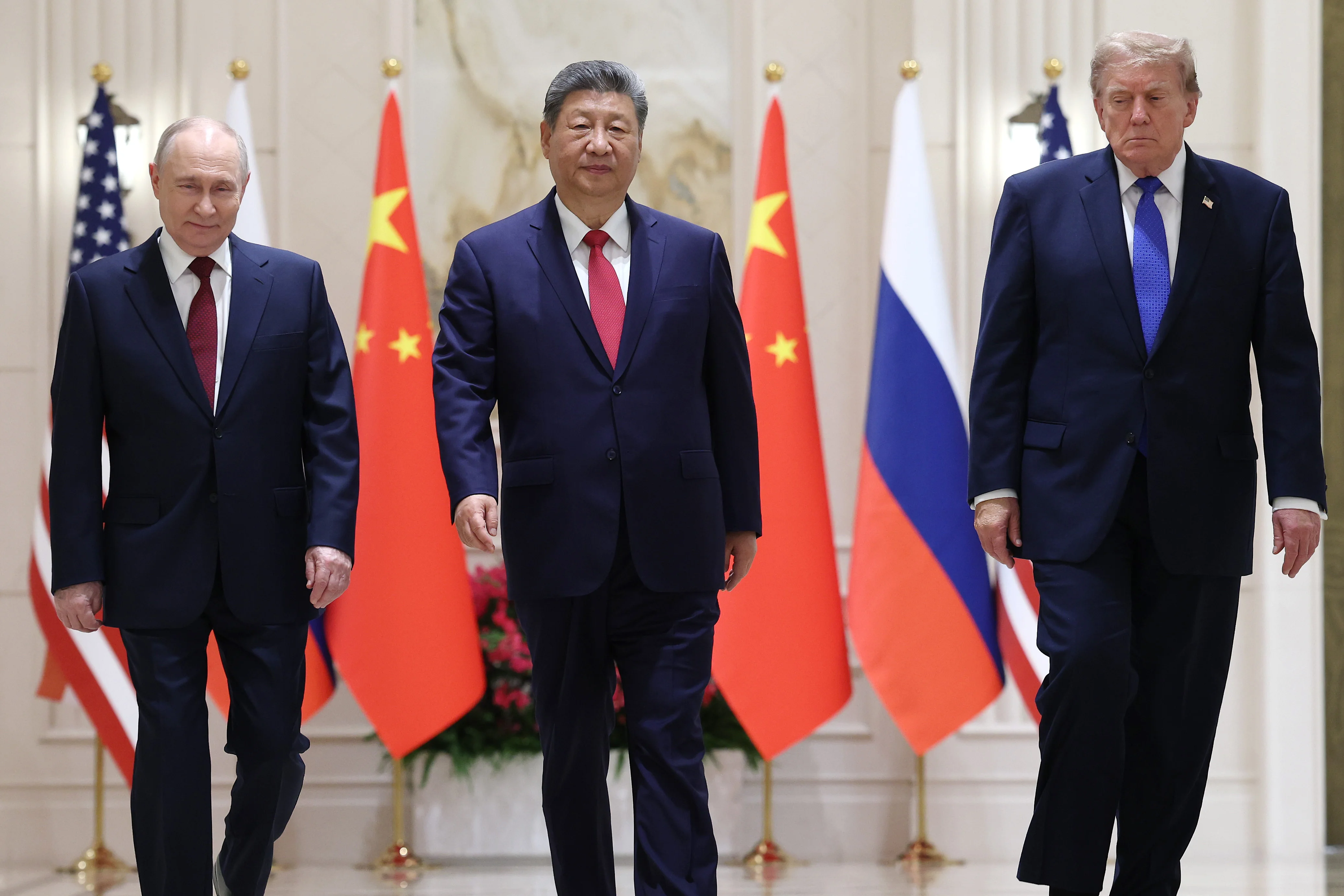
Cold rain hits the tarmac at Beijing Capital International Airport, turning the floodlights into smeared streaks of amber across the concrete. Inside the terminal’s VIP lounge, the air smells faintly of green tea and wet wool, while three different security details sweep the corridors with the silent, practiced paranoia of men who carry the nuclear codes in their pockets.
When Donald Trump, Xi Jinping, and Vladimir Putin converge on a Chinese summit, the headlines inevitably treat it like a heavyweight prize fight. Pundits tally up the handshakes, dissect the lapel pins, and declare winners before the motorcades have even cleared the ring road. Yet if you step back from the cable news chyrons and look closely at what each man is actually bringing to the table—and what each is terrified of losing—you realize they aren't even playing the same sport. You might also find this related article interesting: Stop Calling the Trump, Putin, and Xi APEC Meeting Historic Because It Is Actually Geopolitical Theater.
To understand the invisible stakes of a China summit involving Washington, Beijing, and Moscow, forget the press releases for a moment. Consider a hypothetical scenario involving an ordinary family in Ohio, a factory owner in Shenzhen, and a retired engineer in St. Petersburg. Let us call the Ohioan Marcus, a logistics manager watching shipping container rates fluctuate wildly every time a tariff threat trends on social media. In Shenzhen, Lin runs a mid-sized electronics assembly plant, lying awake at three in the morning wondering whether export controls will cut off her supply of specialized semiconductors before she can make payroll. And in St. Petersburg, Viktor watches the price of imported medicine climb while state television assures him that his country is standing tall against Western encirclement.
These three people will never sit in the Great Hall of the People. They will never taste the state banquet dishes or pose beneath the towering murals. Still, every syllable uttered during this summit lands directly on their kitchen tables. As highlighted in latest reports by NBC News, the implications are widespread.
The Architecture of Divergent Ambitions
According to diplomatic reporting and official readouts surrounding major trilateral dynamics in Beijing, the core friction at such a gathering stems from three fundamentally incompatible wish lists. Trump approaches summitry like a high-stakes real estate closing, prioritizing bilateral trade imbalances, immediate economic concessions, and visible wins he can take straight to an American rally stage. Xi, by contrast, plays a generational game centered on regime stability, technological self-reliance, and positioning China as the indispensable architect of a multipolar world order. Meanwhile, Putin arrives with an urgent, existential agenda—securing sanctions relief, locking in energy buyers, and proving to both his domestic audience and the West that Russia remains a vital great power rather than an isolated pariah.
Look at how those priorities collide.
Trump wants a deal he can hold up in front of cameras tomorrow morning. He views tariffs not merely as economic instruments, but as leverage—a crowbar to pry open markets, force manufacturing back to the American Midwest, and extract commitments on everything from agricultural purchases to fentanyl precursors. To him, multilateral summits are often distractions from the real action, which happens behind closed doors between two strongmen sizing each other up. If he walks out with a signed commitment that lowers the trade deficit or boosts American energy exports, he considers the trip a triumph.
Xi cannot afford transactional improvisation. Every move the Chinese leader makes is filtered through the lens of long-term Party survival and national rejuvenation. When Xi hosts a summit in Beijing, the stagecraft itself is the message. He wants to project calm, unshakeable authority—an image of China as the steady hand guiding global governance while Western democracies bicker and lurch from election to election. For Xi, agreeing to sudden, sweeping concessions under public pressure looks like weakness at home, a dangerous vulnerability in a political system that prizes control above all else. He is willing to talk trade, certainly, and he desperately wants to stabilize an economy grappling with sluggish domestic consumption and a bruised property sector. Yet he will not trade away China’s state-led industrial strategy or its ambitions in artificial intelligence and green technology just to appease Washington.
And then there is Putin.
Sitting beside Xi, the Russian president projects solidarity, speaking warmly of a "no-limits" partnership and shared resistance to American hegemony. Beneath the rhetoric, however, Moscow’s position is markedly more asymmetrical than the Kremlin likes to admit. Cut off from Western financial markets and heavily dependent on Chinese purchases of discounted oil and gas, Russia needs Beijing far more than Beijing needs Moscow. Putin’s priority at the summit is survival and validation. He wants concrete assurance that Chinese banks and companies will keep vital supply chains open despite the threat of secondary American sanctions. Just as importantly, he wants to drive a wedge between Washington and Beijing, ensuring that Trump and Xi do not strike a grand bargain that leaves Russia out in the cold.
Why It Feels Like Watching Three Different Movies
I remember standing outside a diplomatic venue in East Asia years ago during an earlier round of high-level trade talks, watching journalists sprint toward the barricades every time a black sedan rolled past. The air was thick with humidity and speculation. Inside, negotiators were deadlocked over language that sounded absurdly abstract to anyone outside government—phrases like "structural reform" and "mutual respect." Later that evening, over lukewarm noodles at a corner stall, a veteran trade official told me something I have never forgotten. "People think diplomacy fails because leaders hate each other," he said, wiping condensation from his glass. "Usually, it fails because each leader is terrified of a completely different ghost."
Think of this summit like three people negotiating the lease on a burning building, except one man is worried about the rent, the second is worried about who owns the land, and the third is quietly trying to sell matches to pay his debts.
If you cannot explain the dynamic simply, you haven't stripped away the diplomatic jargon. Stripped down to bare metal, here is the dilemma:
- Washington’s ghost is economic hollowing-out and the political fury of voters who feel globalism left them behind.
- Beijing’s ghost is stagnation—the fear that an aging population and Western tech blockades will trap China in middle-income mediocrity before it can claim global preeminence.
- Moscow’s ghost is irrelevance—the dread of becoming a junior resource colony to Beijing while remaining locked in a costly, grinding confrontation with the West.
When analysts ask whether the summit will produce a breakthrough, they are often asking the wrong question. Breakthroughs require shared definitions of success. When Trump talks about fairness, he means reciprocal tariffs and balanced ledgers. When Xi talks about fairness, he means ending Western export controls that restrict China’s access to advanced microchips. When Putin talks about fairness, he means dismantling the post-Cold War security architecture in Europe and Asia.
It is exhausting to track, and honestly, a little unsettling. Anyone telling you they know with certainty how this triangle will settle over the next five years is selling something. History shows us that great-power alignments rarely snap cleanly into place; they grind, shift, and fracture along unexpected fault lines. Just look back at the early 1970s, when Richard Nixon and Mao Zedong shocked the world by finding common ground against the Soviet Union, proving that ideological adversaries can become sudden partners the moment their fears align. Today, the geometry has flipped, yet the underlying human instinct—self-preservation dressed up as grand strategy—remains identical.
The Invisible Weight on Everyday Lives
Let us return for a moment to Marcus in Ohio, Lin in Shenzhen, and Viktor in St. Petersburg.
What happens to them when these three leaders leave Beijing without reconciling their priorities? Nothing dramatic happens on day one. No sirens wail. No borders slam shut overnight. Instead, a slow, grinding friction settles into the global economy like sand in a gearbox.
For Marcus, it means his company quietly reroutes supply chains through Vietnam and Mexico, adding weeks to delivery schedules and tacking an extra twelve percent onto the cost of industrial parts—a hidden tax that eventually shows up on the price tags of tractors, appliances, and cars across North America. For Lin in Shenzhen, it means laying off thirty assembly workers because her European buyers are nervous about secondary sanctions and unpredictable tariff hikes, forcing her to pivot toward domestic buyers who are already pinching pennies. For Viktor in St. Petersburg, it means watching Chinese consumer goods replace familiar European brands on store shelves while Russian raw materials flow east at bargain-basement prices, locking his country’s future ever tighter into Beijing’s orbit.
This is the part that rarely makes the evening news. Geopolitics is not an abstract chessboard played by giants in bespoke suits. It is a vast, invisible plumbing system carrying capital, energy, medicine, and microchips across oceans. When the men at the top refuse to agree on how the valves should be turned, pressure builds in places nobody is watching until a pipe bursts miles away.
The Illusion of Control
Watch the body language closely when the cameras are allowed into the room.
Trump leans forward, hands clasped or gesturing broadly, projecting the energy of a man trying to close a room through sheer force of personality. Xi sits straight, measured, offering brief, deliberate nods that reveal nothing while signaling absolute command over his own delegation. Putin shifts slightly in his chair, trading knowing glances with his Chinese host, eager to demonstrate that he belongs at the center of the frame.
Each leader believes he holds leverage the others cannot afford to ignore. Trump knows access to the American consumer market and the U.S. dollar remains the ultimate prize in global commerce. Xi knows China controls critical mineral supply chains, green energy manufacturing, and the sheer scale of Asian trade. Putin knows he possesses vast nuclear stockpiles, abundant commodities, and the capacity to disrupt global stability from Eastern Europe to the Middle East.
Yet leverage is a tricky thing. Push too hard on a tariff, and you ignite inflation at home. Tighten export controls too aggressively, and you accelerate your rival’s drive to build independent supply chains that exclude you forever. Lean too heavily on a single diplomatic partner, and you wake up one morning realizing you no longer have the freedom to say no.
Silence settles over the conference table once the translators finish their final sentences and the photographers are ushered out by stern protocol officers. Outside, the rain in Beijing has stopped, leaving the wide avenues glistening beneath the streetlights as black armored limousines pull away in three separate directions.