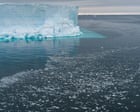
The failure of winter sea ice formation along the western coast of Antarctica represents a structural regime shift in the Southern Ocean climate system, rather than a transient anomaly. Satellite observations confirm that the Bellingshausen Sea is missing approximately 650,000 square kilometers of sea ice relative to the 1991–2020 climatological baseline—a deficit equivalent to the surface area of mainland France. This absolute spatial deficit has eliminated the regional marine insulation barrier, accelerating a local atmospheric heatwave that drove winter temperatures to $15.4^\circ\text{C}$, a deviation of more than $20^\circ\text{C}$ above seasonal means. Quantifying this breakdown requires evaluating the interlocking oceanographic, atmospheric, and thermodynamic feedback loops that govern polar ice dynamics.
The Tri-Phase Wind and Ocean Layering Feedback Mechanism
The immediate physical catalyst for the current ice deficit stems from a multi-year disruption of the Southern Ocean’s vertical stratification. Historically, the West Antarctic marine environment maintained a stable, multi-layered structure that insulated surface ice from deep-ocean thermal energy. This system operated on a clear mechanical trajectory:
- Phase 1: Wind-Driven Ekman Transport. An intensification of the Southern Hemisphere westerly winds—driven by the widening polar ozone hole and a tightening polar vortex—accelerated the northward transport of cold, low-salinity surface waters.
- Phase 2: Upwelling of Circumpolar Deep Water. The removal of surface water triggered a mass-balancing upwelling of Circumpolar Deep Water (CDW). This subsurface layer is inherently warmer and saltier, originating from lower latitudes.
- Phase 3: Haline Destratification. As the warm, saline CDW breached the upper 100 to 200 meters of the water column, it disrupted the density gradients that normally allow surface waters to freeze.
Because sea ice acts as a primary source of freshwater when it melts during the austral summer, a failure to generate ice during winter establishes a self-reinforcing hydrological deficit. The subsequent winter lacks the fresh, low-density surface meltwater layer required to maintain vertical stratification. The upper ocean remains saline, dense, and mechanically unstratified, allowing continuous vertical mixing that brings deep-ocean heat to the surface, preventing ice crystal nucleation even when air temperatures drop.
The Albedo-Thermal Coupling Loop
The localized winter heatwave peaking at $15.4^\circ\text{C}$ on the Antarctic Peninsula is directly linked to the absence of the open-ocean ice buffer. The thermodynamic relationship between sea ice coverage and atmospheric boundary layer temperature can be modeled through radiative balance equations and sensible heat flux.
[Missing Sea Ice (650,000 sq km)]
       │
       ▼
[Suppressed Ice-Albedo Effect] ──► [Increased Solar Absorption]
       │                                     │
       ▼                                     ▼
[Open Ocean Exposure] ───────────► [Elevated Sensible Heat Flux]
                                             │
                                             ▼
                                  [Localized Winter Heatwave]
When sea ice is present, it reflects up to 80% of incoming solar radiation back into space. The open ocean, conversely, absorbs roughly 90% of that same energy. In a normalized winter cycle, even minimal solar radiation is deflected, and the physical barrier of the ice prevents the ocean from transferring its retained heat directly into the atmosphere.
By leaving the Bellingshausen Sea entirely ice-free into June, the ocean surface acts as a massive thermal radiator. The atmosphere is exposed to direct sensible and latent heat fluxes from water that is significantly warmer than the freezing point. The absence of the ice barrier did not merely coincide with the atmospheric heatwave; it functioned as the primary local amplifier, raising the thermal floor and preventing overnight radiative cooling from stabilizing the regional microclimate.
Glaciological Cascades and Grounding Line Instability
The consequences of this sea ice deficit extend past the immediate marine boundary layer to the structural stability of continental ice shelves. Sea ice serves an essential mechanical function: it acts as a dampening buffer against open-ocean swells.
Without a protective perimeter of sea ice, coastal wave energy propagates unimpeded into the calving fronts of floating ice shelves, such as those anchoring the Thwaites and Hektoria glaciers. This continuous mechanical flexing accelerates structural fracturing, widening existing rifts and increasing the calving rate of tabular icebergs.
The structural degradation follows a strict downstream chain of causality:
- Loss of Buttressing Force: Floating ice shelves exert a counter-pressuring, buttressing force against the grounded ice sheets inland. As wave action and warm ocean currents degrade the shelf, this resistance drops.
- Grounding Line Retreat: The boundary where the glacier transitions from sitting on bedrock to floating on water—the grounding line—begins to migrate landward as warm seawater wedges underneath the ice sheet.
- Accelerated Glacial Discharge: Stripped of downstream friction, inland glaciers accelerate their descent into the ocean under the influence of gravity. This mechanical acceleration directly shifts ice from sub-aerial storage to ocean displacement, driving global sea-level rise.
Empirical Constraints and Analytical Limitations
A rigorous assessment of the West Antarctic climate state requires acknowledging the limitations of current predictive models and observational baselines. The passive microwave satellite record for Antarctic sea ice extends back only to late 1978. Evaluating whether the current multi-year low represents an anthropogenic tipping point or an extreme manifestation of low-frequency natural variability remains constrained by this 47-year window.
Furthermore, climate models have historically struggled to accurately simulate the complex ocean-atmosphere-ice interfaces unique to the Southern Ocean. Current computational architectures frequently underestimate the rate of subsurface ocean warming at the 100-to-200-meter depth scale. Consequently, while the correlation between increased westerly wind velocity and ice loss is well-documented, the exact partitioning between anthropogenic greenhouse gas forcing, stratospheric ozone depletion, and internal chaotic ocean variability cannot be isolated with absolute mathematical precision.
Strategic Outlook for Polar Research Infrastructure
The operational reality of a structurally altered West Antarctic ice system necessitates immediate reallocations in global scientific deployment and logistics. The ongoing transition of the Bellingshausen Sea from a reliably frozen zone to an open marine environment invalidates historical navigational baselines for polar research vessels and automated sensing arrays.
The strategic play requires shifting from historical statistical baseline comparisons to real-time, high-frequency vertical profile monitoring of the Southern Ocean water column. Automated bio-argo floats, autonomous underwater vehicles (AUVs), and deep-sea mooring arrays must be deployed systematically within the 100-to-200-meter depth layer across the Amundsen and Bellingshausen sectors.
Simultaneously, satellite observation paradigms must pivot from measuring simple two-dimensional ice extent to verifying real-time changes in ice sheet grounding lines via interferometric synthetic aperture radar (InSAR). Operational planning for Antarctic research logistics must immediately factor in shortened seasonal windows for ice-based transit and increased structural hazards for coastal research stations encountering unbuffered marine wave action.


