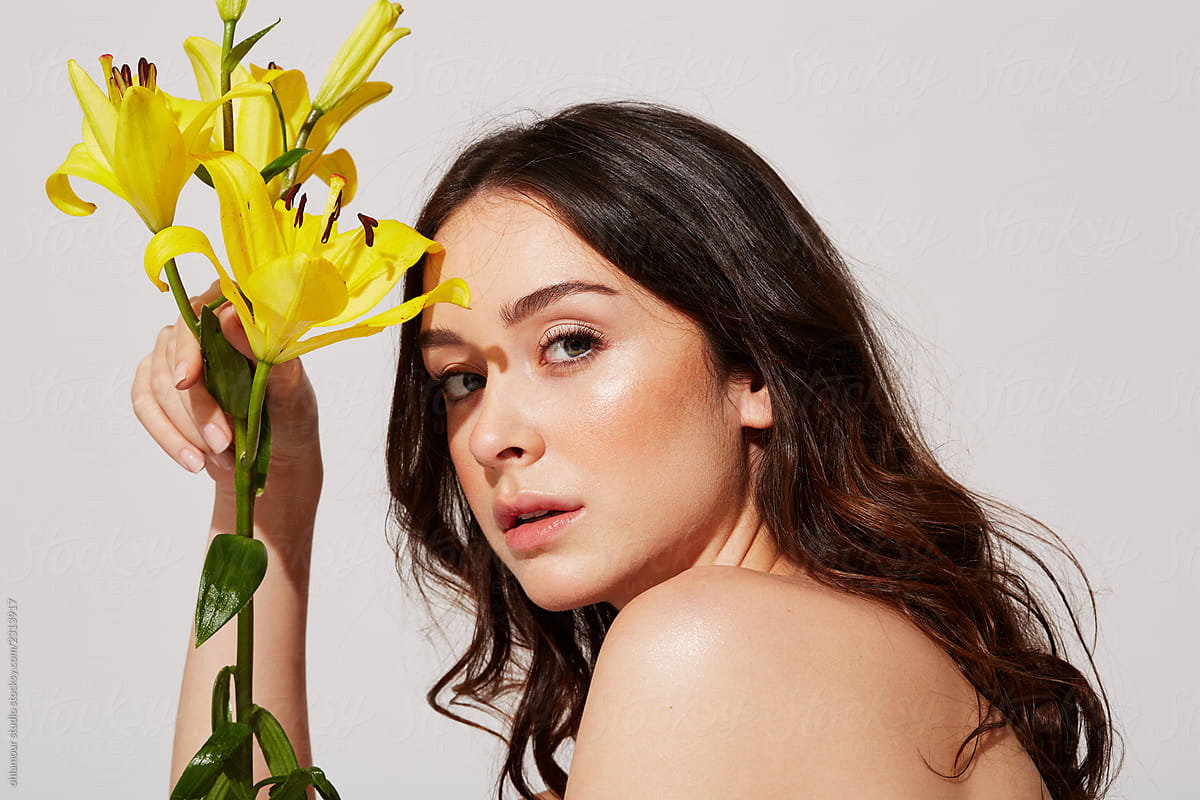
When we talk about beautiful women that are naked, most people’s brains immediately jump to the modern, hyper-digital world of social media or glossies. It’s understandable. We are basically drowning in imagery 24/7. But honestly, if you look at the actual history of human expression, the unclothed female form has always been less about "content" and way more about power, health, and a weirdly specific type of cultural storytelling.
It’s complicated.
Art historians often distinguish between being "naked" and being "nude." It sounds like a semantic trick, right? But Kenneth Clark, a pretty famous art historian from the 20th century, argued in his book The Nude: A Study in Ideal Form that to be naked is just to be without clothes—maybe a bit vulnerable or embarrassed. To be a "nude" is to be an art form. It’s a bit of a snooty distinction, but it explains why we look at a Renaissance painting differently than a selfie. One is an exploration of geometry and light; the other is a personal moment.
Why the Human Form Sticks with Us
Why do we care so much? Evolutionarily, we are wired to look at bodies. It’s basic biology. But the standard for what makes beautiful women that are naked "beautiful" has shifted so many times it’ll make your head spin.
Take the Venus of Willendorf. She’s a tiny limestone figurine from about 25,000 years ago. She doesn't have a face, but she’s got massive hips and breasts. To those ancient people, beauty wasn’t about being "fit" or "toned." It was about surviving the winter and being able to raise a family. Fast forward to the Italian Renaissance, and you get Botticelli’s The Birth of Venus. She’s pale, elongated, and honestly, her proportions are kind of physically impossible if you actually measured her out.
Artists like Peter Paul Rubens later championed a "fuller" look—nowadays we literally call it "Rubenesque." It was a status symbol. If you had some extra weight, it meant you were wealthy enough to eat well and sit inside while everyone else was working the fields.
The Shift in Photography and Realism
Then the camera showed up and messed everything up.
Early photography in the 19th century tried to mimic painting to stay "respectable." Think of photographers like Oscar Rejlander. They’d pose models in these heavy, dramatic Greek goddess positions. But the camera is unforgiving. It showed skin texture. It showed reality. This was the first time the public really saw beautiful women that are naked without the "filter" of a painter's brush. It caused a massive scandal because it felt too real. It wasn't an "ideal" anymore; it was a person.
The Psychological Impact of Imagery
Social psychologists have spent decades looking at how we process these images. Dr. Jean Kilbourne has written extensively about the "objectification" of women in media. She argues that when we see bodies used purely as props to sell perfume or cars, it changes how we view people in real life. It’s a heavy topic.
But there’s another side.
Many modern creators argue that reclaiming the image of the body is empowering. You see this in movements like "body neutrality." It’s not always about being "perfect." It’s about existing. When we see beautiful women that are naked in a way that includes stretch marks, scars, or different abilities, it actually breaks down those rigid, fake standards that the fashion industry spent eighty years building up.
- The "Male Gaze" (a term coined by Laura Mulvey) describes how visual arts are often structured around a masculine viewer.
- The "Female Gaze" is the response—focusing on emotion, connection, and the internal life of the subject rather than just the exterior.
The Science of Aesthetics
Is beauty actually "objective"? Some scientists say yes. They point to the "Golden Ratio" or $1.618$. You see it in snail shells and galaxies, and apparently, we find it attractive in human faces and bodies too.
But culture usually wins over math.
In some cultures, neck rings or specific tattoos are the height of beauty. In others, it’s minimalism. The point is, our definition of a "beautiful body" is a moving target. If you went back to 1920, the "flapper" look—thin, athletic, almost boyish—was the peak. By the 1950s, Marilyn Monroe’s hourglass figure was the only thing people cared about.
What the Data Says About Perception
A study published in PLOS ONE found that our "ideal" body type is heavily influenced by the media we consume. If you show people images of plus-size models for just fifteen minutes, their personal preference for what they find "attractive" actually starts to shift. Our brains are incredibly plastic. We like what we see often.
This is why representation matters. If the only beautiful women that are naked we see are photoshopped to death, we start to think reality is "wrong."
Navigating the Modern Digital World
Today, the line between art and "content" is thinner than a piece of paper. Platforms like Instagram have strict rules about what can be shown—often leading to "censored" art that wouldn't have been a problem in a museum in 1880. It’s a weird paradox. We are more exposed to imagery than ever, yet we are more sensitive about where and how it’s displayed.
There's also the rise of AI-generated imagery.
This is where things get really trippy. We can now generate "perfect" images of beautiful women that are naked that don't even exist. They are amalgams of millions of other photos. It creates a feedback loop of "perfection" that is literally impossible for a human being to achieve because, well, the person in the photo isn't a human.
Actionable Ways to Change Your Perspective
If you’re feeling overwhelmed by the "perfection" of the digital age, there are actual steps to ground yourself.
First, diversify your "visual diet." Follow artists, photographers, and creators who document real bodies. When you see the human form in its natural state—unfiltered and unposed—the "perfection" of advertisements starts to look a bit boring and flat.
Second, learn a bit of art history. Go to a museum. Look at the sculptures. You’ll notice that "perfection" has meant a hundred different things over the last two thousand years. It’s liberating to realize that today’s "standard" is just a temporary trend.
Third, recognize the difference between "looking" and "observing." Looking is passive. Observing is noticing the lighting, the muscle tone, the expression, and the humanity behind the image. Whether it’s a painting or a photograph, there’s always a story being told.
The human body is the most enduring subject in the history of the world. It’s not just about aesthetics; it’s about what it means to be alive. By understanding the history and the psychology behind these images, we can appreciate them without getting lost in the "idealized" traps of the modern internet. Focus on the reality of the form, the diversity of the human experience, and the fact that beauty is far more expansive than a single pixelated image could ever suggest.