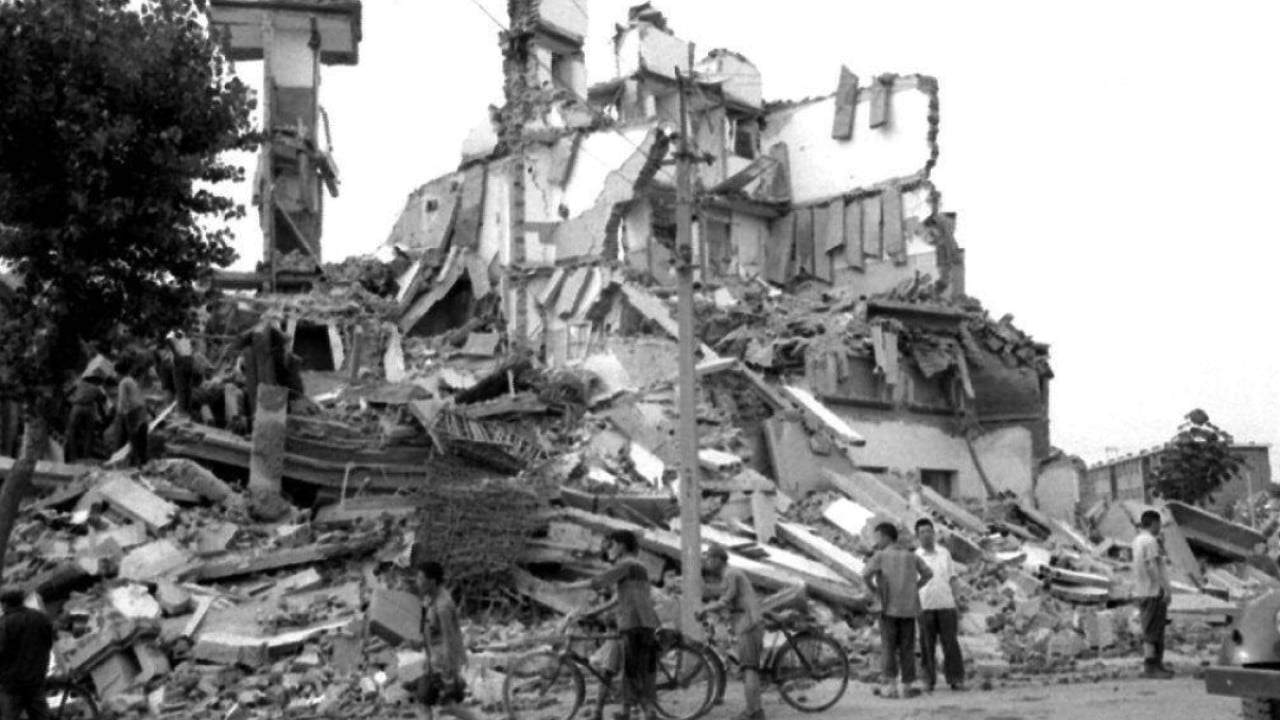
Ground zero didn't make a sound before it ripped apart. At 3:42 in the morning on July 28, 1976, a subterranean monster woke up beneath the industrial hub of Tangshan in China's Hebei province. In less than twenty seconds, a city of over one million residents turned into a smoking heap of rubble.
Official numbers put the death toll at 242,000 people. Modern researchers whisper that the true count might be closer to 650,000. It stands as one of the deadliest industrial disasters in modern human history. Yet, outside of seismic history textbooks, people rarely talk about it today.
You need to understand what happened that night because it shattered the illusion that humanity can outsmart the earth.
The Night the Earth Broke in Half
The quake hit with a moment magnitude of 7.8. Seismologists classify it as a shallow-focus earthquake, which means the energy released directly beneath the surface with maximum violence. Tangshan sat on a major coal-mining region. Miners underground were trapped in total darkness as shaft walls collapsed like matchsticks. Above ground, brick houses built without seismic reinforcement pancaked instantly.
People were asleep. They didn't have a single second of warning.
Seismograph stations across the globe registered the violent shockwaves. But inside China, the political climate of 1976 made immediate reporting difficult. The country was already mourning the fading health of Chairman Mao Zedong and navigating the chaotic final months of the Cultural Revolution. Information moved slowly. Rescue crews faced total isolation because roads cracked, bridges snapped, and rail lines warped into twisted metal.
Communications went completely dead. For hours, Beijing had no idea whether Tangshan even existed anymore.
Why the Death Toll Sored So High
Earthquakes don't kill people directly. Buildings kill people.
Tangshan was a dense manufacturing city. Most homes consisted of unreinforced masonry—cheap bricks stacked with minimal mortar. When the primary shockwave struck, these structures offered zero resistance. They crumbled into dust, burying families in their beds before they could even open their eyes.
Then came the secondary disaster. Firestorms broke out across the ruins fueled by broken gas lines and domestic coal stoves. Injured survivors trapped beneath heavy concrete slabs faced smoke inhalation and burning debris.
Government response suffered from severe logistical paralysis. The state machinery was fractured by political infighting. While military units mobilized quickly, they lacked heavy excavation equipment. Soldiers and surviving locals had to dig through tons of concrete with bare hands, shovels, and kitchen spoons.
The Political Fallout and the Silence
You won't find many contemporary photographs of the immediate aftermath. The Beijing government kept foreign journalists away from the zone for months. Officials viewed natural disasters through an ideological lens. They didn't want the world seeing socialist infrastructure flattened so easily.
Mao Zedong died just weeks later, on September 9, 1976. For many superstitious citizens at the time, the Tangshan quake felt like an ancient imperial omen. Chinese tradition long held that massive natural disasters signaled the loss of the Mandate of Heaven, especially when paired with the death of a supreme leader.
The state doubled down on self-reliance. They refused foreign aid entirely. They told the population that Chairman Mao's spirit and collective socialist labor would rebuild the city from scratch.
What We Learned About Seismology
You might wonder if science made any progress from this tragedy. Yes, it did. Tangshan forced Chinese geologists to completely rethink earthquake prediction models.
Before 1976, researchers believed they could forecast major tremors by monitoring strange animal behavior, minor tremors, and groundwater anomalies. In fact, just a few years earlier, successful warnings helped evacuate the city of Haicheng before a massive quake.
Tangshan proved that prediction is terrifyingly inconsistent. Some local officials had noticed strange well-water fluctuations and restless livestock days before the shock, but no evacuation order came down. The failure humiliated the national seismological bureau and shifted the focus of global science away from short-term prediction toward long-term structural engineering.
Today, engineers design buildings to bend rather than break.
How Tangshan Rose From the Dead
They didn't abandon the site. Within a decade, a brand-new city rose from the dust of the old one. Today, Tangshan is a bustling metropolis known for steel production and modern urban planning.
If you visit the city now, you will find the Tangshan Earthquake Memorial Museum. Preserved ruins of old air-raid shelters and factory walls stand as silent monuments in public parks. The city remembers its dead every year on July 28. Sirens wail across the streets. People stop walking. They bow their heads in memory of a night that wiped out entire family trees in less than a minute.
We cannot stop tectonic plates from shifting. We can only choose how we build our homes above them.