The glow of a smartphone screen at two in the morning has a very specific temperature. It is cold. Blue. Clinical.
Imagine—as a hypothetical window into how millions of voters actually experience modern geopolitics—a young graphic designer named Maya sitting at her kitchen table in Tel Aviv. The Mediterranean breeze outside smells faintly of salt and exhaust. Her coffee went cold an hour ago. She scrolls through her feed, thumb moving in the muscle-memory rhythm of exhaustion, past a friend’s wedding photos, past a recipe for charred eggplant, and then—stop.
A mushroom cloud.
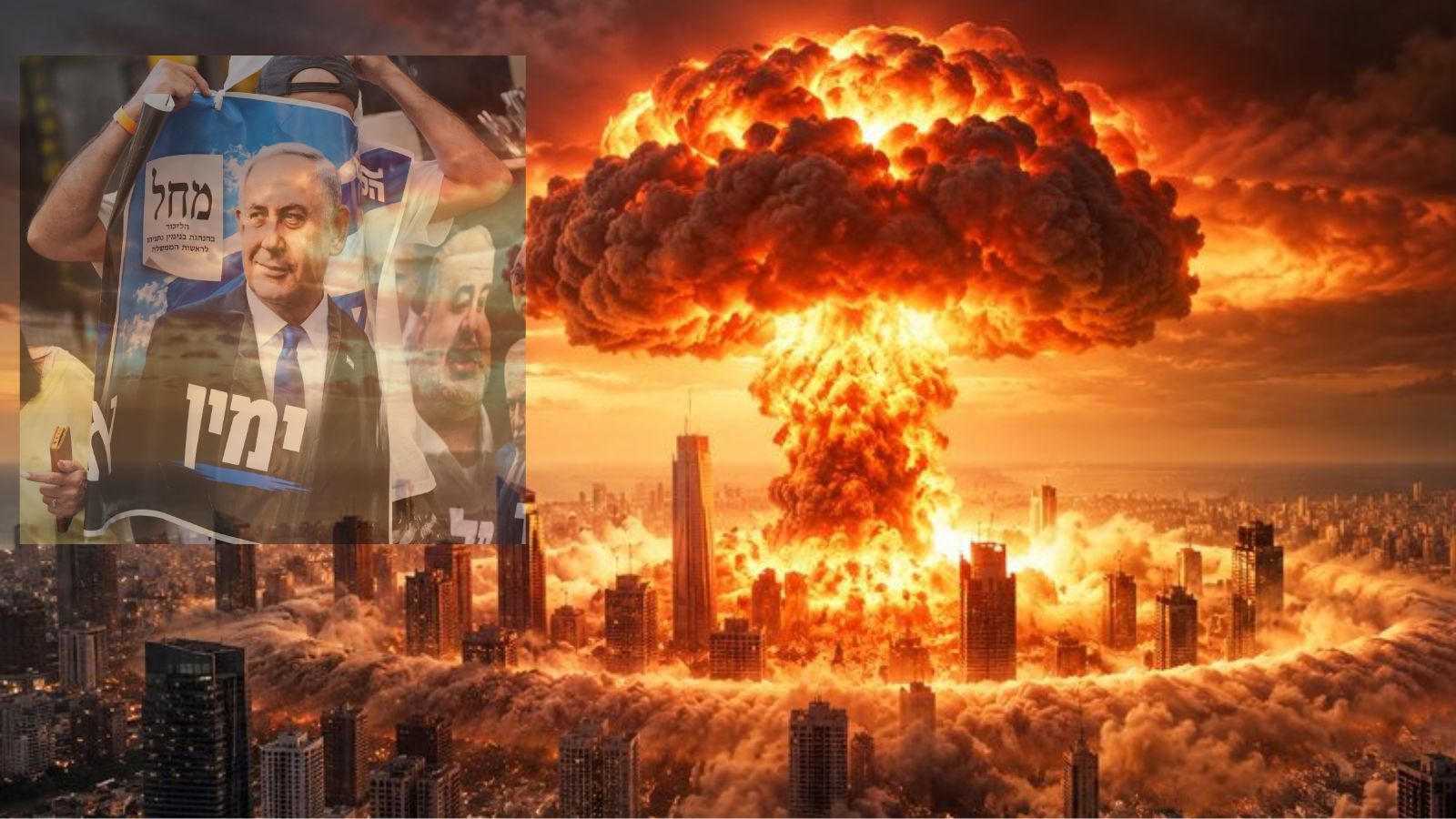
It rises directly over the Azrieli Towers, the unmistakable geometric skyline of her own city rendered in hyper-saturated, synthetic orange and ash. Above the fabricated firestorm sits the stark, uncompromising declaration from Prime Minister Benjamin Netanyahu that Israel faces "existential danger," deployed right as the machinery of an election cycle begins to grind forward.
Silence.
For three full seconds, Maya’s nervous system does not process pixels, prompt engineering, or electoral strategy; it processes the primal terror of watching her own neighborhood vaporize in high definition before her brain catches up to the watermark of artificial intelligence.
That three-second gap between visceral panic and rational correction is no longer an accident of modern political communication. It is the entire battlefield.
The Architecture of Manufactured Dread
To understand why a sitting head of government shares an AI-generated image of his own capital city burning in a nuclear blast ahead of an election, you have to look past the surface shock and examine the mechanics of political survival. According to news reports covering the post, Netanyahu framed the synthetic imagery around warnings of an "existential danger" facing Israel—a phrase that has anchored his political messaging for decades, particularly regarding Iran’s nuclear ambitions and regional threats.
Yet the medium marks a sharp departure from traditional campaign rhetoric. Historically, leaders relied on speeches, televised debates, or archival footage to convey national peril. Those formats carried built-in friction: they required real events, real cameras, and real limitations. Generative artificial intelligence removes every boundary between a politician’s darkest strategic warning and the voter’s visual cortex.
Political psychologists have long studied what happens when fear enters the voting booth. Decades of behavioral research—most notably Terror Management Theory, developed by social psychologists Jeff Greenberg, Sheldon Solomon, and Tom Pyszczynski—demonstrate that when human beings are reminded of their own mortality, their cognitive instincts shift measurably. Nuance evaporates. Long-term policy debates feel suddenly frivolous. Voters instinctively gravitate toward familiar, strongman-style authority figures who promise immediate physical protection, even if those same leaders are facing intense domestic scrutiny over governance, economic strain, or judicial reform.
Consider what happens next: when an election approaches, an incumbent leader burdened by political polarization faces a difficult math problem. Debates over the cost of living, coalition infighting, or past security failures divide the electorate along messy, unpredictable lines. Existential survival, by contrast, flattens the room. You do not argue about municipal budgets while staring at a nuclear fireball over Tel Aviv.
Critics, Supporters, and the Battle Over the Frame
The reaction to Netanyahu’s post reveals a society—and an international audience—deeply divided over where legitimate warning ends and emotional manipulation begins.
Supporters of the Prime Minister argue that stark visual metaphors are justified when confronting threats that state officials routinely describe in existential terms. From their perspective, complacency is the deadliest enemy. If intelligence assessments and regional hostilities point toward catastrophic risks, defenders contend that using modern digital tools to shock an distracted public into paying attention is not alarmism—it is civic duty. To those who share Netanyahu’s worldview, the synthetic mushroom cloud is simply a visual translation of what decades of diplomatic warnings have failed to make visceral.
Critics, opposition figures, and media ethicists see something far more corrosive at work. Opposition politicians and commentators condemned the imagery as reckless fearmongering designed to distract voters from domestic accountability and rally a fracturing political base through trauma. Media analysts pointed out a troubling paradox: a head of state circulating apocalyptic imagery of his own city risks undermining public morale, rattling financial markets, and normalizing synthetic media in official state communications at the exact moment democracies are struggling to defend factual reality against deepfakes.
Both arguments collide over a single, unresolved question: What happens to democratic accountability when the person entrusted with preventing the catastrophe is also the one generating its most terrifying visual simulations?
The Boy Who Cried Pixel
I have spent years reporting on and living through the psychological aftermath of conflict cycles, and there is a specific kind of fatigue that settles into your bones when every news cycle is pitched at the volume of an air-raid siren. You learn the difference between genuine vigilance and engineered adrenaline. Genuine vigilance sharpens your senses; engineered adrenaline leaves you numb, suspicious, and hollowed out.
Think of generative AI in political campaigning like an industrial loudspeaker wired directly into a crowded theater. In a real emergency, a clear voice directing people toward the exits saves lives. When the theater manager tests the loudspeaker every ten minutes by playing the recorded sound of a collapsing roof—just to remind the audience how badly they need a manager—two things happen. First, people stop checking where the exits actually are. Second, when the plaster finally starts to crack, half the room assumes it is just another recording.
Digital forensics researchers and disinformation scholars have warned about this exact erosion of trust—often called the "liar's dividend." When political leaders normalize AI-generated catastrophes as routine campaign visuals, they train citizens to disbelieve their own eyes. Real photographic evidence of war crimes, infrastructure damage, or humanitarian crises begins to look indistinguishable from prompt-engineered campaign graphics. Everything becomes plausible; nothing feels real.
Why Voters Keep Clicking on the Fire
It would be comforting to blame the algorithms or the political strategists alone, yet that lets the rest of us off the hook too easily. We share these images. We argue beneath them. We let our pulse rates spike on command.
Human evolution wired our brains for a world where sudden visual threats—a shadow in the grass, smoke on the horizon—demanded immediate survival responses. Our nervous systems were never calibrated for an era in which a political consultant can type twelve words into a diffusion model and conjure a photorealistic apocalypse before lunch.
Let us return for a moment to our hypothetical designer, Maya, sitting at her kitchen table in Tel Aviv.
After those first three seconds of shock fade, she zooms in on the image. She notices the unnatural symmetry of the smoke plume, the slightly warped geometry of the coastline, the uncanny smoothness of the lighting. Her shoulders drop an inch. She feels a flash of anger—not at a foreign adversary, but at the realization that her fear was harvested as a campaign asset while she was trying to finish a cup of coffee.
Yet even knowing the image is fake, she cannot quite shake the afterimage. When she closes her eyes to sleep, the orange glow lingers behind her eyelids.
The Invisible Stakes Beyond Election Day
Elections end. Ballots are counted, coalitions are cobbled together, and campaign posters are eventually peeled off concrete walls by rain and municipal workers.
Synthetic fear, however, leaves a residue that does not wash off so easily. Once a political system discovers that hyper-realistic apocalyptic imagery outperforms policy papers, town halls, and verifiable journalism in capturing human attention, the incentive structure changes permanently. Every subsequent election demands a louder siren, a brighter explosion, a more immediate existential cliff.
In the quiet hours before dawn, high above the real streets of Tel Aviv, the Mediterranean wind still moves over concrete apartments where families sleep beneath real roofs, paying real bills, hoping for an ordinary tomorrow. No mushroom cloud hangs over the skyline—only the pale, indifferent light of another morning, and a citizenry left to figure out where reality ends and the campaign begins.