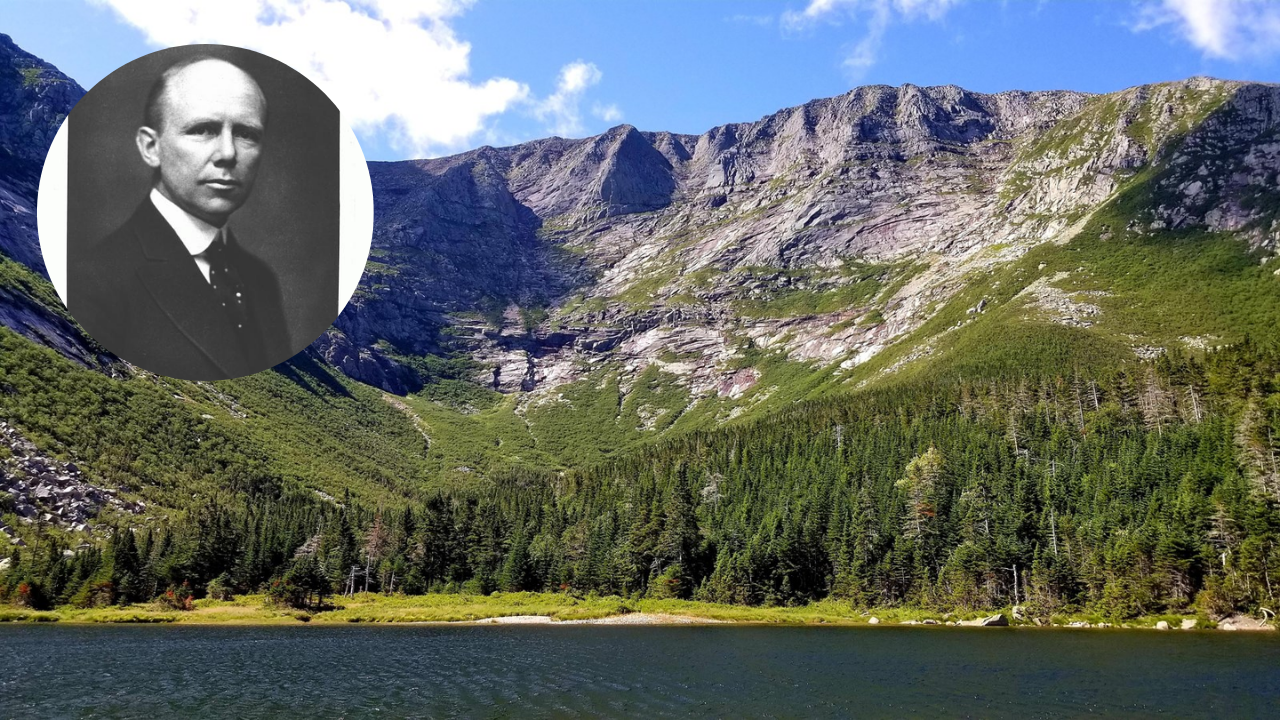
In 1930, a former Maine governor named Percival Baxter spent a portion of his personal fortune to purchase nearly 6,000 acres of untamed timberland surrounding Mount Katahdin. It was not a speculative investment or a philanthropic afterthought. It was the opening salvo in a three-decade private war against legislative cowardice, industrial greed, and the systemic failure of public stewardship. Over the next thirty-two years, Baxter would methodically buy up more than 201,000 acres, parcel by parcel, and gift them directly to the state under rigid legal chains that politicians could never break.
To understand why Baxter had to resort to buying an entire mountain with his own inheritance, you have to look past the romantic postcard imagery of Maine's North Woods and examine the raw machinery of state politics in the early twentieth century.
The Legislative Dead End
When Percival Baxter first entered the Maine legislature and later assumed the governorship in 1921, his ambition to create a massive state park around Mount Katahdin ran headfirst into an immovable wall. The region was dominated by powerful paper and timber corporations. To these industrial titans, a tree was a ledger entry, and a mountain was an obstacle to pulp mills.
Baxter introduced bills to establish a protected public reserve, only to watch them stall and die under heavy lobbying pressure. Lawmakers, fearful of crossing corporate employers and hesitant to spend public funds on remote wilderness, dismissed his vision as the eccentric dream of a wealthy preservationist.
Public funding failed. Eminent domain was politically toxic. If the wilderness was going to be saved from the chainsaw, the state government was useless. Baxter realized he had to act alone.
The Strategy of a Private Empire
Following the stock market crash of 1929, the Great Northern Paper Company and various land speculators found themselves holding distressed assets. Baxter, who had inherited wealth from his father's canning and real estate enterprises, stepped into the vacuum. In 1930, he shelled out roughly $25,000 for his initial 5,960-acre acquisition.
He didn't just buy the land; he weaponized the deeds.
When Baxter handed those first acres to the state in 1931, he attached strict covenants. This land was not to be managed by the usual political appointees or subjected to the whims of changing administrations. It was to be kept "forever wild," functioning as a sanctuary for beasts and birds.
Over twenty-eight separate transactions spanning thirty-two years, Baxter repeated this cycle. He scouted tracts, negotiated with reluctant owners, paid out of pocket, and transferred the titles with restrictive language so binding that it still governs the park today. By 1962, his personal crusade had ballooned the protected area to over 201,000 acres.
Trust Issues with Uncle Sam
A lesser-known friction point in Baxter's campaign was his absolute refusal to involve the federal government.
National park proposals had floated around Katahdin as early as 1911. Many contemporary conservationists argued that federal oversight under the National Park Service was the only logical scale for such an ecosystem. Baxter flatly rejected the idea. He distrusted federal bureaucracy, believing that Washington-run parks eventually succumbed to commercialization, tourist traps, and political compromise.
Instead, he engineered a unique governance model. Baxter State Park is managed not by the standard state park agency, but by a three-member authority consisting of the Maine attorney general, the commissioner of Inland Fisheries and Wildlife, and the director of the Maine Forest Service. Furthermore, he established private trust funds totaling millions of dollars to subsidize maintenance, ensuring the park would never rely on tax dollars or state budget cuts.
Pragmatic Compromise in the North Woods
Purists often romanticize Baxter's vision as absolute ecological preservation, but the reality is more nuanced. Baxter was wealthy, but he was also pragmatic.
Buried within his complex trust deeds was a provision for a Scientific Forest Management Area—roughly 30,000 acres where selective, sustainable timber harvesting is legally permitted. Baxter understood that to prove conservation could coexist with regional economics, the park needed to generate its own forestry revenue while maintaining an ironclad wall around the core wilderness. This hybrid model remains a contentious blueprint among modern ecologists, balancing strict wilderness recreation with active silviculture.
The Cost of True Independence
Operating outside standard bureaucratic channels means Baxter State Park runs under rules that shock modern tourists. There is no grid electricity. There is no running water in the campgrounds. Vehicle numbers are strictly capped, and reservations are deliberately difficult to secure.
The park does not bend to modern demands for convenience because its benefactor explicitly forbade it from doing so nearly a century ago. Baxter anticipated that future generations of politicians would trade away environmental integrity for tourist revenue if given half a chance. He built a legal fortress to tie their hands from the grave.
Buildings crumble, fortunes evaporate, and political promises wash away with every election cycle. Percival Baxter spent his life ensuring that a jagged cluster of granite and spruce in northern Maine would answer to none of them.